What the UK report establishes
TikTok Shop UK published its first LIVE Shopping Report on 12 November 2026. Prepared with survey research by OnePoll for TikTok Shop, it offers two distinct views of live retail. One survey covered 2,000 British adults, nationally representative by age, gender and region, from 1 to 5 October. A second surveyed 735 UK small-business decision-makers whose businesses already use LIVE Shopping, from 6 October to 6 November. The second group matters because it describes what adopters report, not what happens to the average business when it adopts the format.
Among those businesses, 61% said a LIVE session brought in more revenue than other channels in a normal week; 24% said it exceeded a normal month. Those comparisons are self-reported, use each business’s own baseline, and do not isolate the contribution of discounts, paid traffic or unusually strong hosts. TikTok also said its UK shop had more than 6,000 shopping broadcasts a day and LIVE sales had risen 55% over the previous year. Those are platform figures for the UK, not an independently established uplift that a merchant should plug into its forecast.
The report also describes lower return rates for fashion bought through LIVE than fashion bought from static listings on the platform. That comparison could reflect a better understanding of fit; it could also reflect differences in products, audience, selling prices or return windows. Likewise, a report of an in-store purchase after viewing says there can be a retail journey beyond the app; it does not identify whether that purchase would have happened without the broadcast. Read the evidence as a reason to test a mechanism, rather than as a reason to purchase a studio.
Where a demonstration can change a decision
A product page is efficient when a shopper already understands the product. If the open question is how much space a coffee machine takes, whether the handle works for a left-handed user, or why a fitting attaches to one model but not another, the buyer may have to assemble the answer from photos and reviews. A good live host can build the answer in front of them and use the product card to remove the search step. The interaction is useful when the demonstration answers a real question; a countdown clock cannot do the same job.
Select a product for which the uncertainty appears in support tickets, returns or product-page feedback. Ask the service team for examples of mistaken assumptions and show one of them directly. A countertop appliance might be shown next to a ruler, with the plug and cleaning details visible. For a garment, show how the fabric moves and give the model’s measurements where appropriate. Avoid concealment: show a limitation as well as a benefit. If the buyer chooses a more suitable variant or decides not to buy, the broadcast may have prevented a return rather than lost a worthwhile order.
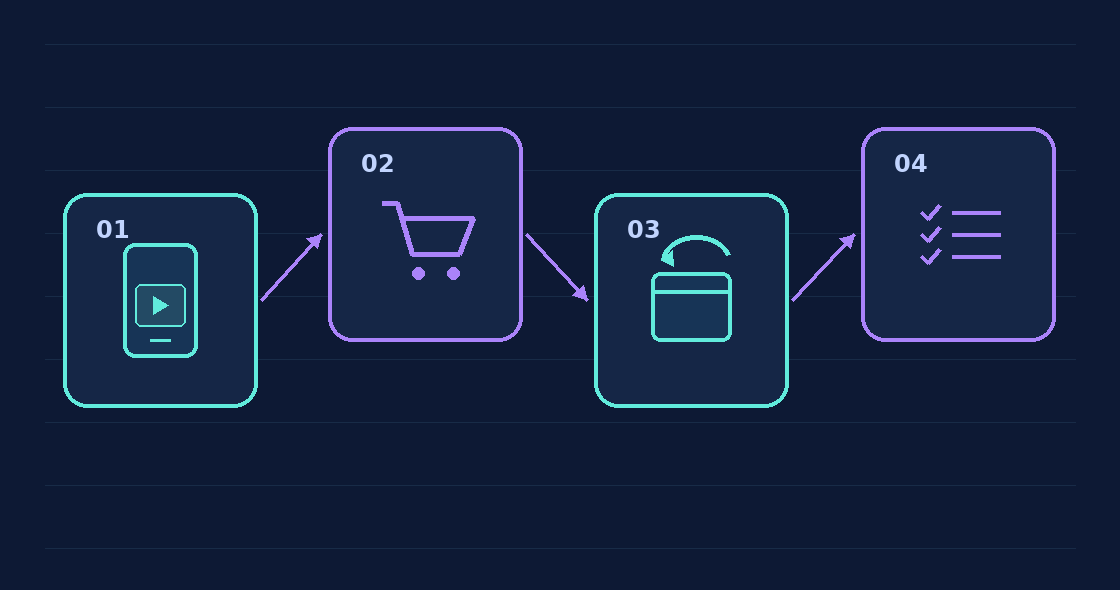
Original illustration, not a platform screenshot or a data chart: the four icons connect the broadcast, the shopping cart, returns and the final comparison of commercial results.
Primary source behind this illustration
Prepare for the late arrival. A viewer who joins halfway through should still be able to learn the product name, version, full price, delivery details and where to find the return conditions. Repeat the product setup in short cycles and ask the moderator to pin the correct variant when it changes. Keep unsupported claims off the script and give the moderator an escalation route for a question that cannot be answered. Preserve the broadcast notes so frequently repeated questions can improve the standard listing even if the LIVE pilot does not continue.
Test four sessions before building a programme
Start with one SKU or one clearly defined product family, four scheduled sessions, one host and one moderator. Record the hypothesis before broadcasting: for example, seeing the setup and cleaning process will reduce uncertainty about maintenance and produce more retained purchases per eligible viewer than a static creative with the same offer. Choose a realistic range of session times and keep inventory, price, shipping promise and promotional eligibility as comparable as possible. Run a short replay or static creative as a comparator rather than changing the selling terms every time the stream is on.
Use a random audience split if the seller can do so without contaminating the groups. If not, compare matched audiences or comparable days, state the risk of selection bias, and treat the result as directional. Keep both sides observable: an audience that would choose to watch a long demonstration is likely to differ from one seeing a static post. If you cannot estimate exposure for both arms, avoid claiming a precise conversion lift and use the test to learn about objections, staffing and fulfillment first.
Before going live, script four moments: show the problem, use the product in real time, answer the common objection, and explain the next step. Let the host vary the answer when viewers raise a new question. Give the moderator responsibility for accuracy and the commerce team responsibility for stock and price. Pause the product card if it shows the wrong variant or the offer has run out; viewers should never have to discover that mismatch at checkout.
If you compare branches, check that stock availability and delivery promises line up across both arms. Log service interruptions and inventory delays, and apply an exclusion rule decided before looking at outcomes. A quick dry run with the checkout owner can confirm that shoppers in both arms reach the intended product.
Measure the whole trip from viewing to margin
Count unique eligible viewers and report the exposure rule. Then record unique product clicks, cart adds, completed paid orders and retained orders after the same refund window. Product clicks divided by eligible viewers tells you whether discovery led to product inspection; paid orders divided by product clicks reveals friction further down. Keep denominators visible and do not add overlapping viewing populations across sessions as if they were unique. Separate organic, boosted and replay activity where the platform allows it. Use order IDs for deduplication inside the store and keep any authorized aggregate comparison separate from customer details.
A sales dashboard can look healthy while the session leaves little margin. Reconcile net sales after discounts and refunds, then deduct cost of goods, platform and payment fees, shipping and return handling, host and moderation hours, production and any incremental ad spend. Report the same cost scope on the comparison arm. In an illustrative example, a live session records £1,500 in net sales and £1,400 in all these costs, leaving £100. A static comparison yields £1,100 in net sales and £900 in comparable costs, leaving £200. The live session wins on sales and loses on contribution. These numbers are examples, not TikTok results.
Set a common cutoff before reading the result. A sale made yesterday can still be refunded, and differences in delivery speed can change the age of the orders when the team reviews them. Label early results as provisional and inspect reasons for refund, cancellation or fulfillment failure once they mature. Where delivery, product-card errors or stock are the constraint, the correct decision may be to fix the operation and repeat the test rather than to commission more content.
Set out in advance how you will count an order that gets placed during a session but later changes variant. Follow the transaction identity in your own records, preserve the original exposure group if the test was randomized, and distinguish a refund from an exchange or a delivery exception. Check whether the buyer is new or returning if you can do so with approved, aggregated data. An impressive total may be mostly purchases from people who were already planning to buy. In a pilot with small order counts, show absolute numbers alongside percentages; two returns out of ten should not be communicated with the confidence you would put in a much larger comparison.
Adapt the mechanism to the Gulf without importing the benchmark
The report does not establish that TikTok Shop, its LIVE checkout or the same measurement features are available to every Gulf account. Verify what the merchant can use in the target market and where the transaction happens. If checkout occurs on your own site, give viewers a clear path to the correct local product page, retain transparent delivery and exchange information, and reconcile traffic against the order system without sharing personal data unnecessarily. Select the language and presenter around actual audience questions and test timing against local viewing and buying patterns.
Healthcare teams can borrow the educational structure, but a retail scorecard should not define appropriateness of care. An approved expert could explain how to find the right booking option, what questions to prepare or how a virtual appointment works. Use a verified booking path and moderate public questions without inviting patient details into the chat. Route personal concerns to an authorized private service and avoid making clinical claims or promising that the viewer is a candidate. Count qualified requests, confirmed appointments and completed visits separately, without treating platform activity as evidence of clinical outcomes.
Build a short debrief around three questions. What concern turned up that we could realistically answer? What unexpectedly blocked an otherwise suitable purchase? What would make the next broadcast cheaper or clearer without compromising accuracy? Check the notes from the moderator, compare timestamps with order and service aggregates, and list one change with an owner. If the same issue comes from the comparison group, improve both experiences. That makes the test useful even when the difference between groups is not persuasive enough for a budget decision.
Make the expansion decision before the excitement fades
Agree in advance on a commercial threshold and a service guardrail. A retailer might require the pilot to beat the comparator on contribution per eligible viewer without materially increasing returns or complaints. Give finance the order window and the full production cost; give customer service a list of objections the recordings exposed. A small sample may justify another round rather than a rollout. If the test works chiefly because people finally understand the product, use that insight to improve the always-on listing and compare it against the next broadcast.
The most important output from the UK report is a question a team can answer with its own data: what does the shopper learn in real time that changes the decision? Pair that answer with evidence of retained orders and a repeatable production process. Good questions from viewers are useful even if sales disappoint; a spike in checkouts without margin or reliable delivery is a weak case to scale.
Primary source: TikTok Shop UK's LIVE Shopping Report and survey methodology
Comments
No published comments yet.