
What Threads is testing
Social Media Today’s November 19 report links the official @threads post and reproduces its example. According to that coverage, hosts in selected live chats can collect questions, participants can vote to prioritize them, and people in the chat can read the responses. This is a test, not a general rollout. The April Meta announcement confirms Live Chats existed, not that November’s Q&A is broadly available.
Set expectations before opening submissions
Choose one educational goal readers can recognize, such as understanding when a community workshop is suitable for a beginner. State what the host can explain, what falls outside the session, when questions close and how unanswered topics will be handled. Pick a moderator who can review submissions while the host concentrates on answering. If a question needs personal details to answer, it is outside this public format. Ask for no names, contact information, patient details or individual advice. If this format is not available in your chat, use a moderated submission process that your team already supports. Do not imply that a manual workaround is the Threads feature.
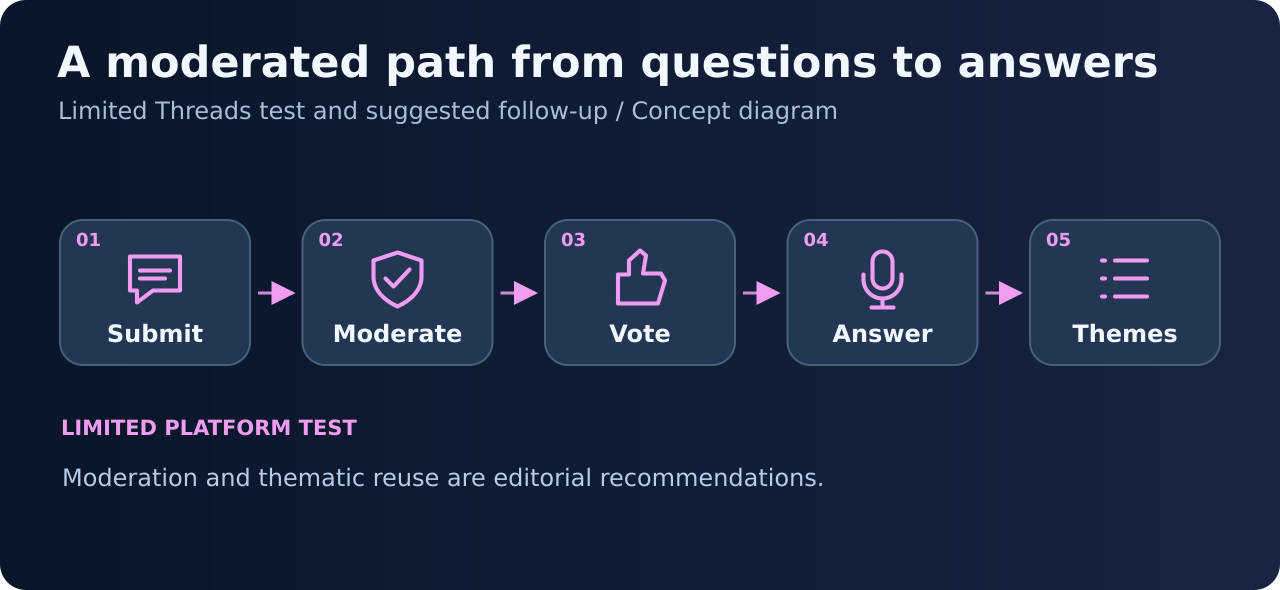
Original explanatory diagram by Karim Elganainy. This is a proposed editorial workflow, not a Threads interface or a description of its moderation tools.
Screen before asking the audience to vote
The diagram describes a team process, not a guarantee that the test exposes a separate approval queue. Only present screened questions for a vote where your workflow supports it. If submissions appear immediately and cannot be screened, use a separate moderated intake or keep the live discussion to prepared prompts. Remove identifying details from anything reusable; do not repeat them in the chat while explaining why a question was skipped. Combine questions about the same issue only when the merged wording preserves what people were asking. Keep exceptional but legitimate questions available for a moderator’s slot rather than letting every topic compete on volume alone.
Use votes to choose what to explain first
Imagine a fictional community studio running a chat about introductory photography workshops. Several people ask whether a phone is enough; others ask whether editing software is required. The host can group these under equipment, with a separate follow-up about software. An accessibility question might draw fewer votes yet deserve a clear answer before people decide whether to attend. Reserve a short moderator slot for questions that would otherwise be overlooked. The subject expert should answer the public question, mark any uncertainty, and say where readers can verify the answer. If a detail is unknown, record it for follow-up rather than guessing.
Draw up a small operating plan
Write a brief that fits on one page. Put the audience question at the top, followed by what people should know or be able to decide at the end. Identify who opens and closes collection, who handles exceptions, and who checks facts before they are published. Those assignments matter when a host is reading a busy conversation and cannot also resolve every ambiguous submission. If one person has to fill all the roles, narrow the format to questions screened in advance. A smaller session with dependable answers is a better test of the idea than a larger one that the team cannot safely manage.
Give the moderator visible rules to apply consistently. A useful rule is based on the topic and information a response would require, not whether the speaker is supportive. A difficult but relevant criticism can go forward. A question whose answer would expose someone should not, even when it is popular. If a generic version is still useful, write it without any connection to the person who raised it. Otherwise, move on and tell the audience in general terms that the session does not handle individual cases. Never display the original in a recap just to demonstrate that moderation happened.
Plan for interruptions. If the reviewer loses access or the host cannot keep up, close submissions where possible, say that the current intake is paused, and switch to prepared questions or end the session. A pending question is not a promise of an answer. Leave enough time to wrap up with one verified place to revisit information. Decide beforehand who can correct that page if an answer changes. This lets readers find the latest version rather than searching a fast-moving thread for an answer that may no longer apply.
Rehearse a second scenario with closed and open questions
Imagine a neighborhood repair group hosting a basic session on how to prepare for a bicycle maintenance class. One person asks whether tools are provided. Another asks whether they need to bring a bike. These are separate questions even if both fit under preparation: giving a single answer might obscure whether a particular tool is available or whether participants need their own equipment. The host can use a common heading, answer each question explicitly, and check the current workshop notes before giving any instruction. Keep the example about attending a class, not individualized mechanical diagnosis.
Now suppose someone submits a personal complaint naming another participant, followed by a general question about what happens when the workshop can no longer accept new attendees. The first item should not appear on the ballot or in a public summary. The second concerns a service rule and can be asked without the identifying context. Verify the waitlist process before answering. If no rule exists, explain that you cannot yet give a reliable answer, assign the follow-up and avoid promising a reservation. The moderator's job here is to protect people without burying an important, answerable question.
During rehearsal, include a closely related question with a different condition, such as whether shared tools are available to visitors who are only observing. Ask someone other than the author to classify it, then compare the reasoning. If the reviewer assumed everyone could use the tools and the expert did not, the team has found a wording problem before the audience encounters it. Update the screening note with this distinction. The goal is not to force agreement on every phrasing choice, but to reveal disagreements that would change the answer or the next action.
Decide which records to keep and which to discard
It is tempting to copy the full transcript to make analysis easier. Start instead by listing the few fields needed for the follow-up: a neutral topic, whether the question was eligible, whether it received a verified answer, and an owner when work remains. The tally does not need a profile handle or an exact quote. Keep access to operational notes limited to people who maintain them, and follow the team's retention rules. If a topic is unusual enough that the wording can identify someone anyway, aggregate it more broadly or omit it from the public recap.
Record what the decision depends on. A team can verify a definition, an opening schedule or a workshop requirement without keeping the message that triggered the check. Note the public source or owner responsible for the fact, and distinguish the audience-facing answer from internal work. Do not treat the question backlog as permission to send people marketing messages. A chat about a course and consent to receive promotions are different events. If people want an update, tell them where to find the corrected public information, not that they have been enrolled by participating.
Judge the experiment without over-reading the platform data
Before the session, choose a small set of observations you can collect consistently. Separate the count of raw submissions from the count of eligible, distinct questions after screening, and record which eligible topics were answered, deferred or left open. Specify whether a reply must contain a verified answer to count as answered or whether acknowledgment is counted separately. If the platform does not make a useful measure available, say so and keep a bounded manual aggregate where appropriate. Do not imply that the test supplies a particular analytics export.
If a team compares this session with an earlier format, retain the same definitions and make differences in topic, timing, audience and staffing visible. A higher answer rate could reflect a narrower subject or a better prepared host rather than voting itself. A larger number of submitted questions can be useful, but it can also mean the opening explanation was unclear. Check whether a reader who was not in the room can find the recap and use it to reach a reasonable decision. This direct task is more informative than interpreting a busy chat as proof of learning.
End the pilot with a concrete choice. Keep the workflow when eligible questions are answered more clearly without unmanageable screening, revise it when people cannot distinguish what is in scope, or stop when the moderation process cannot operate safely. Document the evidence, what was not measurable, and the smallest change worth trying next. Even if the Threads test is not available for the next session, those findings still apply to an ordinary moderated discussion. The portable lesson is a decision about the design of the event, not a prediction about a platform rollout.
A useful dry run is to give a colleague only the published scope and ask them to play the audience. Give another colleague only the follow-up notes and ask them to build the public recap, without access to the chat. If the first person repeatedly asks for information that should have been excluded, improve the opening guidance. If the second person needs a user handle or private context to explain the answer, the notes are not ready. These checks are cheaper than correcting a public record after the event, and they test whether the process can be repeated by a different team member.
Use the same approach when an answer later turns out to be wrong. Correct the published answer where readers are most likely to find it. Explain what changed and when, without attributing the error to a participant or reproducing a sensitive question. Then update the team’s checklist so a future host can verify the changed detail before answering. This matters even for a small class: a mistaken statement about whether equipment is provided can send people to the wrong place or make them spend money unnecessarily. Better follow-up means an accountable correction, not a more complete archive of everything people said.
Judge the session by what people can do afterwards
Track how many distinct, in-scope questions were answered, how many needed follow-up, and how many remain open. Compare answered questions with eligible questions, not with votes, because a single question can receive many votes. If you publish a recap, list themes without usernames, identifying quotes or copied chat logs. Use recurring issues to improve the next session or clarify an existing help page. A highly voted question can signal interest among people who voted; it does not represent the entire audience. A useful first result is a set of clear, verified answers that participants can find again, even if they missed the live exchange.
Comments
No published comments yet.