
What was announced
The Verge and Social Media Today report that Instagram announced Story editing on November 18, 2026. They describe a 15-minute window for changing text, music, stickers or drawings while retaining existing views, likes and replies. The cited Adam Mosseri post and Instagram update could not be fetched directly during verification. These reports do not establish whether an account has the feature, whether every link can be edited or whether core media can be replaced.
Keep approval before publishing
The proposed process below is an independent operational recommendation, not a description of how Instagram approves content. Decide who owns the post, who can sign off on it and who is available immediately after it goes up. Approve the visual, dates, conditions and contact information while still in draft. Keep a reference copy of the approved version and, where relevant, confirm the destination with someone who can see the service or product actually offered. The team should be able to explain a change, not merely remember that it made one.
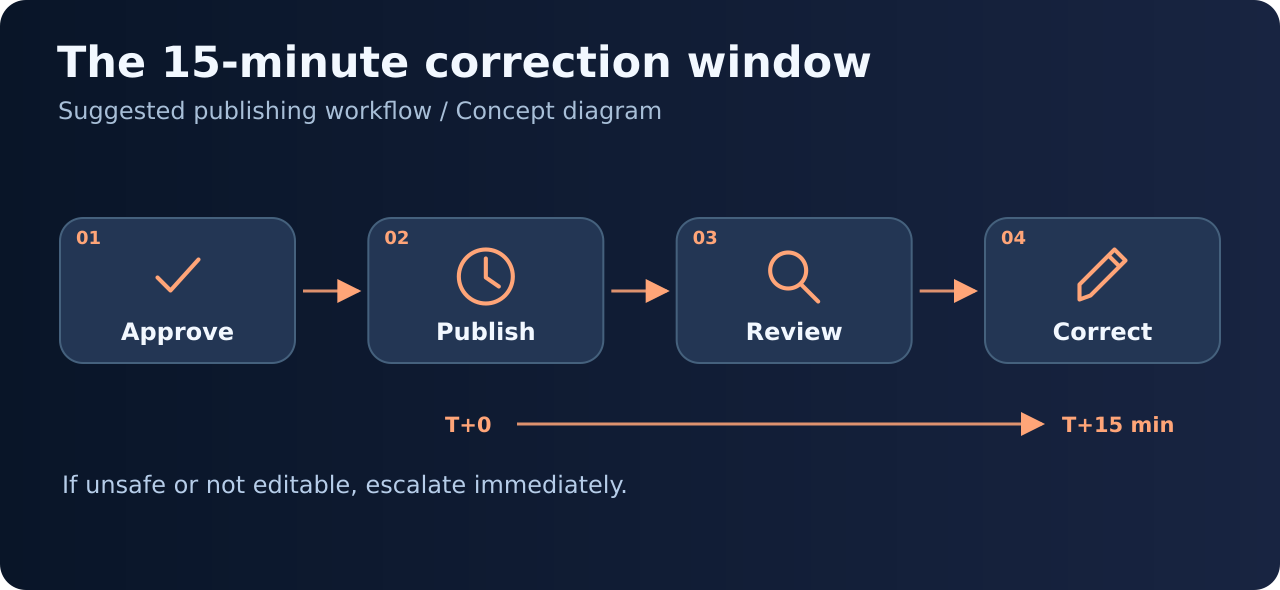
Original conceptual diagram by Karim Elganainy. It illustrates the proposed review process, not Instagram’s interface.
Inspect the version an audience actually sees
Assign the first review when the post appears, not when a reminder happens to be read. Compare it with the approved draft on a relevant device. Check that text has not been obscured by controls, that an essential condition is readable and that the intended destination is correct. A reviewer should classify the discrepancy before choosing an action. Correcting a harmless typographical error through an available edit is different from correcting the substance of an offer. Where an edit is supported, make the smallest change needed and reopen the posted Story to verify the outcome rather than relying on the editing screen. Do not use a past screenshot as proof of what is visible now.
Escalate material errors immediately
Suppose a hypothetical store posts a Story promoting an in-store appointment, but the visible location is wrong. Ask the operational owner to confirm the correct location and the person responsible for the post to stop further amplification. If the audience could have acted on what it saw, merely editing the label may not reach those earlier viewers; a separate correction can be more appropriate. For sensitive or private information, follow the organization's incident process immediately rather than waiting for the editing deadline. If the control is unavailable or the window has passed, decide whether to remove the Story, publish a clear correction or take another approved action based on the nature of the error.
Measure review quality, not edit volume
Keep a small internal record of the intended version, the time someone verified it, the issue category and the corrective action. Measure the share of published Stories actually reviewed and the time from discovery to resolution. Count repeated errors by type rather than encouraging staff to edit more posts. Preserved engagement is useful for continuity, but it does not tell you which version a particular person saw or whether a correction reached them. The best process treats the editing option as a useful fallback while removing the avoidable causes of correction upstream.
Walk through a scheduled weekend promotion
Imagine a homeware shop preparing a weekend collection offer. Its Story contains a short demonstration, a sticker taking people to the product and a caption that says pickup is limited to selected stores. In this fictional exercise the content team prepares one master brief, but a store lead owns the collection rules. Before publication, ask that person to verify not only the branch names but the order in which customers will be asked for information. A reservation page that shows all branches can still cause a bad experience if the customer sees the exclusion only after trying to reserve a product.
When the Story goes up, the assigned reviewer should open the currently published version and follow the intended customer path. If a purchase would be required to go further, stop at that point and use a test environment or ask the responsible store team for confirmation instead of creating a real order. The review question is whether the audience can complete the action advertised with the conditions it was given. Record the branch, device and destination checked, but do not assume that one phone represents all users. A materially different localization or version needs its own check rather than a blanket sign-off.
Suppose that an Arabic line has wrapped and now covers a detail about collection. If the supported controls can move or adjust text without introducing any new claim, the editor can fix the layout and reopen the published result. But if the destination points to a different offer, treat that as a destination problem, not a text polish. Verify the actual path and decide whether it needs a correction or withdrawal. Distinguish an action that was requested from one that was confirmed; someone saying they pressed a button is not evidence that the corrected Story or landing page is now visible.
Use an issue sheet that makes a decision possible
Build a short response sheet with the observed error, the approved expectation, the responsible owner, the next step and confirmation of its effect. You do not need a new software system to do this. A shared internal record can be enough if the people who need it can find the current version quickly. Use one place to record the incident so the editor, reviewer and customer support team do not each act on a different version. Keep timestamps with a known time zone, and record whether anything outside the Story was changed, such as a product page or an automated reply.
Use consequence rather than visual severity to distinguish issues. A misspelling that changes nothing for the reader is a small defect. A polished image displaying an incorrect date or limitation is material even if it looks fine. An accidental disclosure has its own incident path and should not be left in a general content queue. Leave the report free of private details that would reproduce the problem, and refer authorized staff to the organization's approved handling process. Assign an owner for any outstanding work rather than closing the record because the edit screen displayed a successful response.
In a busy publishing week, two people may try to correct the same thing. Agree that the assigned editor performs the change and a different reviewer confirms the result when practical. If the second person is not available, write down the limits of the check and avoid pretending a second review took place. After resolution, update the template or brief if it repeatedly creates the same error. If the failures come from a stale product catalog, transfer the issue to the catalog owner instead of asking the social team to proofread its way around outdated facts.
Choose a communication response after the correction
Ask three questions: could the old message have changed a decision, can earlier viewers reliably be reached through this channel, and can the organization honor the original promise? These questions help distinguish a quiet fix from a clear public correction. If an earlier version gave the wrong collection address, a separate Story with the correct address and the applicable offer may be useful, and support should have the same answer. If an earlier version merely misspelled an adjective without confusing the offer, a separate broadcast could add noise without helping anyone. Do not describe a small technical fix as proof that confusion was eliminated.
Do not claim that an amendment reaches a particular audience just because existing interaction remains attached. Once the wrong address has been copied, sent to a friend or remembered, the corrected original may not be what people consult. Design the response around the audience’s likely next action, such as checking where to go, not around preserving a visually tidy account. If a customer asks what changed, a factual explanation is better than implying there was never an error. Avoid using a correction to introduce unrelated promotion or to claim that the original offer never existed.
When planning campaigns in several languages, be precise about which versions and destinations are affected. Some issues will be shared across all versions because they come from a common source of product information; some will be limited to a translation or layout. Correct what is wrong, preserve what is accurate and make the rationale visible to the support team. If staff cannot determine what users saw before the fix, say so in the review record. A complete record can acknowledge uncertainty without presenting guesses as observations.
Compare two review cycles and make a decision
Use a measurement card with a short definition for each outcome. The review coverage rate is the number of published Stories checked by a reviewer divided by the number of eligible published Stories. Keep the eligibility rule stable: for example, include all scheduled commercial Stories within the observation period and record any exceptions separately. Time to review starts when the Story becomes visible, not when someone receives a reminder. Time to resolution starts at discovery and ends when the corrective action is verified, not when the edit was requested. Review coverage and resolution speed answer different questions, and both can be useful.
Imagine that in one experimental week the team reviews 18 of 24 eligible Stories, and in the next it reviews 21 of 24. That changes review coverage from 75% to 87.5%, a difference of 12.5 percentage points. If those weeks differ in staffing, formats or number of urgent announcements, the comparison cannot isolate the effect of the review checklist. Check coverage separately from issue volume. A stronger process may surface more errors it previously missed; that is not automatically worse publishing. Compare types of error and the customer effect, and review a sample for consistent classification before changing staffing or scheduling.
For the next cycle, pick one improvement you can verify, such as clarifying who checks locations before publication or replacing a hard-to-read caption template. Keep the change narrow and write down what would cause you to reverse it. If almost every problem starts with an inaccurate brief, adding another post-publication checkpoint is unlikely to address the cause. If the published version often differs from an accurate draft, check how the format is rendered on the customer’s device. The editing window is most valuable when it supports a disciplined process rather than filling the gap left by one.
Practise the handoff before the next event
Run a tabletop review using a made-up offer, not a real account or customer. Give one person the approved terms and another person a mock of the published version with a deliberate mismatch. Ask the reviewer to describe the problem, identify who owns the underlying information and state how the correction will be verified. Compare their answer with the process you intended. A team that can spot the mistake but cannot name the responsible person has an escalation problem, not an editing problem. A person who can name a responsible editor but cannot prove what the audience saw needs a better verification step. Repeat the exercise when account responsibilities change, and record only the category of failure, not any unnecessary personal information.
In a second pass, assume the editor is unavailable. Ask who can decide to withdraw an inaccurate message and who can confirm that customer support is using the revised wording. The exercise should identify a named substitute before a live mistake occurs.
Comments
No published comments yet.