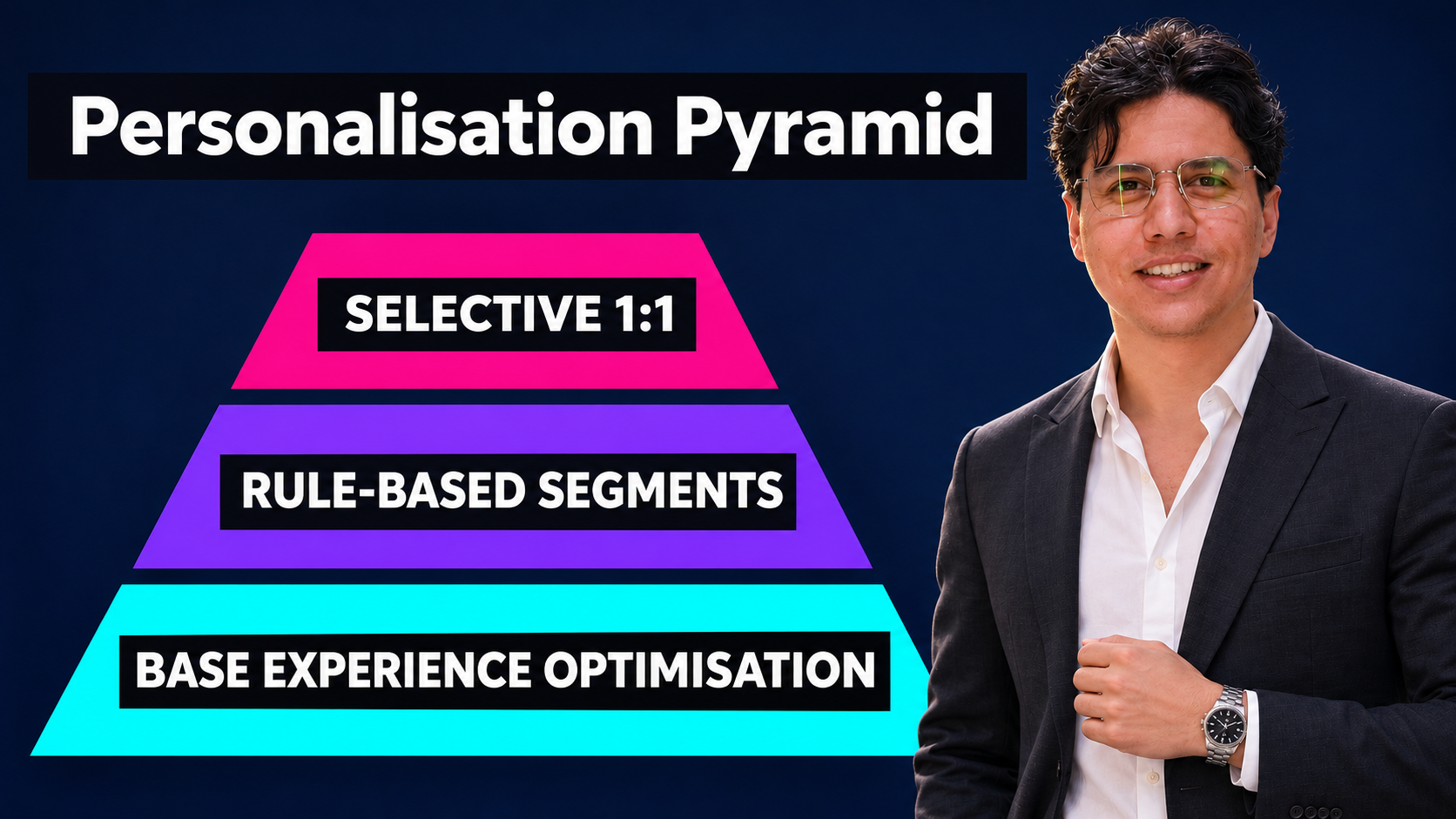
A useful personalised experience starts with a question about the customer’s task: what does this person need to do now, and what can we make easier without taking away choice? Changing a name in a greeting is not the same as helping someone compare a plan, understand a requirement or finish a form. The Personalisation Pyramid gives teams a way to compare broad improvements, carefully defined segments and selective one-to-one adaptations without assuming that the top is the destination.
Use the pyramid as a decision tool, not a ladder that every business has to climb. Start with a working experience that everyone can use. Add a variation only when the team can explain the signal, maintain the change and check its consequences. The examples below are fictional teaching exercises, not customer results or performance benchmarks. They show how a higher conversion count can coexist with worse customer outcomes and why a narrower audience can make an apparent advantage harder to interpret.
Define a useful form of personalisation
Start by writing one practical sentence: people need to complete this task, but they often reach an obstacle at this point. A prospective buyer who has not seen the implementation requirements might need a clearer explanation, not a different sales message. A person who cannot use a form on a phone needs an accessible form before anyone considers choosing content for them. Link each proposed difference to an observable part of the task rather than to an attractive technology.
Distinguish information the person actually provided from a signal that merely seems predictive. A stated preference answers a narrower question than a category guessed from browsing. Even a useful signal introduces noise when it is old, incomplete or taken from a different context. Expose a straightforward way to change the preference or return to the standard path. Someone who chooses a different route has not necessarily rejected the offer; they may simply know more about what they need.
A good baseline still shows the same essentials to everyone: clear choices, useful descriptions and a path to complete or abandon the task. Review it with people who have no account history and with an unfamiliar device. If the standard version is confusing, a sophisticated variant may hide the defect for some visitors while leaving it in place for others. It is usually easier to explain the value of a real adaptation after the common path works.
Read the two course variants without merging them
The introductory course PDF, physical page 191, credits Chaffey and Ellis-Chadwick (2019) for figure 7.10. Its ascent starts with optimisation through A/B or multivariate testing, moves through rule-based segmentation and reaches machine-driven one-to-one adaptation. The digital customer experience notes on physical page 75 instead start with personalisation at scale for large B2B audiences, then prioritise segments and finally individual named customers or accounts. A test of a shared default is not identical to personalising for a broad audience.
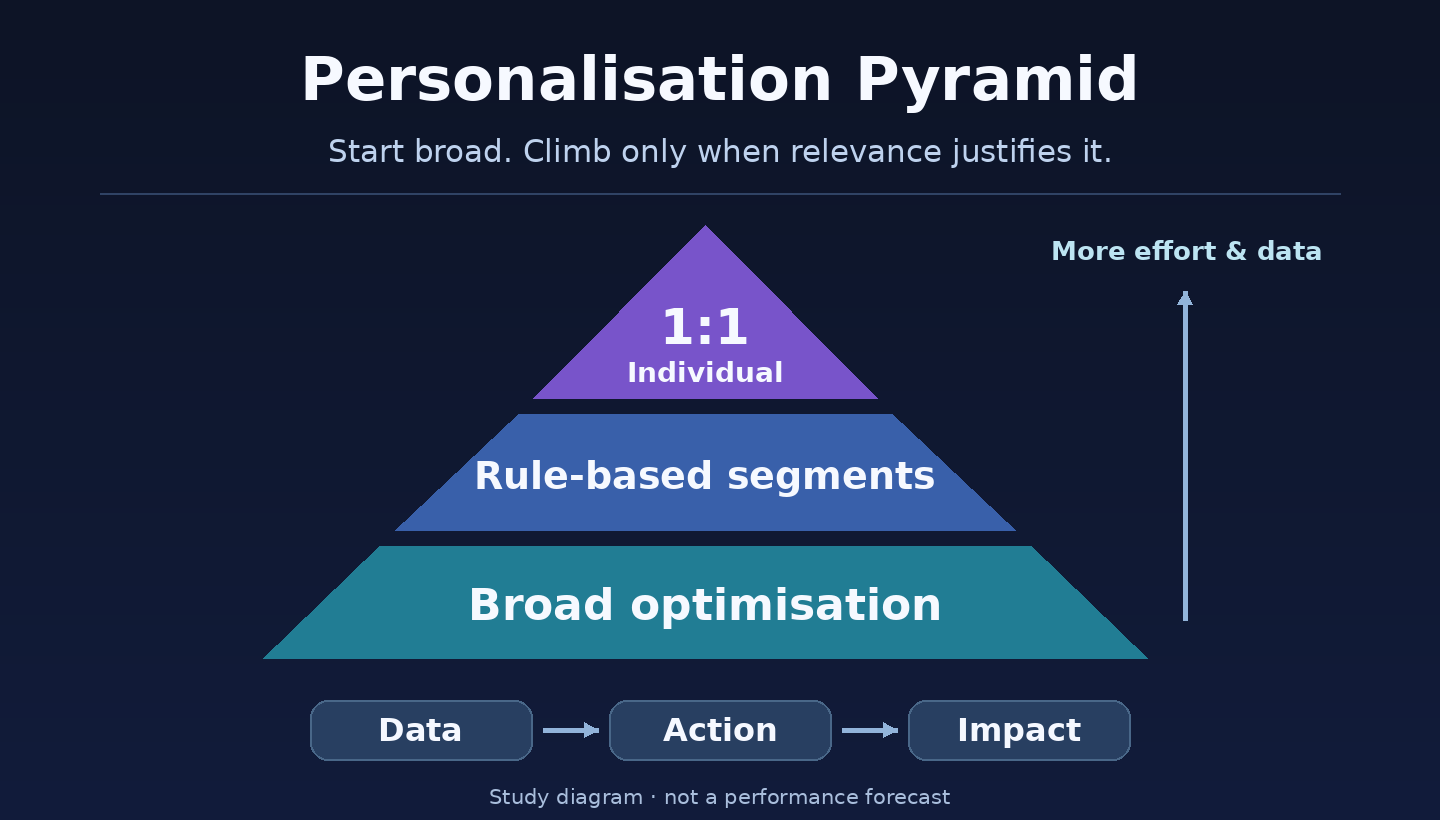
Original editorial illustration for Karim Elganainy’s website. It shows a practical synthesis; the surrounding text distinguishes the two course variants. It does not reproduce either slide or forecast performance.
The variants converge on a practical point: a change designed for a smaller group or a named account takes a more selective decision than a broadly applicable one. They do not prescribe the same first move. Use the introductory variant to keep ordinary optimisation in view and the customer-experience variant to ask how far a large B2B audience can be served at scale. When presenting your plan, name which base you mean so colleagues do not mistake a universal redesign for segmentation.
As you move toward more selective changes, you may serve fewer people with each version. The work of validating data, producing alternatives, reviewing access and maintaining corrections may grow. Wider reach is not automatically better, and neither is greater precision: a small, well-understood change may be useful; a precisely targeted mistake still harms the people who receive it. Compare these tradeoffs against the task and available evidence rather than presenting advancement as a reward for collecting more data.
Use Data, Action and Impact as three disciplines
Data is the signal that justifies the variation. Write down where it came from, what it was collected to do, what it means and when it was last confirmed. A team size declared during intake has a different meaning from a feature page visited last month. Check whether the signal is still applicable at the moment of choice. If you cannot explain what the team knows and why it may use that knowledge, do not make a tailored version depend on it.
Action is the change the signal is allowed to cause. Specify the part of the experience that changes, who may approve the variation and how to turn it off. An implementation example might change while the core features, limitations and terms remain available. Record what the fallback shows and decide how to handle contradictory input. Review the alternate versions themselves, not just the logic that selects them. A sound rule can still send a person to an inaccessible or inaccurate page.
Impact is the evidence you use to decide whether to keep the change. Pick an outcome that says something about the customer’s task and a guardrail that can detect damage elsewhere. Make the units clear before comparing. An observed difference might reflect traffic composition, measurement gaps or chance instead of the variation. The aim is to preserve a credible route from the signal through the decision to what was measured, with enough context for another reviewer to challenge the interpretation.
Optimise the shared base before splitting audiences
Inspect the path that currently receives everyone. Walk through it on a phone, including validation errors, slow or failed steps and the point where the person knows the task is complete. If the main button does not accurately describe what will happen, try a plain call to action. A label that explains the next step may reduce uncertainty without requiring any audience information. Keep core access available wherever the visitor starts and give the team a fallback it can restore.
For an A/B comparison, define the eligible population and assign groups randomly so the variants do not simply reflect when or where the visitor arrived. Change one intended feature at a time where that is the question, and ensure that the events are captured comparably. If a browser loses assignment or a page fails only on one path, investigate before attributing the result to the new wording. The standard path is a working alternative, not a deliberately degraded comparison.
A multivariate design examines combinations, and each additional factor can increase the number of combinations that need enough comparable observations. That may be an appropriate cost if the interaction is the decision under review, but not when traffic is limited and a basic defect is known. A simple comparison, accessibility fix or short observed walkthrough can be more informative. Record which pieces are safe to keep independently and retain a tested fallback before moving to narrower rules.
Use rule-based segments for a clear priority
Imagine a generic B2B page for a product used by small teams and larger enterprises. The person may explicitly select the team type that best describes their situation. A small-team example can show a simple setup path; an enterprise example can show a review of implementation responsibilities. Both should retain the same accessible product information. The rule changes which example appears first, not whether someone is allowed to discover essential details or request help.
Use first-party declarations that match the intended decision. Give the rule a version and record its allowed inputs, destinations and expiry conditions. Ask what happens if the choice is absent, more than one answer is recorded, or the person later changes it. In each case, favor the standard route or an explicit selection over a silent guess. Avoid using an inferred attribute that the person did not provide simply because a vendor offers it or because it seems correlated with a team type.
Before adding a second rule, confirm who maintains the current examples and how the visitor can see the other version. Someone in a small organisation may need an enterprise workflow; the declared segment should not trap them. Review the variant with keyboard use, mobile display and readable labels in mind. If the segment can no longer be validated or updated, remove it rather than leaving obsolete information on a path that receives less routine attention.
Reserve one-to-one adaptation for a specific benefit
Consider a named B2B account that selected a demonstration agenda and agreed which problem to review. A tailored agenda might open with the documented task rather than a generic feature tour. This is different from guessing the preferences of individual employees or gathering unrelated personal information. A relevant adjustment could save the people in the room from repeating a requirement. If the team cannot articulate that benefit, granting a special path because an account is recognisable is not enough.
Set limits before enabling overrides. Specify which parts may be customised, which version is approved and who can retire it. Start with explicit rules when a documented choice already answers the question. Machine learning is not necessary to display an agenda the buyer selected. If several different requests appear for the same account, show a standard agenda or seek clarification through the team’s ordinary approved process rather than guessing which version should override the others.
A one-to-one path should leave evidence of why it exists and still make the common information available. If the selected agenda no longer reflects the discussion, turn off the override. Compare the maintenance work and customer benefit with a simpler priority segment. A change kept for a few selected accounts should be easier to inspect precisely because its scope is limited; it should not become an invisible backlog of exceptions that nobody can audit.
Recognise when the right move is to stop
Low volume can make a subgroup difficult to evaluate. A signal may also be weak enough that the right course is to stay broad rather than spend time on rules that merely produce different text. If the source of a preference cannot be confirmed or permission is stale, take the standard path instead of silently inferring an alternative. Moving down a layer is not a failed strategy; it can be the correct response to limited information and responsibility.
Treat protected or health-related contexts as particularly sensitive. A visitor’s access to essential help, accessible controls and clear conditions should not depend on a classification that they cannot inspect or correct. Do not infer a health concern or a protected trait in order to select a sales message. Check who may access any supporting information and whether it is necessary for the stated task. A legitimate operational exception needs its own safeguards, not a general permission to profile everyone.
Sometimes a proposed change is unjustified even at the base. A confusing prompt should not be made more persuasive if people need a clearer explanation of what it commits them to. Keep essential information and routes equivalent throughout the experience and offer an ordinary alternative. Write the stopping condition before presenting a recommendation. If the team cannot support the change without creating uneven access, weak validation or unreviewable data handling, leave the existing path in place while fixing the underlying issue.
Worked example: a fictional retail comparison
A retailer tests a shared shopping path in a randomised A/B comparison over four weeks. Each arm includes 2,000 eligible visitors, and the original path records 100 purchases compared with 120 on the variant. These are descriptive rates of 5% and 6%, a difference of +1 percentage point or +20% relative to the original rate. With equally sized arms, there are 20 more observed purchases in the variant. Those figures describe this fictional comparison, not a benchmark or forecast.
Now consider a guardrail measured on a different denominator. There are 10 refunds among the 100 original purchases and 18 among the 120 variant purchases. The refund rate per transaction is therefore 10% versus 15%. Within the agreed observation window, 90 and 102 purchases respectively remain after refunds. Do not subtract a refund percentage from a visitor conversion percentage; these figures apply to different units. Treat the refunded and remaining transactions consistently across the comparison.
The example had a preset refund guardrail of +3 percentage points. The observed refund difference exceeds it, so hold the rollout even though the headline purchase count rose. Investigate whether something in the path sets the wrong expectation and whether refund status is complete for both arms. Remaining purchases do not by themselves prove incremental impact or tell you the value of the orders after variable costs and returns. The purpose is to follow the decision rule, not to declare a winner from whichever number looks best.
Worked example: a fictional B2B account comparison
A B2B team has 200 accounts in scope and randomises at the account level, assigning 100 accounts to each arm. Within 60 days the standard arm records 20 qualified opportunities and the variant records 26. That is 20% versus 26%, a difference of +6 percentage points based on assigned accounts. Define qualified opportunity in advance so a salesperson cannot simply relabel a conversation after seeing which version they received. The fictional example illustrates the reporting method, not realised performance.
The same report shows 8 versus 10 held demonstrations, or 8% versus 10% of assigned accounts. A held demonstration is a different event from a qualified opportunity; its definition and evidence need to be recorded separately. There is no basis for calling these figures a demonstration-to-opportunity rate. Keep people at the same account on a consistent path where possible, so participants comparing the proposal do not receive contradictory information because each person was randomised independently.
Mark the limits of the comparison. With these counts, consider uncertainty and whether missing follow-up or assignment errors changed the records. Keep audit logs narrowly focused on which variation was served, under which rule version, and whether a correction or fallback occurred. Report complaints, confusing permissions or other agreed guardrails alongside the opportunities and demonstrations. A higher opportunity count does not license another use of account information and is not a guarantee of more contracts.
Build a rollout gate and data contract
Describe who qualifies for the baseline, then write down the events that move them to a variation and the events that leave them on the baseline. For each event name a responsible owner, the meaning of a valid value and the condition that causes a fallback. Store version identifiers for the decision rule and content. Include what to do when signals disagree, arrive late or cannot be accessed, so the implementation does not make a new policy decision by accident.
Check each part of the journey before expanding rollout. Verify the experience for someone who is signed out or who has not supplied the preference. Then confirm that the proper variation appears only for the intended condition and that both paths can finish the task. Test a deliberately missing signal and restore the standard route once in rehearsal. Show which approval applies to the exact combination of copy, rule and destination being released. A correction made in one place should not leave a stale link elsewhere.
Assign someone to own the decision at the first sign of a discrepancy. They should be able to pause the variation without blocking the standard service. Keep the rollout gate separate from any decision to contact customers or share their details. The exercise is to design and audit the journey, not to send communications. Save just enough release evidence to reconstruct the decision, and confirm after change that access, accessibility and essential content still match the reviewed version.
Measure the task and the consequences
State the denominator before collecting results. A conversion per eligible visit answers a different question from a completion per started form or an opportunity per assigned account. Use the grouping and time window established by the design, and record whether events that mature slowly have had time to do so. If samples are small, give the observed counts and describe uncertainty rather than presenting a precise-looking percentage as certain. Hold comparisons whose capture rules changed midway until you understand the consequences.
Distinguish leading measures such as reaching an appropriate help section, from lagged outcomes such as a fulfilled order or a resolved service request. Customer effort may move independently of conversion. Operating costs, refunds, complaints and privacy controls may also tell different stories. Put each in its own field so an apparent benefit is not allowed to offset an unrelated failure by arithmetic. A good report tells readers which decision depends on each measure and which threshold would stop the rollout.
Log the variation identifier and decision version instead of copying message contents, personal traits or irrelevant profile details. Keep review access scoped to those who need it, and remove information when it is no longer necessary for the stated purpose. Check that a reviewer can reproduce the assignment and identify a fallback without reading the customer’s conversation. This preserves a record of the mechanism without turning a measurement plan into another way to collect information about people.
Correct the common failure patterns
Do not send sensitive information to an external tool to make an audience segment easier to build. Start by asking whether the customer’s task needs that information at all. If not, use a non-sensitive input or choose the ordinary path. When a legitimate operational process needs restricted information, the people who own the process should validate who may use it, for what purpose and where it can safely be handled. A convenient upload is not an adequate reason to change those boundaries.
Check timing as carefully as data accuracy. A signal that arrives after a purchase may explain a past choice but cannot have been used responsibly to determine the earlier experience. Avoid building a retrospective segment and acting as though it existed before the event. Likewise, a small audience with no qualified consent is not made acceptable by being small. Preserve suppression and exclusions even when a proposed variation seems useful or past examples show strong performance.
Average figures can conceal damage. If a variation makes a step easier for many people but leaves a group unable to complete it, that access issue deserves direct attention. Inspect where the affected people fall out of the journey and use a correction or fallback rather than dismissing the result as a reporting detail. Keep records of which routes were excluded from measurement and why. The report should let a reviewer detect the gap without having to reconstruct it from personal data.
Student exercise: a fictional digital service request
Design a 14-day plan for a fictional service request form. Start with an ordinary review of the shared version: check labels, mobile input, errors and the confirmation people receive. Decide what counts as a first valid request and what counts as a duplicate. Leave the standard form available throughout the exercise. Write down the people who would maintain it and explain what comparable observation would help the team decide whether an optional language change is worth evaluating.
Then propose a rule based on declared language, not a guess from an address, name or device. Explain how to switch language, make a manual correction and exit the tailored version. Keep the underlying service requirements and ability to submit the request equivalent across versions. Define a failure rule for the exercise: hold the change if the duplicate request rate rises by more than 2 percentage points. That threshold is a teaching example, not a recommended universal standard.
The expected answer is a general review followed, if justified, by a simple language rule with a fallback. One-to-one targeting is not justified if there is no stable identifier and no evidence it would add a benefit beyond the rule. Report uncertainty about whether the observation window can support the conclusion, and name the check you would run before increasing scope. This exercise asks for a transparent plan and stopping decision, not a promise that a real test would produce a measurable gain.
Sources and takeaway
The lesson refers to physical page 191 of the digital marketing introduction and physical page 75 of the digital customer experience course notes. The introductory slide attributes figure 7.10 to Chaffey and Ellis-Chadwick (2019); the experience notes present the B2B progression in terms of scaled treatment, priority segments and named customers or accounts. The examples, calculations, guardrails and editorial illustration here are original teaching applications. They are not a reproduction of the private lesson slides. Pearson’s bibliographic listing.
Keep the distinction between the sources when explaining the base. Ordinary A/B or multivariate optimisation of the shared path does not necessarily choose content for anyone, whereas scaled personalisation deliberately adapts an experience for a broad audience. The direction toward more selective treatment is similar, not a reason to merge the two frameworks into a single fixed model. Use the source distinction to ask which work the organisation is actually proposing and which evidence could justify it.
The practical takeaway is to rise only when the added value warrants the added effort, narrower reach and stronger safeguards. Start with a dependable path; use the smallest justified adaptation; agree on the outcome and the condition for stopping. Protect the person’s ability to choose a different route and preserve the underlying service. The point of the Personalisation Pyramid is not to personalise as much as possible. It is to make a defensible choice about which experience helps someone accomplish their task.
Comments
No published comments yet.