
On November 24, 2026, Taboola announced that more than 60 brands on its Connexity platform can now access over 21,000 creators through Howl. The organization calls Howl an invitation-only social commerce platform, acquired in August 2026. Its participating creators can support campaigns across channels including Instagram, TikTok, YouTube, X and Discord. The news is not that every brand will work with thousands of creators. It is that more merchants can combine a catalog, creator distribution and reporting through one program. Taboola’s announcement
What moves from impressions to sales
In the model Taboola describes, brands pay for sales performance rather than social impressions. An attributable transaction can be more actionable than a view because it ties a purchase to a qualifying interaction under a stated rule. That does not make the rule neutral. A creator’s initial introduction can be missed if credit goes to the last qualifying click; conversely, a coupon found just before checkout can earn credit for demand the brand already had. Before committing, ask for the attribution window, the rule for competing claims, how conversions are deduplicated across channels, and the events that make a commission payable.
Taboola says Howl has driven more than $1.5 billion in gross sales. That is a company-reported cumulative scale figure. It is not Taboola revenue, a prediction for a new merchant, or evidence of net profit. The release does not give a buyer-level experiment that would show how many of those sales would have happened without Howl. Creator counts describe the size of an accessible network, not a guaranteed pool for a particular product or market.
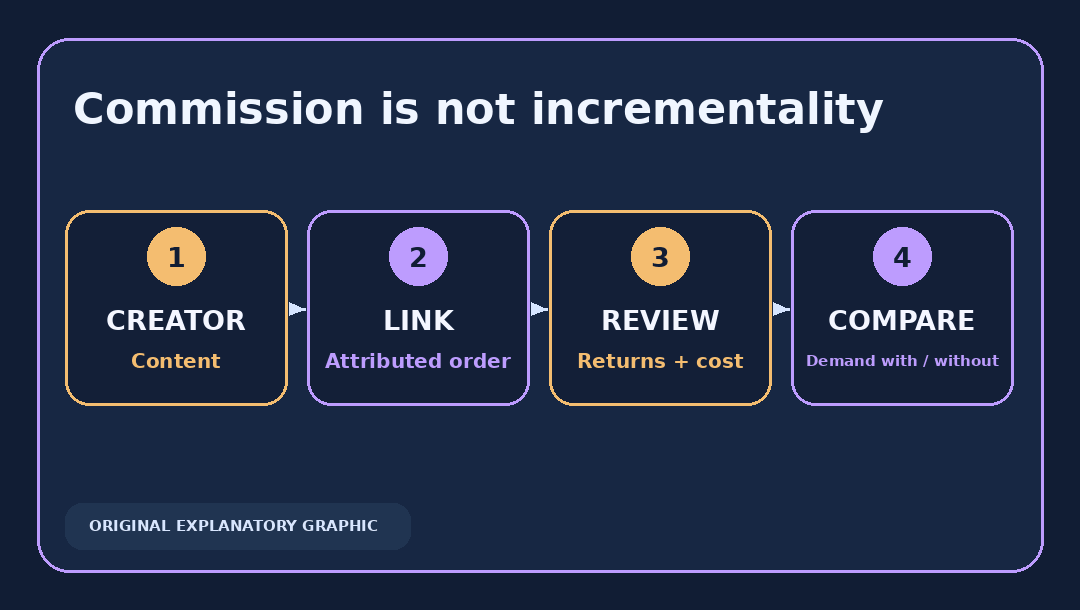
Illustrative measurement framework: attribution allocates credit; incremental lift asks what would have happened without the program.
Build a pilot around contribution, not checkout value
Pick a narrow category with reliable stock, predictable shipping, and clear unit economics. Start with a few creators whose audience understands the product rather than selecting on follower count alone. Give them factual product and disclosure guidelines, not a script that makes each demonstration identical. Agree on creator payment dates and what happens when an order is cancelled, refunded or duplicated. Capture offer start and end dates, product availability, and whether a discount was also visible on other channels.
At the order level, reconcile approved purchases against cancellations and returns, and use your own customer history to label new and returning customers when you can do so reliably. Count each order once. Compare recognized net revenue with product cost, fulfillment, commissions and any fixed program costs. Use a common returns window before comparing creator cohorts; newer cohorts otherwise look artificially favorable. If reporting is delayed, label early figures as provisional instead of quietly mixing them with settled orders.
An example: earning credit is not creating demand
Suppose a home goods merchant runs a small creator pilot. This example is hypothetical: if an order produces $90 of net revenue after discounts, costs $45 for the goods, $8 to fulfill and $12 in creator fees, that leaves $25 before other overheads and any remaining program costs. If orders are often returned or if buyers would have purchased anyway, the attractive tracked margin is not enough to scale. Conversely, a creator may introduce a buyer who later orders through another path and is invisible to the affiliate dashboard.
Measure both perspectives. Use link-level reporting to understand content and compensation. Where feasible, compare similar eligible audiences randomly offered the program or held out, with a defined observation window and the same policy for other discounts. If random assignment is impractical, compare matched markets cautiously and record promotions, inventory and seasonality that could invalidate the comparison. Report new-customer counts, returned orders, contribution and uncertainty, not a single headline return number. The useful question is whether the program attracted profitable demand you would not otherwise have reached.
Choose a product that gives the creator something to demonstrate
A small creator program works best when the value of a product can be shown rather than merely asserted. A backpack seller might choose a model with distinguishable compartments and a published product size rather than a generic accessory whose only draw is a code. One creator can show which everyday items fit; another can focus on the same product's warranty or a clearly disclosed comparison. Those are separate creative hypotheses, so do not expect their conversion paths to match. The reviewer’s audience may be small but unusually well matched to the use case. A broader lifestyle creator might generate more views but fewer shoppers who can actually buy or receive the product.
Agree upfront on offers and fulfillment limits. If a particular color is out of stock, the merchant should be able to pause links or route traffic to a page that makes alternatives explicit. Otherwise a program can wrongly punish creator A for a merchant's inventory mistake and credit creator B for a replenishment. Treat stock and shipping as measurement variables rather than an operations footnote. For an international offer, check duty, local currency, delivery promise, payment acceptance and any product restrictions before choosing the audience, not after the first cohort buys.
Define the campaign contract in operational terms
An affiliate agreement should say more than the payout percentage. Write down a plain-language definition of the qualifying order: was the commission earned at the point of purchase, after a fraud review or only once an eligible return period ends? Decide which party explains rejected orders and how a creator can challenge an error. Confirm whether a post can stay up after an offer expires, how stale links are handled, and whether the merchant has the right to reuse the content in its own ads. Permission to publish a post is not usually the same commercial arrangement as permission to run it as a paid ad. An explicit usage term helps avoid inadvertently assuming the two are bundled.
On the reporting side, ask to see a sample export before launch. Prefer transaction identifiers that can be joined to your own order ledger without sharing unnecessary buyer data. An export that shows only a creator total will not tell you why an otherwise good cohort looks different after returns. A payout ledger, adjustment reason, timestamps, currency and product group are more useful than a full buyer profile. Agree who reconciles the file, on which date and in which currency, especially when buyers pay a different currency than the creator.
Track the handoff from discovery to buying intent
At the creative stage, distinguish reach and actions that express deeper product interest. With a story showing a shoe in use, a viewer may watch through but have no immediate need. A shopper who opens the sizing guide may be one step closer to deciding but still not ready to buy. Add separate events for an eligible product-page visit, a checkout that reaches the payment stage and a settled purchase. Their counts answer different questions. Avoid optimizing a partner's earnings on a proxy event such as scrolling if the commercial agreement is based on actual purchases.
Useful reporting can be simple: for each creator and item, show measured traffic, eligible purchases, returned purchases, recognized net revenue and margin. Preserve the report's interpretation across changes by keeping the links stable and logging changes to the product page. If a creator posts a second take with the same link, count the purchases but be transparent that the platform may not be able to split the influence between versions. Where a brand uses several creator networks, resolve overlaps at order level before combining totals. A single customer record need not be used to learn everything about the creative; the minimum data that answers each question is enough.
Avoid giving the pilot a favorable comparison
A credible baseline must be harder than “no tracked creator sales yesterday.” In a two-week creator program, consider the timing of a payday, a new product launch or paid remarketing. A control that gets the normal campaign but no creator-specific offer is a clearer comparison than a control that loses other brand messaging too. If an influencer's public post can reach people assigned to the holdout, record the leakage and make clear what that means for the result. Comparing two nearby regions can introduce similar problems because regional inventory and competition differ. State openly which assumptions are fragile.
Do not set a growth target by calculating the best creator's result and multiplying by everyone you can recruit. Early partners are usually selected rather than random. Later audiences may overlap or convert at different rates. Report results for the whole agreed group as well as by creator. Check the results excluding the largest order and excluding the most successful creator as sensitivity tests, without presenting either as the single “correct” answer. If profitability depends on one creator or one item, the honest outcome is a more focused next test, not an automatic increase in budget.
Decide what earns another budget cycle
Before launch, set a decision meeting with sales, finance and the team that handles returns. Agree on a small set of conditions: a contribution figure after adjustments, a tolerable return rate, a minimum viable number of first-time purchasers and evidence reconciliation can be done without manual exceptions every week. The precise thresholds should come from your own margins and existing acquisition costs, not from a total published by a vendor. If reports conflict, settle what should count as an order before arguing over which partner should get more budget.
Expand in stages. Keep a well-performing product and partner as a reference while changing one variable at a time: a product group, a shipping market or a creative brief. Preserve fairness by telling creators how they will be evaluated and sharing enough context to interpret a cancellation rate. A limited pilot may show that creator commerce excels at product education but is a weak last-click route for a brand with repeat buyers. That can still be valuable; it simply calls for a different evaluation and compensation design than the headline sales number suggests.
Give the creator the same feedback you give your media team
A partner who did a careful product review should be able to understand what happened after their traffic arrived. If the landing page misrepresented availability or mobile checkout failed, share what can be shared about the problem and how it was fixed. If a measured sales decline follows a policy change in payouts, distinguish that from a decline in shopper intent. Agree which reviews are private and which aggregated findings may be shared. This closes the loop without exposing customer data or confidential competing creator rates. It also tells you whether the program can endure beyond one launch: process, trust and data quality matter as much as the first payout report.
A useful wrap-up pairs the creator's observations with the accounts team's findings. Ask each partner which product question they repeatedly heard and what stopped the audience from proceeding. Pair those observations with stock, cancellation and checkout evidence rather than assuming that audience comments represent all buyers. If the same unresolved question appears in several reviews, test an improvement to the product page before paying for more traffic. Retain the old page as a comparison when feasible and make clear which result comes from the page test and which comes from the creator program.
Comments
No published comments yet.