
What Pinterest announced
On November 23, Pinterest announced a custom integration with Microsoft Advertising. Eligible Microsoft campaigns can access Pinterest’s open-auction inventory across the home feed, search results and related Pins. Pinterest says the bidding model uses its own search queries, contextual signals and first-party indicators of intent. The initial launch covers North America, Australia and New Zealand. Pinterest’s announcement
This is access to a new placement environment inside a familiar buying workflow. It is not an announcement that all campaigns qualify, that an advertiser can always isolate the placement from the reporting interface, or that a new purchase came from an audience the brand could not otherwise reach. Confirm feature availability and controls in the individual account before writing a budget recommendation.
Separate discovery from checkout intent
Someone looking for “small dining room ideas” might save a table configuration before choosing a brand. Someone searching a model number is probably much further along. That difference changes what the first ad and landing page should accomplish. A visual discovery ad can explain what solves the problem, while search traffic for a precise product may need dimensions, delivery and purchase details immediately. A product-led creative should make recognition easy without assuming that the visitor is ready to buy.
Start with a category where the creative can show the use case in a single glance. A retailer could demonstrate suggested layouts, show dimensions in context or lead to a relevant collection rather than sending visitors to a homepage. Treat the collection route as a test, not a claim that a category page will always outperform a product page.
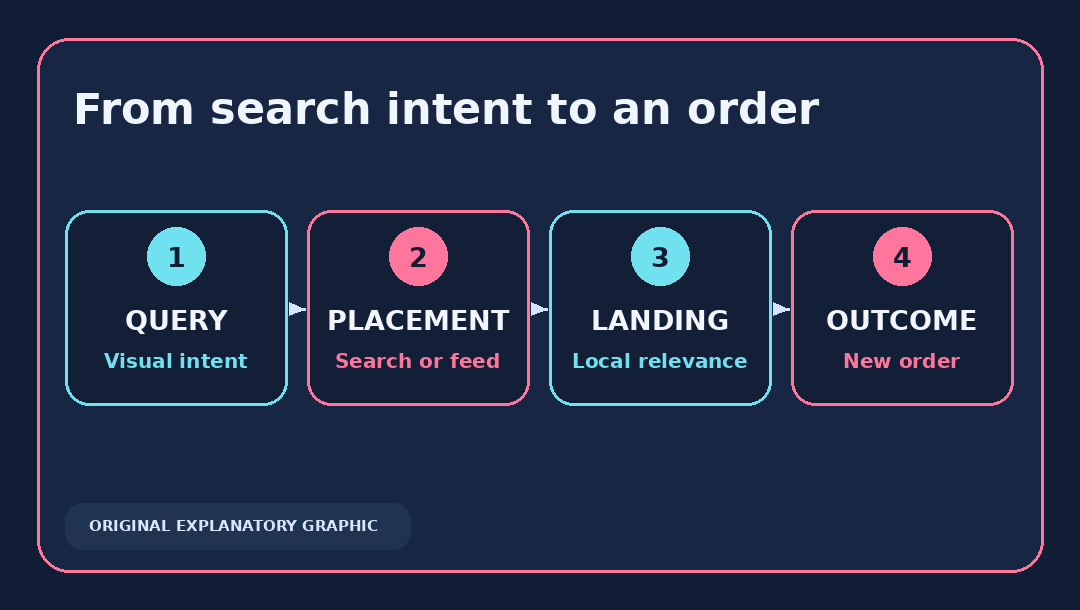
An original measurement diagram: a new placement creates a chance to reach demand, not proof of incremental sales.
Design the pilot around clean evidence
Pick one eligible market, one category and a capped test budget. Keep the underlying offer, stock availability and fulfilment terms steady. Confirm whether placement-level reporting and URL tagging are available before promising a Pinterest-only comparison. If they are not, report the result for the blended change; don’t extract a placement effect from a metric that includes other media. Check that tracking captures a valid purchase and that refunds or cancellations can be excluded from business reporting.
Use new-customer acquisition cost as a business outcome when first-time customers can be identified appropriately. Report revenue, order value and the share of delayed conversions as context, with the same lookback window across test and comparison. Use add-to-cart, engaged sessions and landing-page performance to diagnose friction, not to declare an acquisition win. In a later phase, a suitable holdout or a matched market comparison helps distinguish attributed sales from additional sales.
A practical example
Consider a fictional furniture retailer selling compact tables. It assigns one set of creatives to complete room scenes, while the comparison uses product close-ups. Both routes feature the same assortment and return conditions. The team tracks which shoppers open size guides and whether new-customer purchases justify the contribution margin after shipping and returns. If room scenes generate more clicks but fewer profitable first orders, the next step is to check creative-to-page fit and traffic source before adding spend. That is a better decision than scaling on a cheaper click.
For advertisers based in the Gulf, there is a distinction between geography of the business and geography of the campaign. If the target market is not in the announced launch regions, keep this as a future test. If the brand sells into an included market, verify access and fulfilment locally and avoid assuming the same performance for another region.
Read the announcement as a supply change
The starting point is an ad auction, not a new consumer storefront. Pinterest is making certain placements available to eligible demand from Microsoft Advertising. It describes a custom contextual bidding model that interprets its own browsing and query signals, rather than promising a literal transfer of the advertiser’s existing keyword rules or targeting settings. The published announcement does not lay out a universal switch, reporting breakdown or price. An operations team should document which campaign is eligible, what inventory controls it can see, who owns the measurement configuration and which results the interface can export before switching anything on. The value is less buying friction, but only if the organization has enough visibility to judge what it got.
Give each creative one job
A discovery frame is an opportunity to show a problem in a recognizable setting. A product frame makes an item easy to identify and compare. A detail frame gives a shopper a reason to investigate, by revealing something like the size, texture or positioning of a product in actual use. An experiment can use any two of those approaches, but changing the message, picture, offer and landing page together makes the result difficult to diagnose. Begin by varying one part of the visual message. Keep the display honest: do not show an accessory as if it were included, or a delivery timeline that the landing page cannot honor. Preserve a dated copy of the creatives and their intended variants so a colleague can review what actually ran.
Check the page before increasing delivery
Open the landing page on a phone using the same destination link the ad would use. Check the connection from what the image communicates to what the first screen confirms. If the ad depicts an extendable table, the page should make the smaller and larger dimensions easy to find. If the attraction is a collection, explain quickly why the items belong together, how to narrow them and which products are in stock. Confirm that shipping estimates and currency are right for the market. Test whether a tagged click sends visitors to the correct locale and whether consent settings allow the intended analytics to operate. Sometimes the fastest performance fix is to improve this handoff rather than create another set of ads.
Build a measurement record finance can explain
Start by defining what a valid order is, which events will feed campaign reporting and which order records will feed the business decision. One reasonable test definition is a paid first order that has not been canceled by a predefined reporting cutoff. Do not use this definition if it conflicts with how the business actually books revenue. Use the same cutoff for all groups and define which later refund adjustments are expected. The platform may assign credit to a purchase that a business report assigns elsewhere under a different rule. Neither result has to be broken for the numbers to disagree. Make the attribution model, comparison dates and eligible population visible above the table, and retain both platform and business reporting without silently bridging the gap.
Decide early what counts as a successful test
Agree on a spend ceiling and a minimum amount of useful information before looking at initial results. A tiny number of purchases can produce a dramatic swing in average acquisition cost, so report raw counts beside rates. If acquisition is the goal, a metric such as engaged sessions can justify investigating a creative or page, not declaring the pilot a win. Identify conditions to pause early: an incorrect locale, broken checkout, a sustained out-of-stock problem, or a tracking failure. Separate these operational stops from economic stop rules. An experiment should close when it answers a business question or reaches the predeclared limit, not automatically extend because the dashboard rose on the final day.
Put delayed decisions on the same clock
A shopper may use visual search for planning and return later through branded search, a direct visit or another channel. Compare outcomes after the same follow-up interval for each cohort. If yesterday’s visitors have had less time than last week’s visitors, a simple total falsely favors the older group. Record both the initial exposure dates and the cut date for decision-making. It can also be useful to compare how two attribution windows behave, as long as the report labels them equally for both arms and does not select the friendliest result after the fact. A longer window may show more attributed orders; it still does not establish that the exposure caused those orders.
Ask what would have happened anyway
Sales can rise because an advertisement found a new buyer, because it moved a purchase forward, or because an existing customer already planned to order. A holdout reduces ambiguity when similar shoppers or geographic areas can be excluded without disturbing other media. Choose comparable areas on pretest performance, avoid running different promotions, and watch for overlap when users move between regions. If the planner cannot isolate delivery or build a useful comparison, commit to a narrower answer: whether the blended inventory change coincided with a better business outcome. That answer can inform the next test. It is weaker than proving lift, and saying so makes the result more credible.
Carry the evidence into the next brief
Publish one internal summary that separates what is known from what was learned. The first has the eligible market and delivery conditions. The second records the hypothesis, controls, observed purchases, margin impacts, and the unresolved limitations. Then choose one action: stop, improve the page or creative, or scale carefully in the same market while keeping a comparison. Put a named owner on the follow-up and a date on the next decision, especially when stock, seasonality or early browsing signals have distorted the first read. The integration is an option to test a new stage of demand, not an obligation to expand the buying plan.
Work through the economics before deciding
Suppose, in a fictional pilot, the business sets a 1,000-dollar spend limit and ultimately records 20 validated first orders and another 10 orders from previous buyers. The first-order acquisition cost under that simple calculation is 50 dollars, not 33.33 dollars. The lower figure is close to the cost per order when all 30 orders are included, but it answers a different question. The shop must also determine how many first orders it would have received anyway. The pilot itself does not answer that unless the comparison supports a defensible estimate. Write both cost measures down, name the denominator and report which reporting dates were applied. Do not round a favorable result differently from its control.
Next, assume the typical first order has a contribution of 60 dollars after product costs, outbound delivery, ordinary return allowances and discounts but before paid acquisition. That leaves 10 dollars against the observed acquisition cost under these assumptions; overhead and differences in order mix may change the decision. If returns in the test cohort subsequently cost an additional 8 dollars per first order, the margin of safety largely disappears. These are illustrative numbers, not Pinterest benchmarks. They show why the product and baseline mix matter more than a placement label. A decision memo that includes such a break-even calculation is useful even if attribution detail cannot be exported, provided it describes the whole blended pilot rather than assigning the result to Pinterest.
Comments
No published comments yet.