
The announcement and its limits
Superfan Health announced its launch on November 16, 2026 as an agency connecting healthcare and sports marketing. Company announcement. This November 17 analysis proposes a planning framework; it does not report a tested campaign or demonstrated health improvement. The distinction matters because a new service proposition and an effective intervention are different kinds of evidence.
For a marketer, the central question is whether a sports setting can help a specific audience understand useful information and choose an appropriate next step. Large attention alone does not answer that question. Begin with the audience problem, then decide whether a partnership is a suitable means of addressing it.
Separate the business case from the public communication promise. A sponsor may seek visibility, an organization may seek participation, and an audience member may seek a useful answer. Those interests can overlap without being identical. Write each one down and identify where they conflict. If a proposed activity primarily serves the sponsor, do not describe it as audience education merely because it includes a health-related sentence. This is an editorial test of purpose, not a judgment about the newly announced agency. The framework asks a commissioning team to define what it will evaluate before it buys a package, so that the eventual report can address a genuine question rather than simply justify the purchase.
Define the audience's information need
Write one sentence describing the confusion the communication should reduce. Avoid defining success as making everyone healthier, because that promise is too broad for a marketing plan to evaluate. A hypothetical awareness project might help adults distinguish a general educational resource from an individual consultation. That is a communications objective, not a recommendation about treatment.
Identify what the audience already understands, what language it uses and what practical barriers might prevent follow-through. Ask whether the information remains useful after the event ends. If its value depends entirely on an athlete's popularity, the team may have selected an attention device before defining a meaningful audience benefit.
A practical information brief should also identify the misunderstanding that the activity must not create. A familiar face can make a message memorable while leaving its limits unclear. Ask a reviewer to restate the audience takeaway without seeing the campaign's internal strategy document. If that takeaway differs from the intended educational purpose, revise the material before adding more distribution. Test the question the audience is likely to ask next and decide where a reliable answer belongs. The campaign does not need to answer every personal question itself. It needs to explain its own scope honestly and make the boundary between general information and individual service understandable to the people encountering it.
Select context rather than celebrity alone
Assess the fit between the audience situation and the partnership environment. A noisy event entrance, a quiet digital resource and a community discussion offer different conditions for understanding. Evaluate attention, reading time, accessibility and the ability to leave without pressure. A prominent personality cannot compensate for information that is difficult to find or a next step that is unclear.
Create a short selection scorecard with reasons, not merely a ranking of followers. Record why the setting supports the objective and what would make it unsuitable. Keep commercial visibility and informational usefulness in separate columns so the team can see when an attractive sponsorship fails the practical brief.
Evaluate the partner's ability to sustain the promised experience, not only to attract an opening audience. Consider who maintains the resource, who handles a broken link and who responds when the next step changes. A temporary activation can leave a long-lived message circulating after its practical destination has disappeared. Plan that lifecycle before launch. The scorecard should therefore include operational ownership as well as creative fit. Record an exit condition too: if the destination becomes unavailable or the message no longer matches the service, the team should know how to pause or update the communication. These responsibilities are part of a credible experience, even though they rarely appear in a headline sponsorship pitch.
Design a voluntary route to participation
Map the journey from first exposure to an optional information resource and then to a clearly described next step. Avoid making participation feel like a condition of being a loyal fan. The route should explain who provides the information and what happens after a person chooses to proceed. A visitor should not need to guess whether a form is educational registration or a request for contact.
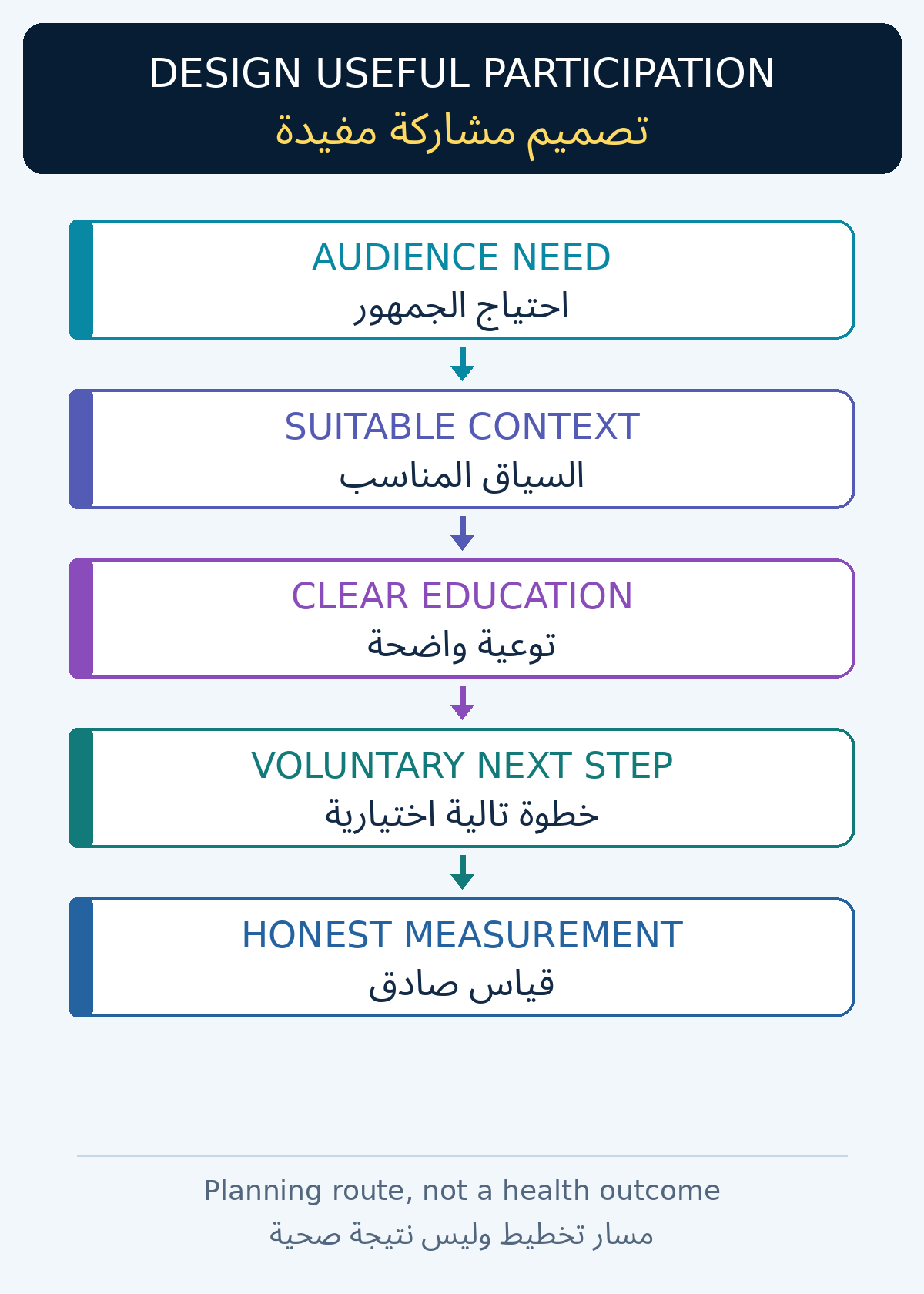
Original explanatory diagram by Karim Elganainy. The route is a proposed planning sequence, not a guaranteed behavior or clinical outcome. Launch context: company announcement.
Review the route from the perspective of someone who declines. Can the person enjoy the event without completing the activity, and can they close the information page without being pushed into an unrelated commitment? This is a proposed experience-design check rather than a statement of legal requirements. It helps distinguish genuine choice from a journey that merely looks optional in the campaign brief. Also consider the person who begins but does not finish. An abandoned interaction can reveal confusing instructions, unavailable support or an unnecessary step; it should not automatically be interpreted as lack of interest. Keep the route simple enough that the team can understand where confusion may arise.
Build review into the creative process
Have qualified internal reviewers examine the claim, implication and next step before production is finalized. A technically accurate sentence can still create a misleading overall impression when placed beside an image or endorsement. As an editorial safeguard, review the whole experience rather than approving isolated lines and assuming the assembled campaign remains clear.
Keep a record of approved wording and where it will appear. If a partner shortens a caption or adapts a video, review the changed meaning rather than treating the earlier approval as unlimited. This is proposed operating practice, not legal advice or a claim that any particular format is universally permitted.
Assign responsibilities across the sponsor, creative team, partner and destination owner. A campaign can pass separate reviews while still failing at the handoff between organizations. Someone must check that the approved invitation leads to the approved resource and that the resource explains the intended next step. Keep a lightweight version record for the complete journey, not only the headline asset. When a material component changes, identify which connected elements need another look. This is not a recommendation for paperwork without purpose. The record should help people answer a practical question quickly: what is currently live, who checked it, and what must be corrected if the experience no longer matches its approved purpose?
Separate communication metrics from health outcomes
Measure the stages that the activity actually observes. Exposure, resource visits, completed educational interactions and voluntary requests are different events. Do not label all of them engagement and then imply a health effect. Agree definitions before launch and retain the denominator for every rate. Missing tracking should remain a limitation, not become evidence of a successful journey.
In a hypothetical example, 80 resource visits from 1,000 recorded exposures represent an 8% visit rate. If 20 visitors complete an educational interaction, that is 25% of visits and 2% of exposures. None of these calculations establishes a clinical benefit. They describe observed communications steps in an invented example, not results attributed to the agency.
Interpret movement between stages cautiously. A higher visit rate could reflect a clearer invitation, a different audience mix or a change in how exposure was counted. Without a suitable comparison, the report should describe the observation rather than attribute a cause. If the team plans to compare versions, hold the relevant definitions steady and explain any differences in delivery conditions. Include the cost of producing and maintaining the activity when discussing operational efficiency. Do not turn that cost calculation into a claim about health value. A transparent report can be commercially useful while remaining modest about what its design can establish, and it should name the questions that require a different evaluation approach.
Make regional adaptation substantive
For a GCC healthcare team, adapt the invitation, language and practical destination, not just the headline. Have local reviewers assess whether the proposed activity fits the audience setting and whether follow-through is available. A well-translated message can still disappoint if the linked resource cannot serve the person who arrives there.
Keep sensitive personal details outside a routine sponsorship performance report. Prefer aggregated reporting for the communications review and route individual questions through appropriate service channels. This is a conservative design recommendation, not an assessment of applicable law or a substitute for specialist review. The purpose is to prevent a promotional workflow from casually absorbing information it does not need.
Regional adaptation also needs a clear owner for the destination experience. A translated post that leads to a page in another language creates a break in the journey, even if the original creative was excellent. Review the full path using the same device conditions likely to occur at the event or in the community. Check whether essential information is visible before asking the visitor to continue. This is an editorial usability recommendation, not a technical certification. Record unresolved language or access limitations and narrow the invitation accordingly. It is better to offer a smaller, coherent route than to advertise a broad promise that the available resource cannot support for all intended participants.
Karim's strategic takeaway
Treat the partnership as a testable route to useful information, not as proof that sports enthusiasm automatically transfers into trust. Before expanding, ask whether the activity reached the intended audience, made the next step understandable and produced observations the team can interpret honestly. A clear negative result can prevent an expensive repetition of an unsuitable format.
The launch offers a reason to examine the intersection of two marketing disciplines, but the investment decision still needs a specific brief and an evidence plan. Keep service intentions, communications measures and health outcomes distinct. The strongest proposal is not the one promising the biggest transformation; it is the one that explains what it can responsibly test.
Use a closing review that allows the team to conclude that sports was not the right context for this particular objective. That possibility is important: an evaluation designed only to celebrate a partnership cannot guide the next investment honestly. Summarize what was learned about audience understanding, operational handoffs and the usefulness of the destination. Retain the parts that worked without assuming the entire sponsorship package must be repeated. A future test might use another setting while preserving the same educational objective. The strategic asset is the accumulated understanding of how to serve the audience, not loyalty to one channel or the appearance of momentum in a campaign calendar.
Comments
No published comments yet.