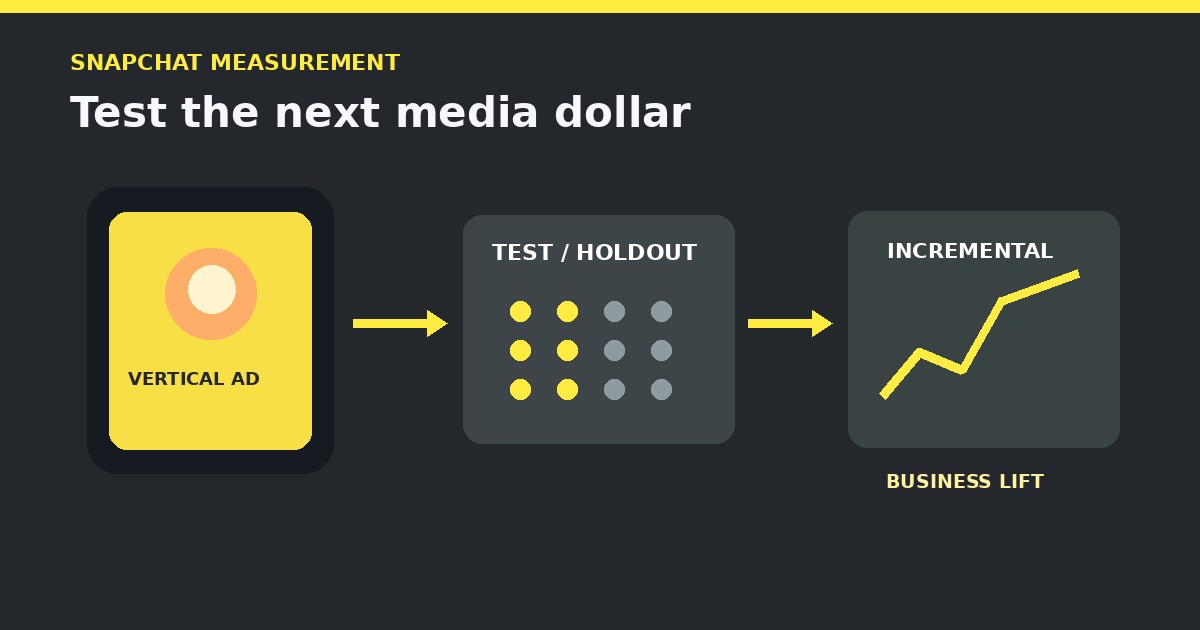
Snap's “Spend Smarter” campaign, launched globally on 30 September 2026, asks advertisers to reconsider inherited social-media budget allocations. The creative theme uses 1990s nostalgia, but the substantive claim concerns incremental returns: Snap cites a Measured study finding approximately 19.3% higher incremental return on ad spend for Snapchat than the blended incremental return of social advertising among brands in Measured's portfolio. The distinction between incremental and attributed return is the heart of the story. A channel can report attractive conversions that would have happened anyway, while an underfunded channel can bring new customers missed by the usual media mix. Snap's announcement and source notes, 30 September 2026.
What the launch does and does not say
Spend Smarter is a global performance-marketing platform and creative campaign, not a new universal guarantee of efficiency. Snap is working with creators from marketing and culture to show ways brands test customer reach, acquisition cost, and return on spend. The company also states that nearly one billion people globally use Snapchat and that users open the app more than 30 times a day on average. The reference notes point to a 2024 Alter Agents study commissioned by Snap. These broad usage figures are not the number of reachable buyers for a Saudi service business, and app openings do not equal attention to an individual ad. Snap, 30 September 2026.
Snap cites faster average time to conversion than other social channels using TransUnion multi-touch attribution findings across 29 brands and 78 outcome metrics, according to its notes. The more decision-relevant figure comes from Measured's incremental return study. Even there, the comparison is among brands in the measurement firm's portfolio; the newsroom page does not provide a full sample design or a Gulf-specific cut. It would be irresponsible to forecast a 19.3% uplift for a local clinic simply because it appeared in the campaign. The finding is a prompt to examine the next marginal unit of budget with a method that distinguishes new demand from reallocated credit. Snap's cited study notes, 30 September 2026.
Attribution and incrementality answer different questions
Attribution assigns a conversion to one or more observed interactions. A platform may report a booking after a person watched its ad, clicked a search result, and visited the site directly. The attribution window and matching rules influence the credit. Incrementality asks a counterfactual question: how many bookings occurred because the ads ran, compared with what would have happened without them? The latter is harder to estimate but more relevant when moving budget across channels.
Suppose a brand spends heavily on one social platform because its dashboard shows many purchases. Some of those shoppers might have bought anyway after seeing email or a physical store. A second platform may show fewer last-click purchases yet reach people the first platform rarely encounters. Moving a modest test budget can reveal whether the second channel adds total sales. This is why the right metric is not merely a platform's reported ROAS but incremental contribution after media, discount, production, and fulfillment costs.
Tests must be designed carefully. A geographic split needs comparable markets and enough volume; a holdout needs a stable definition and minimal spillover; a time-based before-and-after view is vulnerable to seasonality, promotions, and competitor action. For smaller organizations, the feasible test may be a structured pilot with an explicit control period, consistent offer, CRM tagging, and cautious conclusions rather than a sophisticated randomized trial. The quality of the inference should be stated with the result.
Why creative and audience fit still matter
Incrementality is not a property of a platform in isolation. It depends on who the campaign reaches, what the creative communicates, whether the offer is available, and the path after the click or swipe. Snapchat's format rewards content that feels native to vertical, quick-moving visual communication. Reposting a cramped desktop banner may make a poorly designed test appear to prove that the channel is weak. A more fair pilot uses clear first-frame context, readable captions, fast mobile landing, and a single measurable next step.
A healthcare or professional service should avoid sensational content simply to fit a social format. A short practitioner explanation of a consultation process can be engaging without promising treatment outcomes. A local retailer can show product use, stock availability, and delivery geography. The creative should answer a question that matters to the target customer. A strong hook that attracts a mismatched audience can lower cost per view while increasing the cost of qualified demand.
A budget decision built around marginal return
Many media plans allocate spend by habit: the largest platform receives the default majority, while other channels get a small remainder too weak to evaluate. A useful test sets aside enough budget and time for meaningful delivery without risking core operations. Before launching, define the campaign's job: incremental first purchases, new qualified consultations, app installs that activate, or another real milestone. Hold the offer and landing experience comparable to the incumbent channel where practical, and measure both platform signals and business-system outcomes.
Build a baseline from several prior weeks of spend, accepted leads, bookings, attendance, and revenue. Record promotions, holidays, stock issues, and changes in sales staffing. Choose a Snapchat audience and exclusions that avoid obviously irrelevant people. If the aim is new customers, distinguish them from existing customers and reactivation. Predefine the attribution window for operational reporting, then separately design an incrementality check. This prevents a later choice of whichever window makes the launch look best.
During the test, inspect delivery quality rather than changing settings every day. Track reach, frequency, completed views, landing-page load, qualified inquiry rate, cost per attended appointment, and revenue or margin where data permits. Match CRM outcomes to the campaign without overclaiming every assisted conversion. Pause creative with misleading engagement, even if the ad dashboard labels it efficient. When the test closes, calculate the extra business outcome over the best available comparison and show uncertainty from the sample and time window.
A six-week plan for Karim's clients
In the first week, Karim should choose one client with sufficient lead or purchase volume and a service suited to a visual explanation. Document the existing allocation and why it exists. Define the unit economics of a qualified customer, including no-shows, cancellations, and lifetime value only where actual retention data supports it. In week two, set up events and CRM statuses so the pilot reports more than swipe-ups. Check consent, Arabic copy, branch location, appointment capacity, and mobile performance.
Across weeks three and four, run a small but meaningful Snapchat campaign alongside a stable comparison. Prepare several distinct vertical creatives, each with an approved message and a clear response path. Do not change the entire marketing mix midway. Review lead quality and frequency weekly, but avoid treating ordinary daily variance as proof. In week five, let late conversions and booking attendance mature. In week six, reconcile the media records with the business results and decide whether the channel deserves a higher marginal allocation, another test, or a different creative approach.
The decision rule should be tied to the client's business, not the 19.3% study figure. A channel may deserve budget if it produces extra attended consultations at an acceptable contribution margin, even when its platform-attributed ROAS is lower. Conversely, a high reported ROAS may not warrant scale if the test adds no customers. Explain which result is directly observed, which is estimated, and what further test would raise confidence.
GCC relevance, limitations, and strategic takeaway
Snapchat's audience is commercially relevant in several Gulf markets, but the global and portfolio figures in this announcement do not identify Saudi reach, healthcare conversion, or a category-specific causal effect. Media habits, customer age, language, and local service supply differ. Medical advertisers should review targeting, claims, consent, and privacy requirements before using patient-related data in measurement. The pilot must be judged by a compliant service outcome, not vanity reach.
Karim can use Spend Smarter as a reason to challenge budget inertia with a disciplined experiment. Offer a client a short creative-and-measurement plan that defines the business milestone, holds a stable comparison, and reports incremental value with its limits. The strategic benefit is a better allocation decision. If Snapchat adds customers the existing plan misses, expand carefully; if it does not, the test still prevents a larger speculative spend.
What to show an executive at the end
A useful readout has three layers. First, show operational facts: budget spent, delivery, accepted inquiries, bookings, attendance, and sales. Second, show the comparison used to estimate incremental effect and the factors that may have distorted it. Third, recommend a decision with a budget limit and a date for the next review. Do not place Snap's portfolio-wide statistic beside a local result as if the two were directly comparable. Explain differences in market, category, time horizon, and outcome definition. If the test has insufficient volume, the honest recommendation may be to extend the observation period or redesign the audience rather than shift major spend. Executives can work with uncertainty when its source and practical implications are explicit.
Keep the comparison fair as spend moves
When a pilot succeeds, do not assume the same marginal return will hold at a much larger budget. Additional spend may reach less suitable people or raise frequency among the same viewers. Increase allocation in steps and watch accepted-customer cost, reach overlap, appointment capacity, and creative fatigue. Keep the comparison channel stable enough to interpret each change. If the business cannot serve extra demand promptly, a stronger advertising result can still create a worse customer experience. The final decision should include the service team's ability to respond, not only a media model's estimated lift. Review the measurement method after each scaling step so that a good initial test does not become a permanent unexamined allocation.
Comments
No published comments yet.