
What Snap introduced
In its November 18, 2026 announcement, Snap presented Creator Network as an open beta with AI-assisted discovery, review, shortlisting, contact and boosting tools. It also described Visited By for discovering public, location-tagged creator content on Snap Map, and a separate agency partner program in the US, UK and MENA. These are distinct initiatives; one does not establish eligibility for the others.
Start with a brief a reviewer can apply
The process below is independent editorial analysis. Define the audience, the specific action the campaign should support, the setting in which people will see the content and the limits of the brief. A brand seeking visits to a physical store needs different proof from a brand trying to explain a new product. Write down what the creator should be able to demonstrate truthfully, which conditions must be visible and which locations are in scope. A shortlist is useful only when another reviewer can see why an account is on it. Instead of asking for any creator in a city, ask for examples of clear explanations of comparable products or places, without assuming audiences are identical.
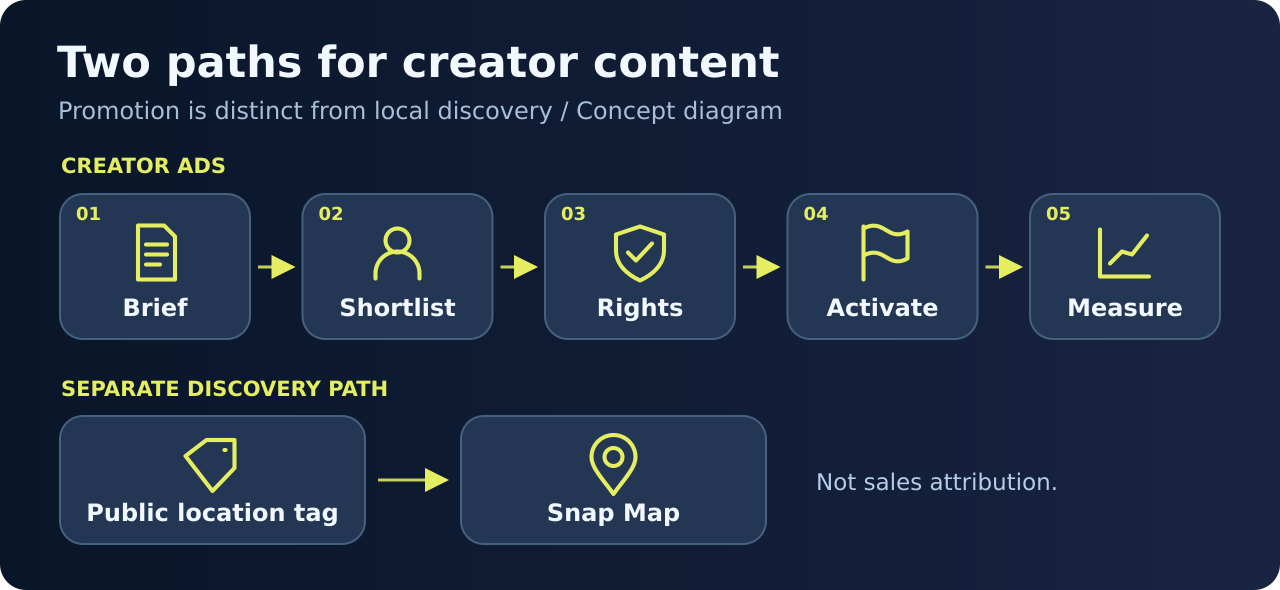
Original conceptual diagram by Karim Elganainy, based on the distinctions in Snap’s announcement. It shows a proposed campaign workflow and a separate discovery path, not the platform interface.
Review the work, not just the match
Read a small sample of recent posts in context. Look for the audience questions each creator answers, how they distinguish sponsorships and whether the important details survive when content is viewed on a phone. Treat recommendations as leads for review, not as approval. A strong visual match is not proof of audience fit or willingness to work together. Record which statements the brand can verify and let the creator decline. If the next action is a paid boost, confirm permission for the account, format, placement, duration and content version before spending. A public post or a location tag alone does not grant advertising rights.
Keep map discovery and performance separate
Imagine a hypothetical neighborhood stationery store. It might commission a creator to demonstrate a notebook and point to a page that confirms stock. Separately, a public creator post with a location tag could help someone discover a venue on the map. Record the commission and amplification against the campaign. Record unsolicited map mentions as a discovery observation, without automatically counting them as paid exposure, a unique visit or an attributable sale. A relevant post may be interesting even when the store cannot determine whether it led to anyone entering. Do not transfer a platform-wide scale figure to one place, campaign or country.
Define what would justify the next investment
Before activation, agree on the practical endpoint. A store might count verified reservations or use of a test offer under a documented rule; a product team might count completed visits to a guide rather than raw impressions. Track spend, delivery and outcome separately. Note how source is assigned, which activity could be duplicated and what cannot be observed. If a team needs to estimate what would have happened without the promotion, plan a credible comparison rather than treating tagged outcomes as incremental. Review any misleading conditions or customer friction before increasing spend. The most useful output is a documented decision to proceed, revise or stop, not a larger creator list.
Turn the brief into a decision a second reviewer can repeat
Take a hypothetical independent furniture shop that wants people to check whether a small desk fits before they visit. The useful audience is not just anyone who lives nearby. It is people in the service area who have a plausible space constraint and can use the information to decide whether the product deserves a closer look. The brief should specify the dimensions the shop has checked, whether the top and legs are included, and what customers can do if a finish shown in the video is unavailable. Do not ask the creator to imply that viewers need to buy today when the shop cannot substantiate a deadline. Give the creator room to choose an honest demonstration rather than forcing an enthusiasm script.
Ask two reviewers to examine the same small set of posts independently. One can look at clarity and accuracy, the other at practical fit, then both record whether they would keep or drop the account and why. Consider disagreement useful information rather than an error to hide. One reviewer might like a well-framed room makeover while the other notices that the creator never discloses what furniture was supplied by brands. The appropriate follow-up is to ask how the creator will handle sponsored material and factual corrections, not to use an invisible suitability score to settle the question. Retain the evidence, use comparable criteria across candidates, and do not retain irrelevant personal details.
Build an approval and rights record before activation
Treat discovery, contacting a creator and paid promotion as separate approvals. Finding a profile does not authorize an approach. An agreed creative commission does not necessarily allow the brand to edit, subtitle, translate or amplify the material. Ask for an explicit agreement that records the exact account and asset, the language versions, changes permitted, placement, dates and who owns the right to pause distribution. Check music and any third-party material separately; rights that cover a creator's regular post may not cover a brand's paid use. Keep the recording and the written terms together rather than relying on someone remembering a promise in an unrelated conversation.
Imagine a creator records the desk next to a recognizable poster. The reviewer spots it after the rough cut but before any boost. Removing it, getting appropriate permission, or using a different shot are all distinguishable options; approval for the overall campaign does not make acceptance automatic. The shop should also verify that the creator's stated dimensions, notes on assembly and availability match its own product page. If one discrepancy remains, send the specific change back to the designated owner and inspect the exported version again. A version labeled “approved” is helpful only when it identifies which release and placements it actually covers.
Design the measurement around decisions, not flattering counters
Carry a short measurement plan into the launch review. Decide which response is enough to support the next step. A product-page visit may provide a signal that the demonstration was relevant; it is not proof that a viewer became a buyer. A completed availability request can be more useful, but two requests from the same shopper are not necessarily two different opportunities. Agree on the event definition, where it is measured, how repeated actions are treated, and who checks the record when the campaign and store systems count differently. Keep proof of delivery and an explanation of the limits visible in the same report.
A useful comparison makes the next decision clearer even when the data do not provide a definitive answer. If possible, hold the offer, stock status and service hours constant and document any changes to them. Consider comparable store areas or time periods before launch, not after seeing which one makes performance look best. Do not say that a comparison is causal simply because it has two columns. Differences in whether stock was available, a weekend event near the store or an unexpected competitor promotion can offer other explanations. If measurement is sparse, report it as sparse and preserve the budget decision as provisional.
Keep discovery observations useful without overcounting them
Use two review rows rather than a single combined tally. The paid activation row records the agreed creative, placement, money spent, approved outcome and known limitations. The public map discovery row records that an eligible public item was seen with a location tag, if someone actually observed it, and whether its information remained correct. The second row can flag a bad location label or offer an idea for a clearer explanation. It should not create a paid impression, a reservation or a sale just because the shop name was present. If a post appears in both workflows, document the possible overlap and avoid adding unverified audiences together.
For example, a visitor may read an unsolicited map post on the way to a shop after already planning the visit. A cashier who remembers the visitor mentioning the post provides useful qualitative feedback, but cannot establish the counterfactual. Another visitor might see the sponsored video on one device and check availability on another. The brand should not invent a link between those activities merely because the times look compatible. Use the narrower verifiable statements that still inform a decision: the post described the right venue, the availability page was reachable, and a certain set of requests met the team's predeclared definition.
Run a small review meeting and leave with a decision
Ask the campaign owner to bring the original brief, the shortlist rationale, the permissions and the measurement caveats to the review. The store team can say whether the creative reduced repetitive questions or merely shifted them from one inbox to another. A brand reviewer can flag a misleading or out-of-date detail even when the reported engagement is encouraging. The team can then choose to continue under the same constraints, repair one identifiable handoff before trying again, or stop if the activity does not answer its question. Assign an owner and a date to any repair. The brief is an operational tool only if it can change the decision the team makes.
Keep the decision narrow when the defect is narrow: fix a broken stock link rather than hiring more creators, or pause amplification while permission remains unclear. State what evidence will reopen the decision. An instruction to increase reach is less useful than an owner testing a specific repair.
In the handover note, separate the change made from the effect still to be tested. For instance, list the exact link that a teammate repaired and the person who confirmed it on a phone. Do not say that the repair increased demand until the team has evidence for that claim. This small distinction lets the next reviewer reproduce the check without inheriting a conclusion the campaign has not earned.
Comments
No published comments yet.