What RADIN Health announced
On November 19, 2026, RADIN Health announced RADINA, a layer of AI-assisted workflow automation intended to coordinate diagnostic imaging between referral and follow-up. It scheduled a demonstration and official unveiling for Sunday, November 29 at 10:40 a.m. at its exhibitor booth. The Radiological Society of North America independently lists its annual meeting for November 29 to December 3 at McCormick Place in Chicago. As of this briefing on November 26, the announcement was public, but the announced unveiling had not happened. Vendor announcement · RSNA meeting dates.
The vendor describes a workflow engine called Autopilot that evaluates the state of an imaging episode and starts the next routine step, referring exceptions to staff. Its described scope includes order intake, eligibility and authorization, scheduling, communications, check-in, payments, report-quality checks and tracking radiologists' imaging follow-up recommendations. A separate Concierge interface is described in robot, kiosk and tablet formats. These are descriptions of the intended product, not proof of performance. The release does not establish times saved, a reduction in denied claims, improved patient outcomes or compatibility with any particular hospital. It also does not justify transferring a physician's decision to software.
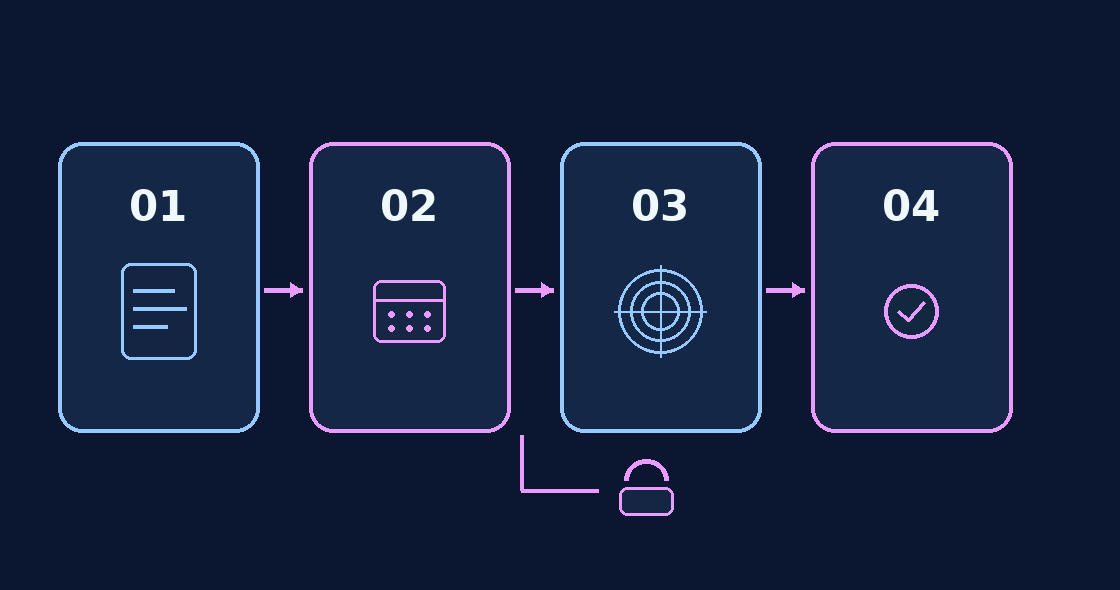
Original editorial diagram: referral, scheduling and authorization, examination and report, then follow-up. Human review handles exceptions.
Primary source for this illustration
The real product question is who owns the next step
A scheduling tool can receive an order and show openings. A portal can collect a form. A radiology system can show when a report is signed. The difficult part is making sure those individual actions collectively move the same referral forward. For example, a referral may be correctly visible in the intake queue but still not bookable because its identity match is unresolved. The appointment system may show a held slot while authorization is still pending. A signed report can leave a later recommendation unowned. The status shown in an application is not automatically the status of the episode.
The attractive proposition in RADINA's announcement is the attempt to join these gaps, not the fact that an interface can talk or move. Test each handoff as a contract. What event has actually occurred, what system asserts it, what action may follow and what happens if an expected event never arrives? A referral can be marked technically received without being ready to schedule. A patient can accept a proposed time without the scheduler confirming it. A handoff should convey these distinctions, including which staff team must act when an exception crosses departmental lines.
Build a workflow around verifiable states
Start from the records the hospital already trusts. A hospital information system may own the encounter and identity; a radiology information system, often called RIS, may own the appointment or worklist; and a picture archiving and communication system, or PACS, may hold the imaging study. Actual ownership differs by organization. Document the authority for each event before mapping data between systems. The key questions are whether accepted orders, appointment updates, finalized reports and follow-up actions can be traced, not whether an interface checklist has many ticks.
At intake, distinguish receipt, validation, acceptance and rejection. If demographic matching is unclear, assign the episode for review and keep it away from outward messaging until someone verifies the identity. During scheduling, distinguish no suitable slot, offer sent, tentative hold, confirmed and canceled. Where authorization is needed, track pending, approved, denied or not required independently of the appointment. Authorization is not an assurance of payment. Preserve timestamps, the reason for each blocked state and the owner of the next handoff. If two records disagree, who can reconcile them and which system is authoritative?
A finalized report needs more than a sent status. If it contains a clinician's follow-up recommendation, capture its owner, due window and intended action according to approved policy. Distinguish creation of the task, notification, acknowledgment and verified completion or an authorized closure reason. A delivered message proves a communication event, not patient attendance. A cancelled study, diversion to another provider and a missed follow-up are different outcomes and should not silently collapse into a generic completed bucket.
A hypothetical acceptance test
Imagine a hospital piloting one outpatient exam pathway. This example is invented; none of the values are RADINA results. Over a fixed intake window, 100 unique accepted referrals are eligible for the workflow. Seventy referrals reach a confirmed appointment by a prespecified cutoff and 56 have a completed examination by the same cutoff. That is 70% confirmed among accepted referrals, 56% completed among accepted referrals and 80% completed among confirmed appointments. Some appointments may legitimately be after the cutoff, so distinguish still pending from cancellation or no-show. Reconcile every request against a source-of-truth identifier before interpreting the percentages.
Suppose 12 reports in a separately defined cohort carry a clinician-approved follow-up recommendation due within the observation window. Eight are verified as completed. Closure among recommendations due is 8 of 12, or about 66.7%; the other four are not automatically failures. Check whether they are open, awaiting external evidence or closed for a documented reason that should be shown separately. A message receipt does not qualify as closure. Post-report tracking and scheduling are distinct questions with different denominators. Combining them into one rate conceals where a workflow loses people.
Before measuring improvement, run an exception drill in a non-production environment. Test replaying the same referral, conflicting identity matches, a missing authorization token, slot cancellation after confirmation and a late update from an external system. Confirm that repeated events do not create extra appointments or repeat outreach; a late update cannot silently revive a canceled appointment; and staff know who must act if a queue reaches its escalation time. Include a simulated connector failure and restore the source-of-truth view before resuming. Log actions and reasons, not copies of clinical records in analytics.
Measure the work a platform might move, not just the work it removes
Start with baseline and pilot cohorts that are comparable by modality, site and urgency category. Prespecify the inclusion rules, observation cutoff and which delayed cases are still open. Compare median and upper-tail times from accepted referral to confirmed appointment, scan completion among eligible referrals and rework time per episode. Measure separately the delay from scan completion to finalized report and closure among recommendations due. Collect reasons for unresolved cases. A shorter median can hide late cases; an average that includes only completed episodes can hide patients left behind.
Measure both savings and workload transferred: cases held for review per hundred eligible referrals, manual touches, time to clear exceptions and interruptions across teams. An inbox displaced into a new review queue is not necessarily progress. For business teams, distinguish scheduling conversions from completed visits and billed claims from collected revenue. If showing denials, separate genuinely adjudicated claims from still-pending items and use appropriate payer-specific comparisons. A paid claim is not proof of correct clinical decision-making; a workflow improvement is not proven simply because visitors click a booking button.
In a shadow phase, capture what the software would have proposed while the existing process remains authoritative. Compare those suggestions with approved rules and staff decisions, including a sample of ordinary cases with no alert. Record false holds and silent misses as well as errors caught in review. If nothing goes wrong in a small pilot, do not interpret that as a guarantee. At a wider scale, rare exceptions can become most of someone's working day. Move only reversible, low-consequence actions into any live phase after a documented review and agree how to pause and recover.
Procurement: buy a verified handoff, not an unattended promise
Ask the vendor to stage a demonstration using synthetic cases and a realistic connector, not merely a tour of the dashboard. Ask how integration maps identifiers, handles duplicates and writes corrections to the owning system. Ask how a reviewer rejects an action, how an override is logged and how status is reconstructed after an outage. Request a clear list of implemented capabilities for the version being offered, including which rely on separate services, which are deployment-specific and which require manual review. A booth demonstration cannot answer all those questions.
For a Gulf provider, check whether local payer, scheduling and messaging workflows can actually be supported, whether the system correctly preserves Arabic and English patient-facing communications, and whether the accountable security and compliance teams have approved data access, retention and hosting. These are due diligence questions, not findings from the announcement. Keep access limited to the role and environment needed, restrict contact channels to authorized users, and create an evidence trail for staff blocking or approving exceptions. Never use the prospect of fewer touches as a rationale to remove clinical review over decisions that require it.
The operational case for buying can be simple: if the main leak is referrals accepted but never confirmed, improve that transition first. If the leak is overdue recommendations after signed reports, test that workflow separately. Compare a process fix with and without a platform and put a named person on the escalation path. Demonstrate accurate state transitions, safe exception handling and enough benefit relative to new workload before considering scale. On November 26, RADINA is a vendor-announced concept worth testing against those questions, not proof that the desired outcomes have been achieved.
One final check belongs in the handover: pick a small sample of closed episodes and reconstruct the decision trail backwards from the final status to the original referral. Then sample episodes still open. Verify that the dashboard tells the same story in both directions, that a new staff member can identify the next owner without asking the project team, and that ambiguous statuses do not get counted as successful exits. Keep the exercise repeatable so the next software release can be tested against the same expectations.
Comments
No published comments yet.