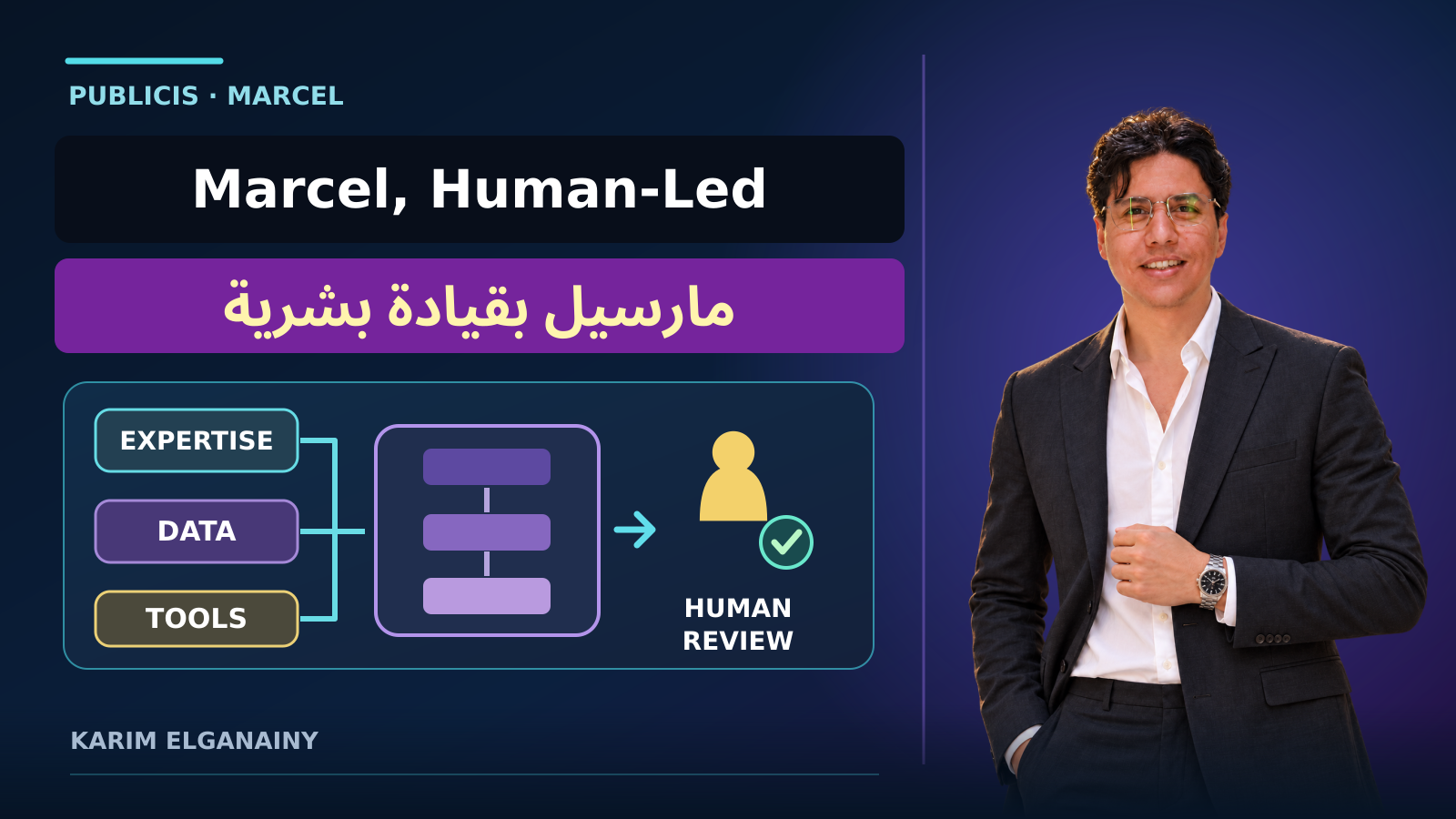
What Publicis announced, and what remains unproven
Publicis named Scott Hagedorn CEO and Sam Levine Archer chief strategy officer of Marcel on 22 October 2026. The company plans to expand its agentic marketing offering, including creator marketing and AI search visibility. Its announcement offers no pricing or independent performance comparisons. Publicis announcement.
The appointments make this a useful moment to examine how a brand should evaluate an agency's AI proposition. The rest of this article is original applied analysis, not a description of confirmed Marcel functionality. Its suggested tests, governance arrangements and hypothetical examples are questions for a buying team to investigate. They should not be read as evidence that Publicis, or any other supplier, already meets those requirements.
Purchase a better decision, not a larger demonstration
A compelling demonstration can show research, copy and channel recommendations appearing within minutes. That establishes that a sequence can run under demonstration conditions. It leaves the commercial question open: does the sequence improve a decision that matters to the buyer, after the cost of checking its output is included?
Start with a problem statement that contains a decision and an owner. A brand might struggle to decide which product questions deserve new explanatory content. Another may take too long to turn an approved offer into locally appropriate campaign briefs. These are different problems and need different evidence. A general promise of faster marketing cannot determine which one to prioritize.
Ask the supplier to complete the sentence: this workflow should help this person make this decision using these approved inputs. If the answer remains a list of platform features, the proposed purchase is still underspecified. A useful next meeting should resolve that uncertainty rather than add more features to the presentation.
Choose a workflow with a visible finish line
Select a first use case that is narrow enough to inspect from beginning to end. For example, an illustrative retailer could request a weekly brief identifying unanswered product questions from approved public materials and aggregated customer-service themes. The deliverable would be a small set of proposed content changes, each linked to its evidence and awaiting editorial approval.
Define completion carefully. Producing a document is not the same as producing an accepted brief. A finished brief should contain accurate facts, a clear audience need, a feasible proposed response and an owner who can act on it. Record the exclusions too: the pilot cannot change prices, publish claims, modify live campaigns or contact customers.
A bounded workflow makes disagreement productive. If reviewers reject the output, the team can identify whether the problem concerns evidence, interpretation, relevance or presentation. A sprawling end-to-end demonstration makes those distinctions harder because a weak assumption can travel through several attractive outputs before anyone notices it.
Establish the baseline before the pilot begins
Measure how the existing process works on a comparable set of tasks. Record elapsed time, active working time, review effort and the number of consequential corrections. Also record whether the accepted deliverable reaches the person who needs it. Faster drafting has limited operational value if the approval queue remains the main source of delay.
Use the same acceptance standard for the current workflow and the proposed one. Otherwise, a team can appear to save time simply by accepting less reliable work. Where practical, reviewers should assess outputs without being told which workflow produced them. This is an evaluation design suggestion, not a claim that blind review removes every source of bias.
Separate process results from business outcomes. A reduction in preparation time can be measured without asserting additional sales. Commercial effects require an appropriate subsequent test, with sufficient observations and attention to other changes in the business. An honest pilot can establish operational usefulness while leaving revenue impact unresolved.
Inspect the inputs and the right to use them
Ask for a concrete map of the information used at each step. Which sources are public? Which are supplied by the brand? Which are licensed by the agency? Which facts are current only for a particular market or period? The map should make uncertainty visible rather than using a broad label such as proprietary intelligence to cover unrelated material.
Trace a sample recommendation backward. The reviewer should be able to identify the supporting source, its date and the inference made from it. A recommendation may be reasonable even when the evidence is incomplete, but its confidence should match that limitation. An unsupported inference should not become a confirmed customer insight merely because several agents repeated it.
Agree how outdated information is withdrawn. A discontinued offer or changed service location can remain embedded in reusable material unless someone owns the update. Discuss permitted use, retention and deletion with the appropriate internal reviewers. These are procurement questions to resolve against the actual arrangement, not assumptions about the supplier's contractual terms.
Keep authority distinct from capability
A system's ability to propose an action should not determine its permission to execute it. Write a small authority schedule for the pilot. One category can cover reading approved reference material; another can cover generating drafts; further categories can cover changing an internal record, publishing externally or committing budget. Assign a responsible approver to each consequential category.
Make the approval specific to the actual output and destination. Approval of a campaign idea should not silently authorize every later translation, image variant or budget change. If a material input changes after review, the workflow should identify the affected outputs and return them for the necessary check.
Test how the process stops. The buyer should know who can suspend a workflow, what happens to queued actions and how work resumes safely. A controlled stop is especially useful when the issue is mundane, such as an incorrect offer date. Operational resilience should not depend on waiting for a dramatic incident before discovering who has the necessary access.
Evaluate errors, not only impressive successes
Build an evaluation set that includes ordinary tasks and deliberately difficult cases. An expired promotion, two similar product names, conflicting specifications and an unanswered question can reveal whether the workflow recognizes uncertainty. Use synthetic examples or appropriately approved material rather than exposing information merely to make the test realistic.
Score important error types separately. A factual error, an omitted limitation and an unauthorized action have different consequences. A single average quality score can hide a rare but serious failure. Reviewers should also record unnecessary escalation: a workflow that asks for help on every routine detail may be safe but operationally burdensome.
Keep a small collection of previously failed cases and rerun it when the workflow changes. Improvement on new demonstrations is less reassuring if an old error returns unnoticed. The objective is a documented understanding of where the workflow is reliable, where human review remains essential and where the proposed use should remain outside scope.
Compare economics at the accepted-output level
The meaningful unit of cost is the accepted, usable deliverable. Include setup, integration, supplier fees, internal supervision, revisions and the work needed to maintain reference material. If a quoted price excludes an important activity, assign that activity an owner and estimate it explicitly rather than treating it as free capacity.
As a hypothetical calculation, a process that reduces drafting effort by three hours but creates two additional hours of specialist review has saved one hour of work before other costs. Whether that trade is attractive depends on the scarcity and cost of the people involved. It does not automatically establish a saving in cash or an improvement in revenue.
Ask how pricing responds to volume, complexity and rejected outputs. A buyer should understand whether more experimentation increases cost predictably or introduces unexpected charges. Model choice can be part of that discussion, but the commercial test remains the complete workflow. A lower-priced generation step can become expensive if it creates more downstream correction.
Treat localization as a decision layer
For a brand operating across Saudi Arabia and the UAE, a useful pilot could examine whether one approved offer becomes accurate, natural communications for clearly specified markets. This is a suggested test, not a claim of Marcel's regional availability or language performance. The team must verify both directly with the provider.
The brief should identify language, service location, audience context, terminology and operational constraints. Arabic and English versions need equivalent meaning without forced word-for-word symmetry. A reviewer should check the strength of the promise, the clarity of conditions and whether the next step is actually available in the stated market.
Record translation corrections as explainable examples. If a phrase feels too formal, too vague or misleading, state why and provide an approved alternative. This creates a useful review standard instead of an expanding collection of subjective objections. Reusable guidance should preserve local judgment, not turn one market's preferences into an unquestioned template for every other market.
Use creator and discovery projects as separate experiments
A hypothetical creator-marketing workflow might help organize public content examples against an approved brief. Its assessment should distinguish evidence about a creator's published work from speculation about private audience characteristics. Human reviewers still need to assess fit, claim accuracy and whether the proposed collaboration is commercially sensible.
An AI-discovery project needs a different evidence plan. Begin with a defined set of customer questions and the factual pages the brand controls. Record exactly what was observed, when and under which conditions. A change in one sampled answer does not establish a broad visibility gain, and visibility alone does not prove incremental demand.
Do not combine these experiments merely because they use a shared interface. Their inputs, review requirements and outcome measures differ. Shared infrastructure may simplify administration, but each use case should earn expansion on its own evidence. This keeps a strong result in one workflow from becoming an unsupported endorsement of every adjacent feature.
Keep healthcare pilots on the communication side
For a healthcare organization, an initial marketing pilot could use approved public service descriptions, location details and administrative guidance. It should not require identifiable patient records or private clinical conversations. Start with the least sensitive information that can answer the operational question, and involve the organization's appropriate privacy and security owners before considering any new data flow.
Have qualified reviewers check medical claims and their translations. A marketing output should not diagnose an individual, imply knowledge of a private condition or convert a general educational statement into a promise of results. A proposed agent workflow is not evidence of clinical effectiveness, and this article provides no clinical recommendations.
Evaluate service accuracy as well as wording. If a page directs enquiries to the wrong location or describes an unavailable service, polished content can still create a poor experience. A useful pilot should connect communication approval with current operational information while keeping sensitive care decisions outside the marketing workflow.
Plan the handover before expanding
A pilot should leave the buyer with more than a folder of outputs. Agree which briefs, source references, acceptance criteria and change records can be retained and reused. Ask how the team would continue the process if the supplier relationship changed. The answer should be demonstrated in a small export or handover exercise where the arrangement permits it.
Appoint an internal owner for each reusable workflow. That person should understand the business purpose, the limits of the evidence and the maintenance obligations. Otherwise, a pilot can work well while its original champions are present and become difficult to manage when responsibilities change.
At the review, choose among expansion, revision, a narrower use or a stop. An inconclusive result deserves that label. The decision should cite observed quality, total effort and unresolved risk, not the amount of attention the category has received. The strongest agency AI proposition will be one the buyer can inspect, compare and govern in ordinary working conditions.
Source and evidence boundary
Published 23 October 2026. The opening news summary reports the company's announcement. The evaluation framework, examples and recommendations are original analysis. No client outcomes, implementation access, regional availability or independent performance validation are claimed.
Comments
No published comments yet.