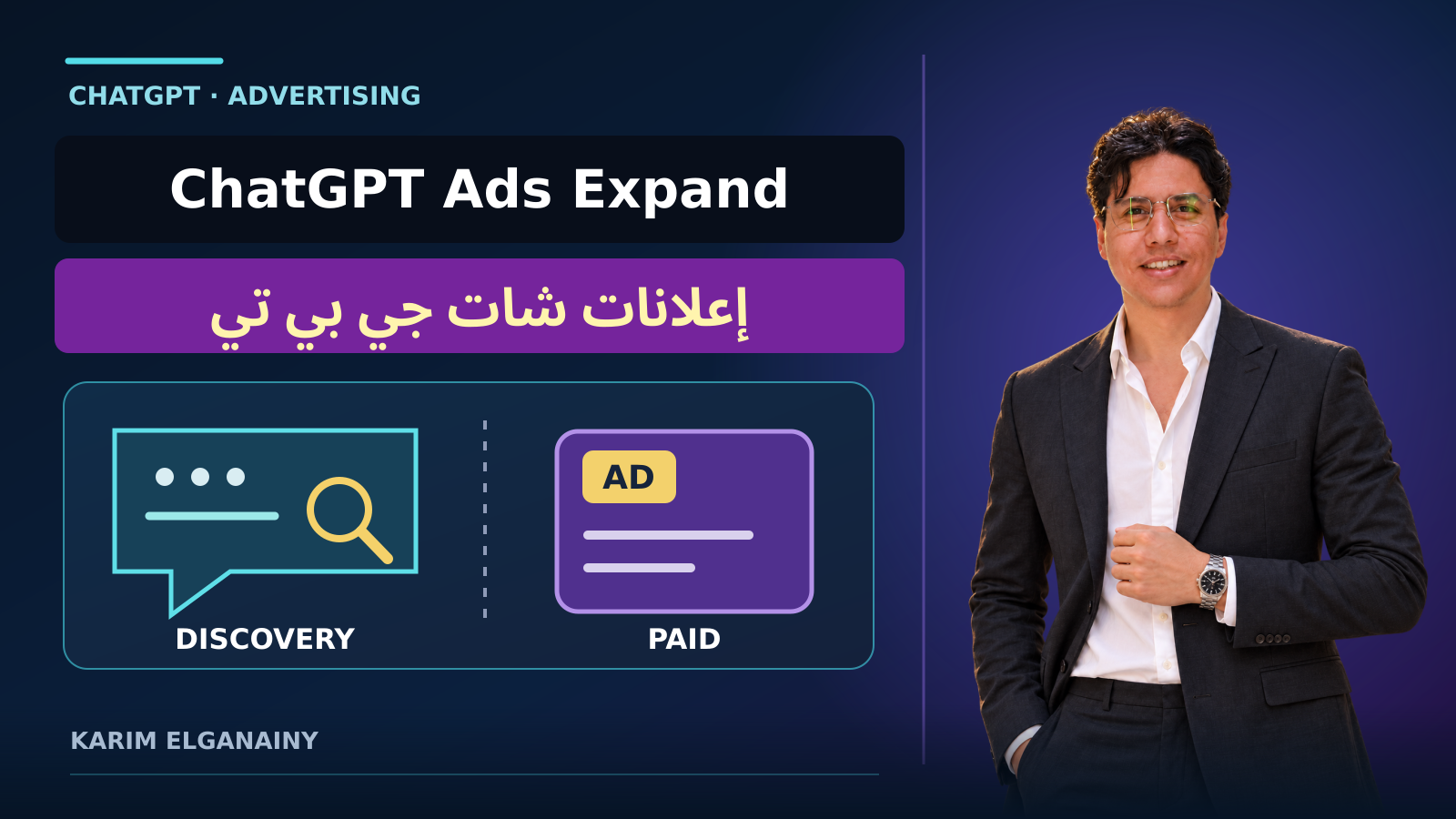
The announcement, with a clear boundary
On 21 October 2026, OpenAI announced 26 additional markets, bringing ChatGPT Ads availability to 89 countries. It reports over 100,000 advertisers and more than 1.2 billion weekly users. Ads are limited to Free and Go; conversations remain private from advertisers, and advertising is separate from answers. Additional formats, objectives and measurement are described as future development. Official announcement.
The practical analysis below is original editorial guidance, not evidence of campaign performance. Wider availability creates a reason to investigate a channel, but a marketing team still needs to determine what it can actually buy, what customer problem it can address and what evidence would justify continuing. The most useful response is a disciplined readiness review rather than a rushed transfer of budget.
Translate a channel announcement into a business question
Start with a situation in which a prospective customer needs help choosing. A home organization brand might serve someone comparing ways to use a small room. A business software provider might serve a team trying to coordinate approvals. These are hypothetical examples of decision problems, not descriptions of targeting options or assurances that particular conversations can be selected in an advertising interface.
Ask what the business can contribute at that point. It might offer a clear specification, an understandable comparison, a credible demonstration or an explanation of delivery and support. A vague brand promise is less useful when the person is trying to resolve a concrete uncertainty. Write the customer’s question before writing the advertisement, then identify the evidence the business can honestly provide.
Finally, connect the proposed role to a commercial objective. Is the immediate goal a relevant site visit, a qualified inquiry or a completed purchase? Choose an objective that matches the offer and the actual capabilities available to the account. Do not design a plan around an imagined future optimization option simply because it would make the planning presentation more attractive.
Keep market size separate from reachable opportunity
A large audience headline can encourage an oversized forecast. Build the forecast from the business’s own addressable market instead: where it serves customers, which products are available, which languages it can support and how much additional demand it can fulfill. Treat broad adoption figures as context, not a substitute for information about the specific campaign’s achievable delivery.
Construct a range of scenarios rather than one confident estimate. An illustrative model might vary the number of eligible visits, the share that becomes a relevant inquiry and the capacity of the sales team to respond. Populate those assumptions with the best available business evidence and clearly label unknowns. Invented channel benchmarks create false precision and should not be used to make the budget look inevitable.
Check the operational bottleneck before increasing expectations. If delivery is restricted to a few cities, customer support is available in one language or the sales team already misses response targets, a broader theoretical audience may add little value. The right initial scope can be narrow even when the announcement is international. A controlled test should match the business’s ability to serve customers well.
Create an account-specific readiness record
Before launching, confirm the market, advertiser eligibility, accepted offer category, available objective, creative requirements, payment setup and reporting options. Record the answers with dates and identify any unresolved conditions. This is a verification checklist, not a claim that all desired configurations are supported. Product announcements and account interfaces answer different kinds of questions.
Assign decision owners across marketing, operations, finance and appropriate review functions. Someone should own the offer, someone the destination and someone the interpretation of results. A campaign can be technically ready while the business remains unprepared to answer inquiries, honor prices or explain the product. These are launch blockers worth resolving before spending rather than treating as unrelated operational matters.
For a GCC team, validate each intended country independently. Confirm the relevant account conditions, language requirements and service coverage instead of extrapolating from a regional label. A company headquartered in the UAE may be planning a Saudi campaign, an international campaign or both; those are separate commercial cases. Keep the destination market explicit throughout the brief, creative review and reporting.
Build a decision-question map from appropriate evidence
A useful creative workshop begins with the questions customers ask before committing. Organize them into need definition, option comparison, practical compatibility and transaction readiness. For an illustrative furniture business, those could mean room dimensions, alternative layouts, material care and delivery timing. The structure helps writers identify what information is missing without claiming knowledge of an individual’s private conversation.
Use sources the business is entitled to review, such as its public product information, aggregated support themes and appropriately handled research. Remove unnecessary personal details from working materials. The aim is to discover recurring uncertainty, not to accumulate raw customer records because a new advertising channel exists. More data is not automatically more useful, especially when it increases privacy risk without improving the question being answered.
For each question, list the strongest available proof and the next helpful action. If the proof is weak, fix the offer or the explanation before buying more attention. If the next action is too demanding for the decision stage, offer a lighter way to learn. This exercise creates a practical bridge between messaging and destination design rather than a list of fashionable keywords.
Write advertisements that can stand on their own
An advertisement should make sense without implying that an assistant endorses the business or has independently selected it as the best answer. Use clear ownership of the claim: the business offers a product, states a benefit and provides evidence. Avoid wording that borrows authority from the surrounding interface or pretends to be part of a neutral recommendation.
Build a small set of creative hypotheses around different uncertainties. One version could explain compatibility; another could show transparent pricing; another could demonstrate a simple process. Keep the underlying offer consistent when the purpose is to compare messaging. Otherwise the team may attribute a change to writing when the actual difference was a discount, a service promise or a different product.
Review every claim against an evidence file. Check dates, conditions, exclusions and the exact product version being described. Words such as fastest, guaranteed or best require particular care because they can imply more than the business can support. Useful specificity often creates a stronger message than inflated confidence: a clear dimension or documented delivery condition can answer a real question without exaggeration.
Make the destination answer the next question
The destination should continue the reasoning started by the advertisement. A comparison-oriented message should lead to a page that explains relevant differences, not an unrelated homepage. A practical compatibility message should make specifications easy to find. A price-led message should make the total offer and important conditions understandable. This consistency is a design recommendation, not a promise about conversion performance.
Inspect the page on a mobile device and in each language used by the campaign. Check the first screen, navigation, forms, loading behavior and the clarity of the next action. Arabic localization deserves its own editorial review, including sentence flow and the direction of mixed-language product names. Translating a headline while leaving the rest of the journey confusing is not a complete customer experience.
Make uncertainty visible where it matters. If an estimate depends on location, configuration or availability, say so before asking for extensive contact details. The person should understand what happens after submitting a request and whether the business can serve them. A more honest destination may reduce unsuitable inquiries while improving the quality of the conversations the team actually wants.
Measure business quality without inventing attribution certainty
Start with a written definition of a useful outcome. For a service business, it might be an inquiry within the service area that matches the offer and can receive a timely response. For a retailer, it might be a completed order that remains valid after cancellations or returns. These are illustrative definitions; the organization should select its own criteria and apply them consistently.
Then map the evidence available at each stage. Delivery reports, site analytics and internal commercial records answer different questions and may not connect perfectly. Verify what can actually be measured before selecting the experiment’s main claim. Do not assume that a future reporting capability is live, or that the presence of several dashboards creates a reliable end-to-end view.
Distinguish observed association from incremental impact. A customer may have encountered the brand elsewhere before clicking an advertisement. A sale after a campaign starts is not automatically caused by it. Where a credible comparison is feasible, design it before launch; where it is not, state the limits and use the evidence to guide a narrower decision rather than presenting certainty the method cannot support.
Use a bounded learning budget
Set a maximum budget that the business can justify as a learning investment. Include creative production, destination work, review and staff time, not only media. Decide in advance what finding would warrant another test and what result would make further spending unreasonable. A spending cap is not a substitute for a hypothesis, but it keeps uncertainty from becoming an open-ended financial commitment.
Avoid making several large changes at once. If the primary question concerns the message, keep the offer and destination stable where possible. If the primary question concerns destination quality, maintain a consistent message. Real operations may require adjustments; record them so that the team does not mistake an evolving campaign for a clean comparison between two conditions.
Allow for an inconclusive outcome. A small sample, inconsistent delivery or a disrupted business process can prevent a reliable judgment. The next decision might be to improve measurement, narrow the audience definition or stop because the learning cost is too high. Calling every ambiguous result a promising early signal protects the campaign narrative but weakens the commercial decision.
Protect sensitive contexts before adding complexity
Healthcare marketing requires particular care in both messaging and measurement. A clinic’s service information, a provider’s administrative product and a general wellness offering should not be treated as interchangeable. The team should define what is being advertised and obtain appropriate category, claim and privacy review. This article does not establish approval for any particular healthcare campaign or substitute for professional advice.
Do not turn patient questions or treatment histories into advertising inputs merely because they seem useful for understanding intent. Use non-sensitive, appropriately reviewed material to explain service access and practical information. Avoid creative that diagnoses a viewer, promises a treatment result or implies that an advertisement provides an individualized clinical recommendation.
Apply similar restraint to measurement. A request for richer reporting does not justify sending medical conditions or identifiable appointment details into an advertising workflow. Begin with minimal information and require qualified review of proposed collection, tracking and sharing. If the only available design creates an unacceptable exposure, revise the design or do not run that part of the test.
Prepare the team for what happens after the click
Marketing should agree with operations on response capacity, offer availability and how unsuitable inquiries will be handled. A campaign can reveal an existing service problem rather than create one. Record response times and common unanswered questions alongside acquisition metrics so the review can separate communication quality from what happens after someone expresses interest.
Use neutral questions when collecting customer feedback. Asking whether someone used a particular platform can bias the answer or overstate its role. It is often more useful to ask what information helped, what remained unclear and what almost prevented the decision. Analyze themes carefully and avoid treating a few memorable anecdotes as representative evidence of the whole audience.
Create a concise review document that preserves the original hypothesis, confirmed setup, changes made, costs and findings. State one decision and the conditions attached to it. The document should help a colleague understand why the team will expand, revise or stop without needing to reconstruct the entire campaign history from screenshots and chat messages.
Decide what deserves action now
The most useful immediate work is unglamorous: verify eligibility, clarify the offer, improve the destination and identify a question the available evidence can answer. Those tasks remain valuable even if the eventual decision is to wait. They also reduce the risk of blaming a new channel for weaknesses that already existed in the business’s acquisition process.
An expansion announcement is an invitation to evaluate, not an instruction to spend. A well-prepared team can move quickly once the conditions are right because it knows its boundaries, responsibilities and decision rule. That is a more durable advantage than being first to announce a test whose purpose, evidence and practical value remain undefined.
Source and analysis boundary
The evaluation framework and examples are original editorial analysis. They are not reported advertiser results, a guarantee of performance or a claim that a particular account, country or offer is eligible.
Comments
No published comments yet.