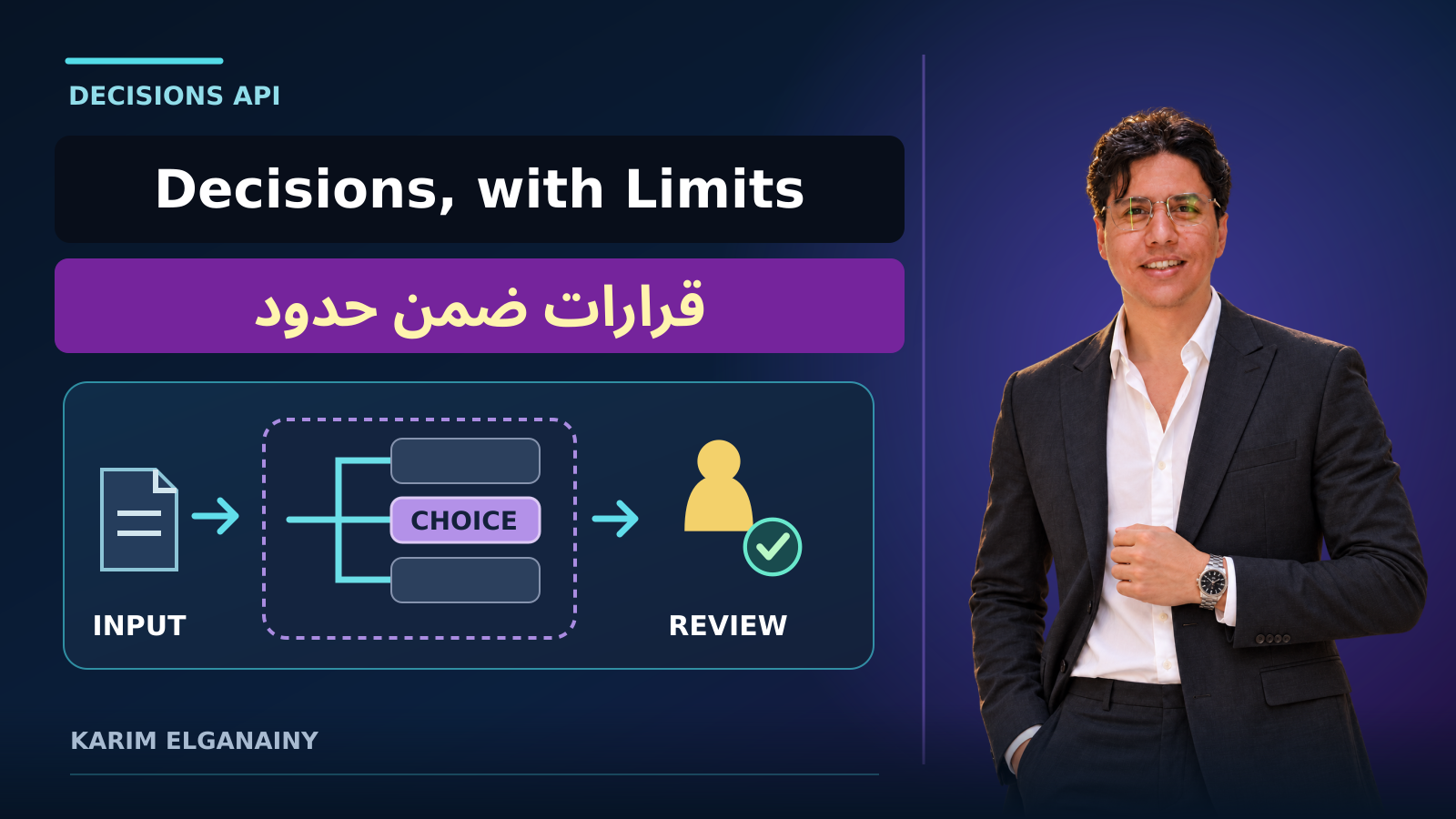
A marketing operation is full of small judgments: which team should receive an enquiry, whether a brief is complete, which campaign label belongs on a record, or whether an unusual submission needs a person to inspect it. These judgments rarely look strategic on their own. Together, they shape response time, reporting reliability and the amount of repetitive work that reaches experienced staff.
The useful question for marketing leaders is how to make those judgments explicit, measurable and reversible. A faster classifier has limited value when the organisation cannot explain what a correct classification means or who is responsible when it is wrong.
Verified announcement: what changed on October 22
OpenAI announced general availability of Decisions API with GPT-6 Luna on October 22, 2026. It describes probability, predefined-choice and rubric-score outputs from text, images or native JSON, supporting up to 400 questions per request. OpenAI claims speeds up to ten times faster than Luna through the Responses API, a vendor comparison rather than a guarantee for every workload. These facts come from the official announcement.
Original analysis: begin with an operational decision
The remainder of this article is independent applied analysis. The proposed workflows are design recommendations, not claims that a particular product already delivers them, and the examples are illustrative rather than client results.
Start by listing decisions that repeat frequently and have bounded consequences. Campaign taxonomy, internal queue assignment and missing-field detection are useful candidates for evaluation. Pricing exceptions, promises to customers and decisions affecting access to services belong in a different risk category and should not be quietly folded into the same pilot.
A strong first project has a narrow input, an agreed set of outputs and a readily available human reference. It should also have a safe fallback. If nobody can describe what happens when the system is uncertain, the workflow is not ready for automatic action, however impressive the demonstration appears.
Write a decision contract before writing a prompt
A decision contract describes the business rule in language operations, marketing and engineering can all understand. It names the decision, lists permitted outcomes, defines the evidence required and states which information must not influence the result. It also identifies the owner who may approve changes.
For an enquiry-routing pilot, the contract could distinguish product questions, existing-customer support, partnership enquiries and unknown intent. Each category needs a positive definition and at least one boundary example. A person asking about an invoice should not be treated as a sales opportunity merely because the message contains a product name.
Include an explicit unknown or review outcome. Without it, a system may be forced to select the least inappropriate category. That produces tidy dashboards while moving ambiguity downstream. The contract should also describe whether multi-topic messages are split, assigned to a primary queue or reviewed by a person. Those are operating choices, not details to leave to chance.
Choose one queue with a measurable baseline
Before introducing a model, measure the current process. Record how many enquiries enter the queue, how often staff reassign them, how long they wait and how much reviewer time the work consumes. Capture the measurement period so that a quiet week is not compared with a launch campaign without explanation.
Use a small, permissioned sample of representative work or create synthetic examples. The evaluation set should include ordinary submissions, incomplete messages and the awkward cases people actually disagree about. Remove unnecessary identifiers before any approved external processing. A privacy reviewer should determine whether the remaining content is appropriate for the proposed destination.
Keep the first pilot separate from customer-facing commitments. A suggested internal label is easier to reverse than an automatically sent message. During the initial phase, the existing team can retain control while the proposed system generates recommendations alongside its normal work. This reveals disagreement without making customers carry the cost of experimentation.
Treat confidence as something to test
A numeric confidence value is useful only when its relationship with actual correctness is understood. A high-looking number should not be interpreted as permission to take a consequential action. Check whether predictions placed in the same confidence range are correct at roughly similar rates on the team's own examples.
Choose thresholds according to the cost of an error. Sending an internal brief to the wrong marketing specialist may be a recoverable inconvenience. Misrouting a complaint or bypassing an escalation rule can have a different operational impact. A single threshold across every category may therefore be inappropriate.
Also measure the cost of abstention. Sending every difficult case to people can preserve accuracy while leaving the original workload untouched. The useful objective is a defensible balance between automatic handling, reviewer burden and correction cost. Set that balance before the pilot results arrive, then document any decision to change it rather than choosing whichever number makes the experiment look strongest.
Build an evaluation that can expose weaknesses
Ask two qualified reviewers to label a portion of the test set independently. Their disagreements reveal unclear business rules as well as difficult examples. Resolve those ambiguities before treating their labels as unquestionable ground truth. Otherwise, the system is being measured against an inconsistent target.
Separate development examples from final evaluation examples. Repeatedly adjusting instructions against the same messages can create an attractive score that does not survive fresh work. Reserve a holdout set, record the instruction version and compare changes against the same evaluation procedure.
Report errors by category, not just as one overall percentage. A common category can dominate an aggregate score and hide poor handling of a smaller but important queue. Include false assignments, missed assignments and review rates. Where sample sizes are small, say so. A handful of successful examples demonstrates feasibility; it does not establish reliable performance across the operation.
Make privacy part of the input design
The easiest data to protect is data the workflow never sends. For a campaign-tagging task, the system may need a campaign description and an approved category list rather than a complete customer record. Design the input around the decision instead of copying every available CRM field because it is convenient.
Before deployment, the organisation should review the intended data categories, processing destination, access controls, retention arrangements and applicable obligations with its responsible teams. This article does not establish that any particular configuration is suitable for a specific jurisdiction or organisation. Vendor features and account settings need to be checked against the actual deployment.
Keep operational logs proportionate. A useful audit record might contain a pseudonymous item identifier, workflow version, selected category, review outcome and timestamp. It does not automatically require the full original message. Define who can inspect logs and when records are removed, and avoid turning debugging into an unplanned copy of sensitive information.
Design the human review experience
A review queue should explain what a person needs to decide. Display the relevant input, the candidate category and the business rule that applies. Allow the reviewer to correct the result and identify why the original decision was unsuitable. Do not require staff to write a long explanation for every routine correction.
Define who owns the queue during busy periods and what happens when it exceeds capacity. Uncertainty that accumulates unattended is still a service failure, even if the classifier correctly chose to abstain. Escalation rules should be visible and tested before automatic handling expands.
Reviewers also need authority to stop the workflow when a recurring problem emerges. A simple rollback route, an accountable owner and a documented fallback are often more valuable than another dashboard. The goal is a working operation that can recover from mistakes, not a system whose output becomes difficult to challenge.
Test Arabic and English as separate operating conditions
For teams serving Saudi Arabia, the UAE or other multilingual markets, translation should not be the entire evaluation strategy. Create separate test slices for Arabic, English and mixed-language messages. Include realistic spelling variation, abbreviated requests and branch names that may appear in more than one form.
Compare error patterns without assuming that equivalent-looking prompts produce equivalent results. If Arabic examples are reviewed by people who understand the relevant customer language, their disagreements can help refine categories and wording. Avoid using language as a shortcut for assumptions about customer value or eligibility.
Maintain a shared category dictionary across languages. The label stored in the CRM should have a stable meaning even when the input and reviewer interface differ. Where a phrase is genuinely ambiguous, preserve the review route. The aim is consistent service handling, not forcing every local expression into an English definition that was never designed for it.
Keep healthcare examples strictly administrative
For a healthcare marketing team, a safe starting point is to evaluate synthetic administrative enquiries: requests for opening hours, directions, a public service directory or an existing appointment contact route. Even these examples need clear ownership and approved information sources. They should not become a way to infer a person's condition or clinical needs.
Do not use a marketing-routing pilot to diagnose, assess symptoms, determine urgency, recommend treatment or decide access to care. If an incoming message contains clinical information, follow the organisation's approved human handling process rather than allowing a marketing classifier to make a clinical judgment. Do not share identifiable patient information for experimentation.
The same separation matters in reporting. An enquiry category is an operational label, not a medical conclusion. Marketing teams should be able to improve administrative handoffs without building a hidden health profile or treating a commercial conversion objective as a substitute for appropriate professional care.
Measure the whole workflow, not only the model
End-to-end performance includes collecting the input, calling the service, validating the result, writing to the CRM and handling retries. A fast individual response may have little effect if records wait in a scheduled import or staff still reconcile labels manually. Measure the time from arrival to a correct, usable assignment.
Budgeting should similarly include integration work, evaluation, review time, monitoring and maintenance. Avoid comparing one isolated technical charge with the full cost of a human process. Use the same scope for both options and show which assumptions could change the result.
Plan for failures that have nothing to do with classification quality. A timeout, duplicate webhook or stale category list can create operational damage even when the model itself would answer correctly. Add idempotent processing, validation against allowed categories and a fallback queue. Test those paths deliberately rather than waiting for production traffic to find them.
Use a staged rollout with a real stop condition
A practical first month can move through four stages, with advancement based on evidence rather than the calendar. First, agree the contract, ownership and evaluation sample. Second, run offline tests and resolve category ambiguity. Third, operate in shadow mode while staff continue their normal process. Finally, consider limited automatic assignment only for a low-risk subset that meets the agreed criteria.
Before that final stage, define conditions that suspend automation. Examples include a sustained increase in corrections, unexpected content categories, a privacy concern or a material change to the input source. These are illustrative guardrails; the organisation should choose thresholds appropriate to its own operation.
Keep a change record for instructions, category definitions and integration updates. After each meaningful change, rerun relevant tests. If the pilot fails to reduce useful work at an acceptable error level, pause it or redesign the decision. An honest negative result can prevent a much larger investment in the wrong workflow.
The management decision behind the technology
The most useful pilot outcome is a clear answer to a business question: can this specific decision be handled more consistently, with an acceptable burden on people and a controlled failure path? Report that answer through a compact scorecard covering correct assignments, review volume, rework, end-to-end delay and unresolved incidents.
A leadership team should then decide whether to expand, revise or stop. Expansion should mean another bounded decision with its own evidence, not permission to automate everything that happens to look similar. Better marketing operations come from clear rules, responsible ownership and continuous verification. The technology earns its place when it improves that system in practice.
Source
OpenAI: Build more responsive apps with the Decisions API, October 22, 2026. Product facts are confined to the announcement summary; the operational framework above is original analysis.
Comments
No published comments yet.