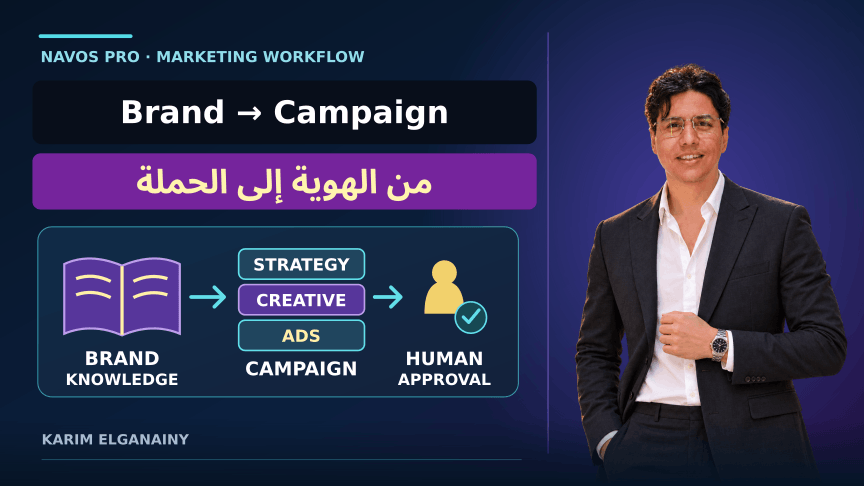
What Tec-Do announced, and when
Tec-Do introduced Navos Pro on October 23, 2026. Its announcement describes website-derived private business knowledge, proactive recommendations and human decision authority. The vendor claims more than 70 MCP integrations, over 100 skills and monitoring of more than one billion data points daily. Those scale figures are company claims, not independent evidence of marketing effectiveness. Tec-Do announcement.
For marketing leaders, the useful issue is whether a system can turn changing information into decisions that employees can inspect and act on responsibly. More recommendations do not automatically create more value. The following is an original evaluation framework for this category of marketing agent, written for the October 25 news edition. Proposed workflows, controls and examples are not claims that Navos Pro has been independently tested or supports every configuration described here.
Define the decision before selecting the agent
A marketing team should begin with a decision it currently struggles to make well. Examples include which landing page needs investigation, whether a product category deserves a creative refresh or where an acquisition campaign is attracting unsuitable enquiries. These decisions require different evidence, different owners and different thresholds for action.
Write a decision contract in plain language: the business question, the information needed, the acceptable response time and the action that a person may approve. Include what the system must do when evidence is missing or contradictory. An answer that says more evidence is needed can be more useful than a polished recommendation that hides uncertainty.
This approach limits a familiar procurement mistake: choosing a broad platform and then searching for tasks that justify it. A narrow decision contract makes a demonstration more concrete. The team can ask the supplier to work through representative cases, explain the basis of its recommendation and show how a reviewer would challenge the conclusion.
Treat the website as an input that needs editorial governance
A company website is often a persuasive sales environment rather than a complete operating manual. It may emphasize attractive benefits while leaving out exceptions, delivery constraints or commercial conditions. Before using website content as business context, the organization should decide which pages are authoritative and which statements require additional qualification.
Create an approved reference pack that distinguishes products, target audiences, positioning, current offers and prohibited claims. Assign an owner to every volatile item. A seasonal offer needs a different review cadence from an established brand description. When two markets have different terms, the reference material should preserve those differences rather than averaging them into a convenient summary.
The practical test is whether an employee can trace a proposed message back to a current, approved statement. A confident recommendation built on an expired offer is still a bad recommendation. Better context management will often require editorial work before any agent is allowed to influence campaign planning or customer-facing creative.
Build an observation layer before an action layer
A sensible evaluation starts with reading and explaining, not with changing budgets. Ask the system to identify a specific pattern, cite the underlying records and state what could make its interpretation wrong. Review whether it distinguishes a commercial change from incomplete reporting, a small sample or a change in how events were recorded.
For example, a decline in reported purchases might reflect weaker demand, a landing-page problem or a broken measurement event. A recommendation to replace creative should not be accepted until the team has considered those alternatives. The same symptom can call for completely different work, and acting quickly on the wrong explanation can waste both media and employee time.
Once observation is reliable, introduce recommendations with explicit approval. Keep execution permissions separate from analytical access. The organization should know who may change an advertisement, approve a new claim, alter a target or commit spend. An integration catalog is a starting point for due diligence, not a substitute for a permission model.
Make every recommendation carry a compact evidence brief
A useful recommendation should answer five questions: what changed, which records support it, why it matters, what action is proposed and what result would count as success. Add the strongest alternative explanation and the cost of being wrong. This format helps employees compare recommendations instead of reacting to whichever message sounds most urgent.
The evidence brief should identify the time period and comparison period. It should distinguish observed values from estimates and show whether the relevant information is complete. If a recommendation depends on a forecast, label the forecast and make its assumptions visible. A reviewer should not have to discover these limitations by opening several disconnected screens.
Set a minimum standard for acceptance. A proposed action without traceable evidence returns for clarification. A recommendation that cannot name an owner remains a finding rather than an executable task. This discipline reduces unnecessary work and creates a consistent record of why the team acted, deferred or rejected a suggestion.
A hypothetical cross-border campaign pilot
Consider an ecommerce brand exploring a second Gulf market. This is an illustrative operating design, not a reported customer deployment. The team might select one product range and one acquisition channel, then define a single decision: which customer objections should inform the next creative test. Budget control and publication remain with employees throughout the pilot.
Prepare a compact reference pack with approved product statements, current commercial conditions, existing creative and anonymized or synthetic examples of customer questions. Include deliberately ambiguous cases. The agent is asked to group possible objections, identify the evidence for each and propose a limited set of testable messages. It should also identify where the evidence is too thin to support a conclusion.
Employees assess whether the suggestions are genuinely different from existing work, whether each claim is supportable and whether the proposed test can distinguish competing explanations. Only selected ideas move into the normal creative review process. The purpose is to evaluate decision support under realistic constraints, not to manufacture a high volume of assets for its own sake.
Compare recommendations with a credible baseline
Before the pilot, document how the team currently makes the chosen decision. Record preparation time, the evidence employees consult, the number of ideas rejected and the quality of the resulting brief. Without a baseline, a new interface can feel more efficient while merely moving work from analysts to reviewers.
Use a comparable set of tasks for the assisted process. Where possible, have reviewers assess recommendation quality without knowing which process produced the draft. A practical scorecard can cover factual support, commercial relevance, actionability, novelty and the completeness of the proposed test. Keep these dimensions separate so that strong presentation does not conceal weak evidence.
Evaluate downstream outcomes only when the experiment supports that inference. If the assisted team also changes the offer, targeting and landing page, an improvement cannot confidently be assigned to the recommendation system alone. Report what the pilot actually establishes: perhaps faster preparation, better briefs or fewer unusable suggestions, rather than an unsupported claim of incremental sales.
Choose economics that reflect the business constraint
Revenue is not always the best objective for a marketing decision. A campaign can increase sales while adding costly returns, discounts or fulfillment pressure. The evaluation brief should specify which economic outcome matters and which constraints cannot be sacrificed to improve it. Finance and operations should help define the measures before the pilot begins.
Consider a deliberately simplified hypothetical example. Campaign A produces SAR 100,000 of revenue and SAR 25,000 of contribution before SAR 20,000 of media cost, leaving SAR 5,000. Campaign B produces SAR 90,000 of revenue and SAR 31,500 of contribution before the same media cost, leaving SAR 11,500. These invented figures exclude fixed overhead and illustrate why a revenue ranking can differ from a contribution ranking.
The correct choice still depends on capacity, customer quality and the purpose of the campaign. The lesson is to give an agent the right decision criteria rather than assuming that a larger sales number answers every business question. Any claimed improvement should identify the metric, baseline, observation window and costs included in the calculation.
Require market-specific creative judgment
Cross-border marketing should not reduce localization to translating a headline. The team needs to consider whether the proposed benefit is relevant to the audience, whether the supporting proof is understandable and whether the commercial details match the destination market. A strong global idea may still need a different explanation or sequence of information locally.
For Arabic creative, review meaning, tone, readability and the relationship between the message and the visual. Test the actual placement rather than only a text document. A phrase that works in a long description may be unclear when shortened for a small advertisement. Mixed-language product names also need consistent treatment across the customer journey.
Do not assume that a vendor's scale claims establish local market expertise. Ask for task-specific evidence and evaluate the proposed outputs against your own approved standards. For health-related services or other sensitive categories, specialist review of public claims remains essential. A marketing workflow must not drift into individualized clinical advice or unsupported promises about outcomes.
Make human authority practical rather than ceremonial
A human approval button offers little protection if reviewers receive dozens of recommendations without evidence or enough time to assess them. Design the workload so that attention goes to consequential decisions. Low-confidence findings should be grouped for investigation, while urgent alerts should explain both the urgency and the cost of waiting.
The reviewer needs meaningful options: approve, reject, request evidence, reduce scope or defer until a specific condition is met. Record a reason in a short structured form. Those decisions can reveal whether the system repeatedly misunderstands stock constraints, audience priorities or the organization's appetite for risk.
Keep escalation paths independent of the agent. If a proposed change crosses a spending limit or introduces a new public claim, route it through the existing owner. The goal is not to create a parallel approval structure that employees must remember. It is to place assistance inside a process that already makes commercial responsibility clear.
Procurement questions that matter more than headline scale
Before signing up, verify current access, pricing, applicable deployment options and the exact integrations required for the pilot. Ask what information each connection can read or change and how those permissions can be limited. Request a demonstration using the intended workflow rather than treating a general product presentation as implementation evidence.
The team should also clarify retention, deletion, export and access controls for the information it would provide. These are procurement questions, not assumptions about the vendor's policies. Involve the relevant internal privacy and security owners before moving nonpublic customer or business records into a new service. Start with synthetic material when that is sufficient for evaluation.
Ask how a recommendation can be reconstructed after the underlying data changes. A useful audit record should preserve the context needed to understand a past decision without collecting unnecessary information indefinitely. If the product cannot support the organization's review requirements, that limitation belongs in the purchasing decision rather than in a later operational surprise.
Set a bounded learning loop and clear stop conditions
A pilot should end with a decision about a defined workflow. Establish in advance what evidence would justify expansion, revision or rejection. Useful conditions might include acceptable reviewer effort, consistent source traceability and a sufficiently low rate of unsupported recommendations. The thresholds should reflect business risk, not a desire to declare the experiment successful.
Stop or narrow the experiment if recommendations repeatedly rely on outdated material, create avoidable work or encourage actions outside the approved scope. Preserve the examples that explain the failure and identify whether the issue belongs to data preparation, workflow design or the product itself. A failed pilot can still produce valuable operational learning.
Expansion should be incremental. Add one decision category or data connection at a time, confirm ownership and repeat the relevant checks. This makes it easier to identify why quality changes. A single impressive demonstration is not enough evidence to grant broad influence over campaign planning, spend and customer-facing communication.
Strategic takeaway: buy better decisions, not more activity
Navos Pro's announcement is a prompt to examine how marketing work is initiated and evaluated. The strongest opportunity is a disciplined process that helps a team notice a meaningful change, understand its cause and choose a proportionate response. The weakest implementation would simply create more briefs, alerts and assets without improving commercial judgment.
For a marketing leader, the next step is to choose one costly or slow decision, document its current process and define what better would look like. Evaluate assistance against that contract, with human ownership and evidence visible throughout. If the result is useful, expand deliberately. If it is not, stop without confusing adoption with progress.
Sources and evidence boundary
Tec-Do’s official announcement supplies the launch facts and attributed vendor claims. The evaluation framework, hypothetical campaign and financial illustration are original analysis, not independently verified product results or promised performance.
Comments
No published comments yet.