The announcement and its boundaries
Meta's 23 October 2026 Forum announcement introduces AI-assisted post review and drafting, more configurable moderation rules, a shared scheduling calendar and pinned comments. The company says the app is available in the United States on iOS and Android. The announcement does not establish Arabic-language support, worldwide access or measured business results. Meta's announcement.
For a marketing leader, this is an opportunity to examine the work behind a branded community. The practical question is whether assistance can protect thoughtful discussion while reducing avoidable administrative effort. The analysis below proposes an operating approach rather than predicting what these features will achieve. Its recommendations can inform community management elsewhere, but they should not be mistaken for a regional product launch or independently tested performance claims.
Define what membership should accomplish
A community needs a purpose more specific than generating engagement. A product-support group could help members solve recurring setup problems. A professional network might help people compare approaches and exchange experience. A local business community could connect members with relevant events. Each purpose creates different expectations about acceptable content, response time and the role of commercial messages.
Write a short membership promise that an ordinary participant can understand. Describe who the group serves, what help they can reasonably expect and which requests belong elsewhere. This promise should guide moderation decisions as much as the published rules do. A technically compliant sales pitch may still undermine a group whose central purpose is peer support.
Choose one behavior that would demonstrate useful membership. It could be returning to answer another person's question, finding a relevant resource or receiving a substantive reply. Avoid defining success entirely as publication volume. More posts can indicate a healthy exchange, duplicated questions, promotional pressure or unresolved confusion. The interpretation depends on what members came to do.
Separate judgment from queue administration
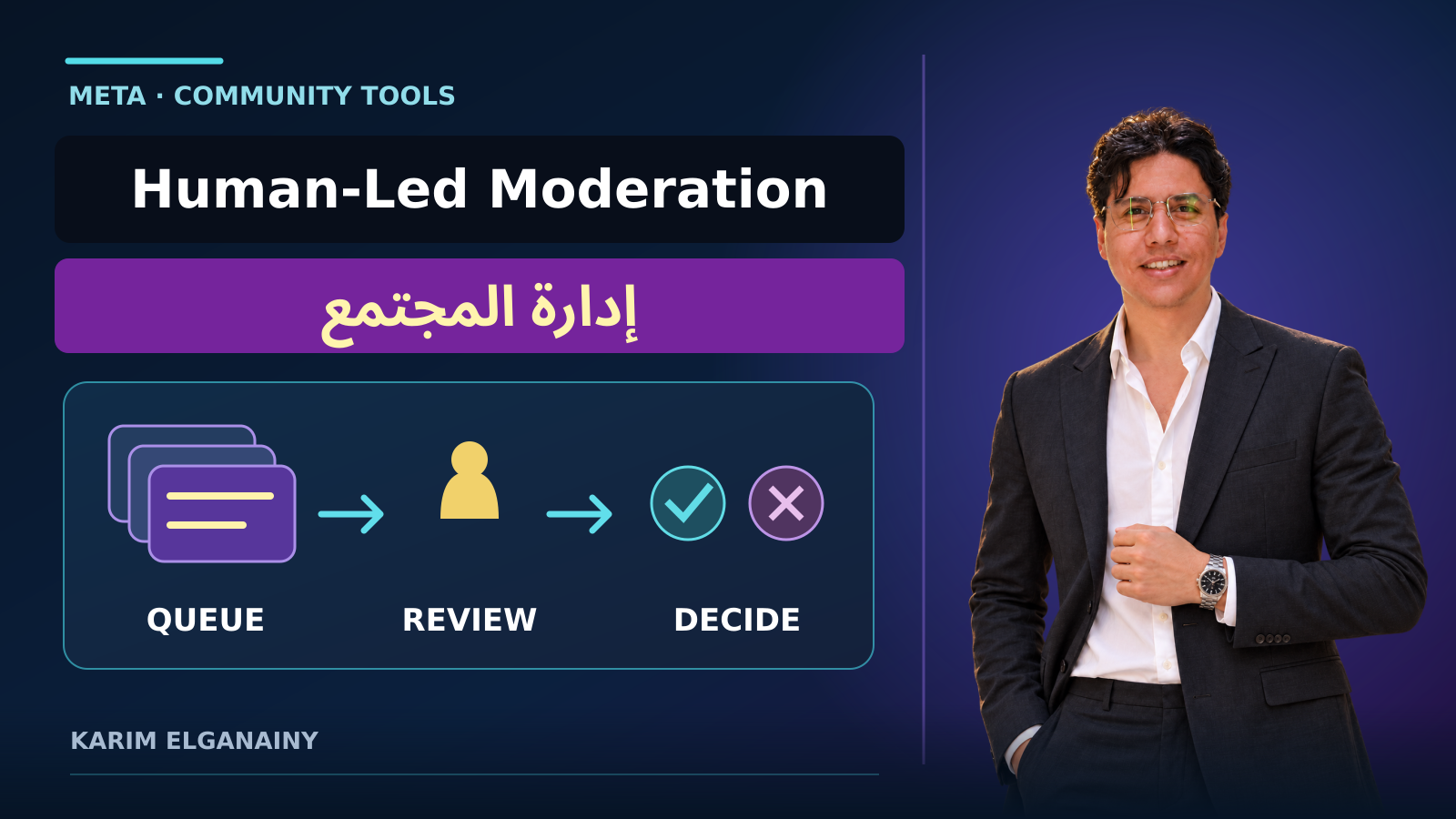
Moderation contains several kinds of work. Some involve organizing information, such as finding unanswered questions. Others involve applying relatively clear rules, such as routing repeated promotions. The most difficult cases require contextual judgment about criticism, sarcasm, disagreement, personal vulnerability or a conflict between longstanding members. Treating these categories identically makes automation harder to supervise.
Create a decision map before changing the workflow. Identify routine items that can be sorted consistently, ambiguous items that need a human decision and sensitive situations that require escalation. Include an owner and a backup for the final category. A tool can make a queue appear manageable while an unresolved sensitive issue remains invisible to the person responsible for it.
Keep review and enforcement distinct. An automated suggestion can help a moderator identify a possible problem without being sufficient grounds for removal. In early testing, compare recommendations with human decisions before allowing broader automated consequences. This protects the team from confusing a confident label with a complete understanding of why someone posted.
Write rules that members and reviewers can use
Vague rules create inconsistent enforcement. A request to remain positive can suppress legitimate complaints, while a request to stay relevant may mean different things to different moderators. Translate broad intentions into observable examples. Explain the difference between a detailed account of a disappointing experience and a personal attack, or between a helpful recommendation and undisclosed promotion.
Include examples near the boundary, not just obvious violations. A member may mention their own company while answering a genuine technical question. Another may repeat a topic because the previous answer was inaccessible or incomplete. These cases reveal whether the rule serves the community's purpose or merely reduces the moderator's workload. Review examples with the people who will actually make decisions.
Rules also need maintenance. When a recurring misunderstanding appears, revise the explanation rather than repeatedly punishing the same confusion. Keep a simple change record with the reason for each meaningful revision. This helps moderators understand why a rule exists and gives members a fair chance to adapt when expectations change.
Audit the decisions you are not seeing
A queue audit should examine both suspected violations and apparently acceptable submissions. Reviewing only flagged content can reveal unnecessary restrictions but miss harmful material that passes through. Take a manageable sample from each category and compare the original context, the proposed action and the final human decision. The sample size should fit the team's actual capacity.
Record the nature of disagreements, not merely their count. Mistaking a quotation for the author's own statement is different from missing a concealed promotion. Misunderstanding a dialect is different from applying a clear rule inconsistently. Useful categories make it easier to improve guidance, adjust the workflow or restrict assistance to tasks where it performs adequately.
Do not publish an accuracy claim from a small convenience sample. Use the exercise to locate operational weaknesses. If the team cannot explain why decisions differ, the safe response is to retain more human review while investigating. Faster throughput does not justify a process that members experience as arbitrary or impossible to challenge.
Protect disagreement and customer criticism
A brand-run community faces an inherent tension: the company wants a useful space, and it may also prefer a flattering one. Establish a separate standard for criticism before a difficult case arises. A factual complaint should not become a moderation violation simply because it is uncomfortable for the brand. Explain where factual correction, customer support and rule enforcement differ.
Consider a hypothetical complaint about a delayed service. The moderator could acknowledge the issue publicly and offer an appropriate private support route without deleting the discussion. If the post contains personal information, the intervention should focus on limiting exposure rather than hiding dissatisfaction. This example is a decision pattern, not a claim about any platform's specific controls.
Create an appeal route that members can realistically use. The person reviewing an appeal should have enough context to reconsider the decision rather than simply repeat the original conclusion. Track recurring reasons for successful appeals. They can reveal that a rule is poorly explained, a reviewer lacks context or a supposedly efficient workflow is imposing hidden costs on members.
Give the calendar an editorial purpose
A shared calendar is most useful when every scheduled item has an intended contribution. Label posts by function: welcoming newcomers, answering a recurring question, inviting experience, announcing an event or collecting feedback. This makes it easier to notice an excess of promotions or a week filled with variations of the same question.
Leave space for member-led discussion. A calendar that fills every available slot can crowd out the conversations the community exists to support. The appropriate rhythm depends on actual participation, moderator capacity and the complexity of the subject. Begin with a cadence the team can sustain, then adjust from observation rather than copying another group's posting frequency.
Editorial ownership still matters when drafting becomes easier. Assign a reviewer to check factual accuracy, tone, permissions and whether the question is worth asking. A polished prompt that no member needs can waste attention. Drafting assistance should help express a useful idea, not create an obligation to publish because a batch of content is ready.
Make corrections visible and useful
Pinned information deserves the same care as an announcement. A highlighted reply may become the first explanation a newcomer reads, even after the original discussion changes. State what the reply clarifies, whether it reflects a temporary situation and where readers should go for current information. Avoid elevating an answer whose certainty exceeds the available evidence.
Assign responsibility for reviewing important corrections. A pinned statement about an event, offer or service limitation can become misleading after its context expires. The review date need not create a complicated process; it simply ensures someone knows when the information should be checked. Important public explanations should not depend on a moderator remembering them by chance.
When a mistake occurs, preserve the distinction between correcting information and rewriting history. Explain the relevant change plainly. Members need to understand what they can rely on now, not read a defensive account of internal approval steps. Transparent correction can support trust, but only when the corrected guidance is itself accurate and easy to find.
Measure useful participation alongside operating effort
Combine member outcomes with workload measures. For outcomes, consider the proportion of substantive questions receiving a useful response, the number of members who return to help others and recurring issues that remain unresolved. For operations, track review time, the age of pending items and the frequency of decisions being reversed. Define each measure before comparing periods.
Interpret the figures together. Shorter review time with more successful appeals could indicate rushed decisions. More unanswered questions might reflect rapid membership growth rather than declining service. A rise in returning contributors could be encouraging, but a small group dominating every conversation may still discourage newcomers. Numbers should direct investigation instead of closing it prematurely.
Avoid attributing every change to a newly introduced feature. Campaigns, seasonality, staffing and a controversial topic can all change participation. Where practical, introduce workflow changes gradually and keep a record of what changed when. The purpose is to make decisions more informed, not manufacture a causal claim that the available observations cannot support.
Apply the lessons carefully in Arabic-speaking communities
Teams serving Arabic-speaking audiences should validate language understanding within their own context. Written Arabic, regional dialects, transliteration and mixed-language posts can communicate meanings that a simplistic rule misses. Assemble examples from authorized material, remove unnecessary personal details and ask reviewers familiar with the community to discuss difficult interpretations.
Do not assume that a translation of an English rule preserves its practical meaning. Terms describing respect, promotional intent or acceptable disagreement can become broader or narrower in translation. Test the rule by asking different moderators to apply it to the same examples. Differences provide a useful starting point for clarification before members experience inconsistent enforcement.
These are transferable management practices, not evidence that the newly announced Forum tools are available in a particular Arab market. Verify access and suitability separately. A team can improve its rules, escalation process and measurement without waiting for a specific product, and it should not reorganize an essential operation around an unverified availability assumption.
Make expansion depend on demonstrated control
Start with a bounded workflow and write down what would justify expanding it. A reasonable condition might combine acceptable review quality, manageable appeal volume and enough time saved to improve member support. Include a condition for narrowing or stopping the experiment if errors affect trust or sensitive cases are mishandled.
The strongest community operation leaves members clearer about how to participate and moderators clearer about how to help. Administrative assistance is valuable when it makes that relationship easier to sustain. The investment decision should therefore consider both the work removed from the queue and the quality of the human judgment that remains.
Sources
Primary announcement and research. Published 24 October 2026. Practical recommendations above are independent analysis, not reported company results.
Comments
No published comments yet.