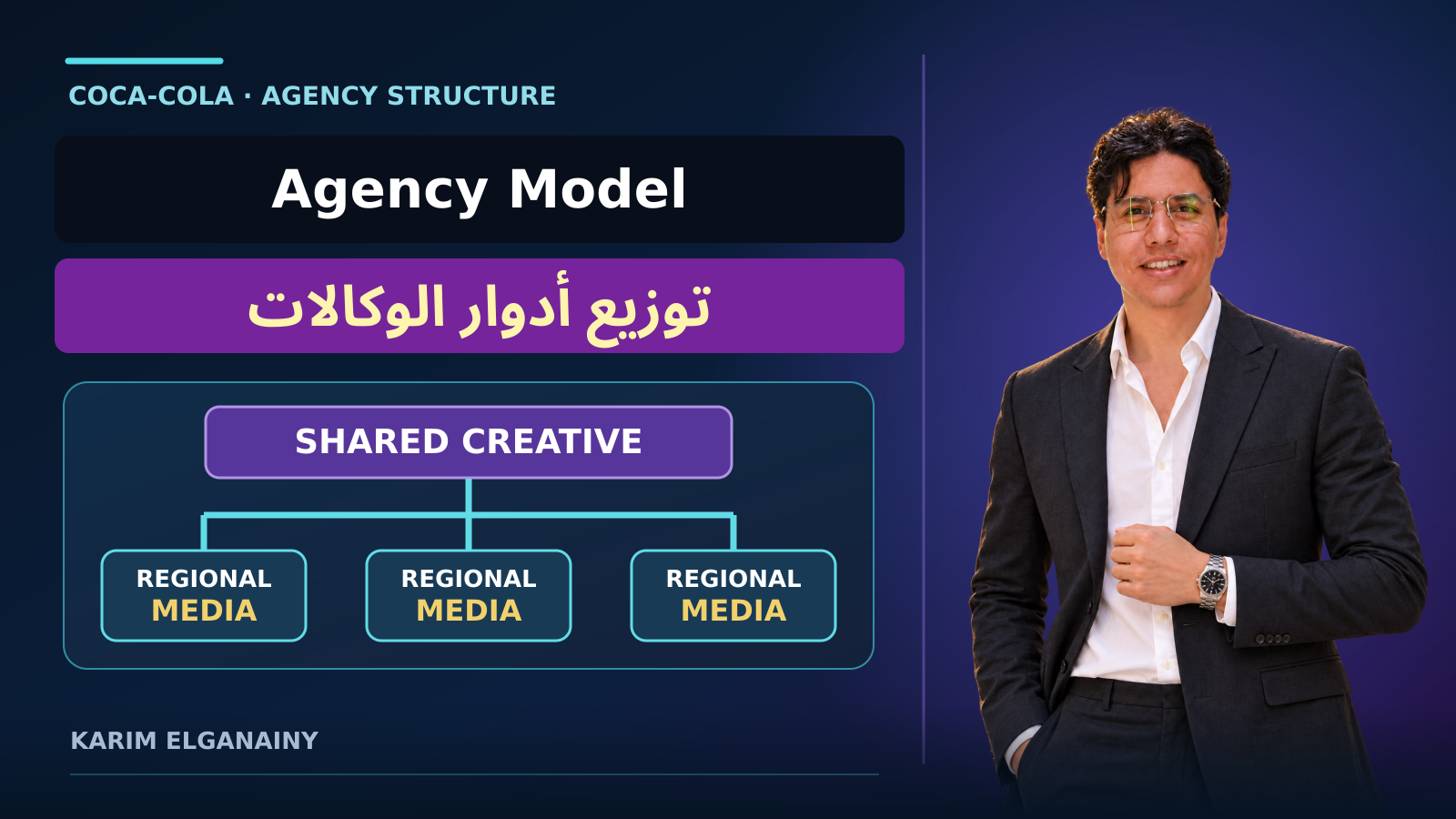
Coca-Cola announced on 22 October 2026 that Omnicom will handle North American media alongside WPP StudioX. WPP Open X retains media elsewhere except Japan and South Korea, where Dentsu continues. WPP remains the global creative partner. Creative and those two Asian markets were outside the review. Implementation begins in phases on 1 December 2026. Official announcement.
The strategic question is how to combine regional expertise with a recognizable global brand without making every campaign dependent on negotiations between partners. The framework below is independent analysis, not a description of the companies’ internal arrangements or a prediction of their results. Its central proposition is testable: specialization creates value only when the benefits exceed the additional cost of coordination.
Separate the decisions before separating the agencies
A useful operating model starts with decisions rather than supplier names. List who defines the customer problem, owns the brand promise, prioritizes markets, selects channels, allocates money, approves adaptations and evaluates results. Assign one accountable owner to each decision. Several teams can contribute evidence, but shared participation should not leave final authority unclear.
Then decide which choices genuinely benefit from central consistency. A recognizable visual identity and a stable product promise may need firm boundaries. Channel selection and buying timing may require regional judgment. This division should follow the business problem rather than organizational tradition. A regional team cannot be responsible for responding quickly if every modest adjustment must travel through a global committee.
Document the exceptions as carefully as the standard process. A legal issue, unavailable product or material price difference may require a local deviation. Define how that deviation is approved, recorded and later reviewed so that an emergency does not silently become permanent fragmentation.
Turn the creative platform into a usable contract
Global creative consistency becomes practical when the central team supplies more than finished campaign files. Regional buyers need the communication objective, intended audience response, protected brand elements, adaptable components and evidence supporting product claims. Those inputs help them judge whether an execution fits an environment rather than merely whether it fits a technical specification.
For a hypothetical video campaign, the protected element might be the product’s distinctive role in a social occasion. The local team could change pacing, language or format while preserving that role. If the adaptation replaces the promise with an unrelated discount message, it should be treated as a strategic change requiring review, not a routine resize.
Create a small set of approved examples and rejected counterexamples. These make boundaries easier to apply than abstract instructions such as “remain premium.” Evaluate whether regional teams can use the guidance without repeatedly requesting interpretation. Confusion is evidence that the creative contract needs improvement.
Establish common definitions before comparing performance
Different partners can produce perfectly accurate reports that cannot be compared. One may count a conversion at order creation, another at payment, and another after returns have been removed. Before consolidating reporting, write a shared measurement dictionary covering the business event, source system, time zone, reporting delay and treatment of cancellations or duplicates.
Campaign naming also deserves explicit rules. Keep identifiers for market, objective, audience hypothesis, creative version and test group. Preserve those identifiers through media systems, destination pages and business reporting where technically and appropriately possible. A naming convention should support a specific decision, not become an elaborate administrative exercise nobody maintains.
Include an owner and effective date for every definition. When a definition changes, show the break in the time series rather than presenting it as performance movement. Retain the prior logic long enough to explain historical comparisons. A dashboard that hides changing definitions can encourage confident decisions based on accounting differences instead of customer behavior.
Design handoffs around acceptance, not file delivery
A handoff is complete when the receiving team can act correctly, not when the sending team uploads a document. Specify the minimum package: approved assets, intended use, rights and expiry information, destination checks, tracking requirements, decision owner and unresolved risks. The receiver should confirm acceptance or identify the missing requirement within an agreed window.
Use a realistic rehearsal before a major campaign. Give the regional media team an actual creative package and ask it to prepare a launch without informal help from the originating team. Record every question, missing file and contradictory instruction. Repair the recurring problems in the package itself instead of creating another standing meeting.
Track the proportion of handoffs accepted first time and the time lost to rework. Pair speed with quality, because a fast approval that releases the wrong asset is not progress. The objective is fewer avoidable interruptions, not more documentation.
Keep access proportional and ownership portable
An integrated workflow does not require every agency to access every dataset. Begin with the decision a partner must make, then identify the minimum information and permissions needed. Separate the ability to view results, edit campaigns, export records and authorize spending. Each capability should have a named business owner and an explicit review point.
Maintain an inventory of accounts, assets, reporting logic and contractual dependencies. Where feasible, ensure the brand can retain its campaign history and essential documentation when a partner changes. Check portability in practice by testing a permitted export and confirming that another authorized operator can interpret it.
Privacy and security reviews should address the actual proposed information flow rather than a broad promise of collaboration. Avoid transferring customer-level information merely because a tool can ingest it. If an aggregate view answers the operational question, additional exposure needs a separate justification and appropriate review.
Separate attribution from causal evidence
Agency evaluation becomes distorted when every partner is rewarded for the sales its preferred model claims. Attribution can help describe recorded journeys and allocate reporting credit, but the organization still needs a separate view of whether activity changed outcomes. Agree which questions are descriptive and which require evidence of incremental impact.
A practical measurement plan can combine delivery checks, customer research and suitable experiments. The exact design depends on available data, geographic comparability, purchase frequency and the scale of the proposed change. Establish those constraints before promising a precise sales contribution for every channel or creative variation.
Where an experiment is feasible, define the intervention, comparison, observation period and decision rule in advance. Where it is not, present the result with its limitations. A regional sales increase alongside a campaign may also reflect distribution, price or seasonal demand. Keep those alternative explanations visible rather than turning a convenient correlation into proof of agency superiority.
Align incentives with the whole customer outcome
Specialist partners should have clear responsibilities without being encouraged to optimize their own scorecards at everyone else’s expense. A media team rewarded only for low acquisition cost may favor familiar customers, while a creative team rewarded only for asset volume may produce work that has little strategic difference.
Use a limited set of shared outcomes alongside role-specific measures. Shared outcomes might include qualified demand or brand consideration where these suit the business question. Operational measures can assess turnaround, accuracy and learning quality. Avoid pretending that each partner controls distribution, pricing or product availability when it does not.
When results disappoint, review the chain of decisions before assigning blame. The aim is to locate a correctable constraint, not to distribute credit through a more sophisticated political negotiation.
Budget the transition as real work
Changing an operating model consumes capacity before it produces evidence of improvement. Estimate the effort for account access, asset migration, taxonomy alignment, reporting reconciliation, training and parallel support. Include the brand’s own staff time. A proposal that prices only the future steady state can conceal a substantial implementation burden.
Use staged readiness gates rather than a ceremonial launch date alone. A first gate could verify access and asset ownership. A second could reconcile a sample of reporting. A third could demonstrate that a representative campaign can move from brief to approval without losing required information. These are suggested controls, not claims about Coca-Cola’s implementation.
Define a recovery path for failures. State which activities can remain temporarily with the existing operator, who can pause a problematic launch and how conflicting data will be investigated. Temporary duplication may be sensible when it protects continuity, but assign an end condition so that two parallel systems do not become the permanent cost of avoiding a decision.
Build a scorecard that can reject the hypothesis
A credible trial must be capable of showing that additional specialization is not worth its complexity. Set a baseline for campaign lead time, first-time approval, reporting consistency and total coordination effort. Add a commercial or brand measure appropriate to the intended benefit. Record how much change would matter operationally before reviewing the results.
Consider a hypothetical pilot involving two comparable campaign cycles. Keep the underlying offer and measurement definitions stable, while introducing the revised handoff and decision process. Compare delays, rework and outcome indicators, noting differences in campaign difficulty. This can establish operational feasibility; it does not automatically prove that the agency structure caused a sales improvement.
Use the findings to choose among expanding, revising or stopping the model. If creative quality improves but approval delays erase the benefit, change approval authority before adding more technology. If reporting remains irreconcilable, pause cross-market rankings until definitions and evidence support a fair comparison.
Apply the principle carefully in MENA
For a company operating across Saudi Arabia, the UAE and other markets, the transferable lesson is a decision framework, not an instruction to copy a multinational agency roster. Start with actual differences in customer needs, language, commercial offers, service capacity and channel economics. Confirm those differences through the company’s own evidence rather than treating an entire region as one audience.
An Arabic adaptation should receive a meaningful creative review, not merely a linguistic sign-off after the media plan is locked. Test whether the wording, visual context and intended action remain coherent together. Give the responsible local reviewer enough authority and lead time to correct a weak idea before expensive production or placement.
Smaller organizations may benefit from one coordinating partner and a limited number of specialists. The relevant comparison is the capability gained against the management burden added. No regional availability, local appointment or country-specific launch is asserted by this analysis.
The management choice behind the agency choice
The most useful output of an agency review is a clearer system of decisions. Who can change the message? Who can challenge the measurement? Who owns the customer outcome when several teams contribute? Written answers make it possible to test whether a new structure is improving work rather than merely rearranging responsibilities.
Before adding another specialist, choose one recurring campaign and trace its complete path. Find the point where information, authority or evidence is lost. Repair that interface, measure the difference and then decide whether broader specialization is justified. This approach keeps the discussion focused on observable improvements instead of the appearance of organizational sophistication.
Source and editorial scope
The Coca-Cola Company, agency partner announcement, 22 October 2026. The opening summarizes the announcement. The operating framework, hypothetical examples and recommendations are original analysis, not reported internal practices, contractual terms or verified performance results.
Comments
No published comments yet.