
What launched in Brazil
Meta’s Brazil announcement presents Achados, an Android app for eligible Marketplace users aged 18 or older. It surfaces new and used offers from Marketplace, Groups and Instagram. A seller can publish to Achados and Marketplace together; buyers can negotiate in the app or WhatsApp, then arrange payment and pickup directly instead of using Meta checkout.
Map discovery and publishing separately
The diagram is an original editorial model, not a screenshot or evidence of a conversion lift. Read the three inputs as ways existing offers can be found. Do not read them backward as a promise that each new listing will be posted to all three surfaces. That distinction matters to the person managing inventory. Before putting time into a listing, identify which system holds the original, who can amend it, and where a change in availability must be reflected. If an item is already reserved elsewhere, remove or clearly mark it before it generates more questions.
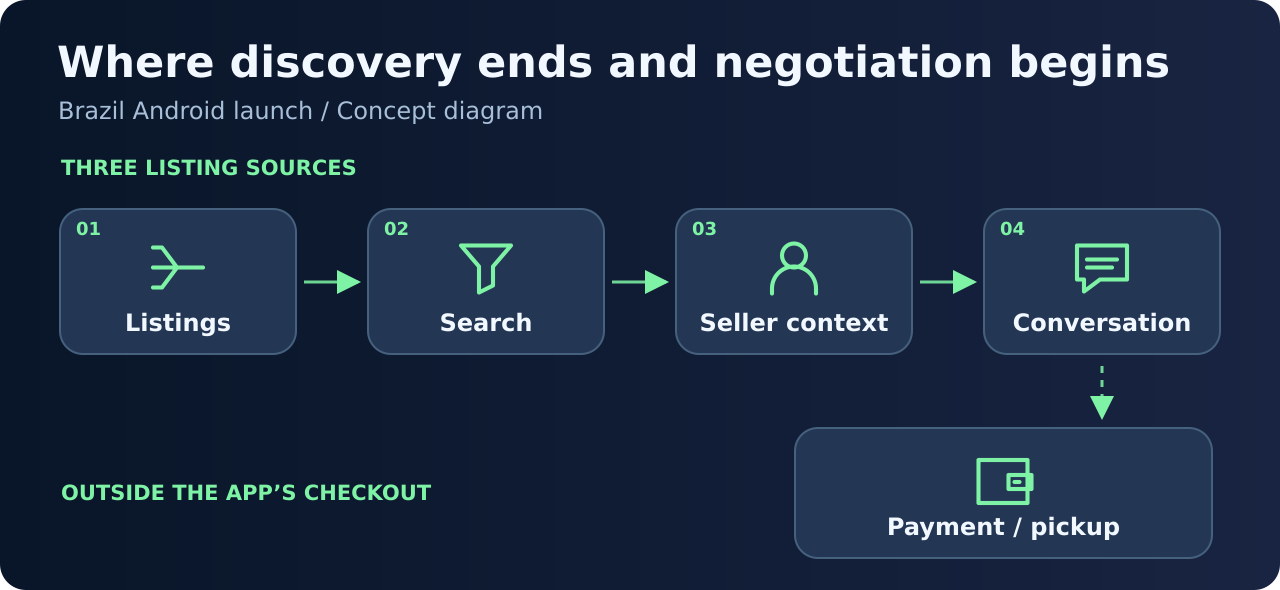
Original illustration for Karim Elganainy’s site: discovery flows inward; the publishing destinations are shown separately from the buyer journey.
Make the offer easy to verify
Imagine a seller listing a used table. A lower headline price only helps a buyer compare if dimensions, condition, pickup area and what is included are clear. Use recent images of the actual table and identify a scratch instead of leaving the buyer to infer its condition. State whether the quoted price includes the chairs. If the listing has a price comparison signal, use it to check comparable listings rather than as proof that the buyer is getting a good deal. A close substitute with a different condition, missing pieces or a distant pickup point can change the real cost.
Treat chat as a place to resolve what the listing cannot establish, not as a substitute for all the essential information. Confirm whether the item is still available, what is included, and the preferred arrangement before either person commits time to a trip. Move from general location to an exact meeting point only when appropriate, and do not collect unrelated details to keep the exchange moving. Document the difference between agreeing to meet and actually handing the item over. An open conversation, a reservation and a completed transfer belong in different fields.
Measure the handoff without inventing sales
For a small pilot, use one consistent product category and a fixed observation window. Count enquiries for active listings, then record how many ask a relevant purchasing question, how many reach an agreed arrangement and how many result in a confirmed handover. Keep missing outcomes as unknown. Do not assign a sale to the discovery screen merely because that was where the buyer first appeared. Another conversation may have shaped the decision, and an off-platform payment does not automatically produce a record you can reconcile with an impression.
Give each listing a short internal reference that follows it through the conversation and collection record. When the title changes or a listing is posted to another eligible destination, the team can still tell whether it is the same table. Photograph the condition at listing time and remove outdated measurements if a listing is reused for a different product. If a staff member takes over the conversation, they should see the current promise and the awaiting decision without asking the buyer to repeat their history.
Look for repeated breakdowns before buying more reach or changing the price. If buyers keep asking whether the chairs are included, clarify the listing. If people agree to buy but cannot get to the pickup area, test a more practical handoff rather than reporting a demand problem. Decide what result will justify the next small test and who owns the correction. These are practical checks for the announced Brazilian release, not assumptions about availability in Saudi Arabia or proof that every seller will gain sales.
Set up an inventory record before expanding discovery
Create a record for the individual item, not just the general model. A merchant with several tables of the same size should be able to tell which photo, defect and collection promise belong to each one. Save the original listing reference and any matching references on other destinations. Give the same person ownership of availability and the ability to correct a mistaken description. If an item is reserved until a certain time, record the boundary and what will happen when the time passes. Avoid quietly substituting a different table when the promised one is no longer available. An alternative should be presented as a new offer, with its own price and condition, not treated as fulfillment of the old promise.
Run a small check before adopting a repeated publishing routine. Choose a sample item and verify which original listings can be found, which details appear to a prospective buyer, and how a change in stock is shown. Use a clean buyer view without exposing another person's personal information. Note the time of the seller update and the time each destination reflects it. An update that appears in one view but not another is a discrepancy to investigate, not a basis for guessing how fast every listing synchronizes. If the team cannot tell which version governs, identify an authoritative record and temporarily avoid repeating the same offer elsewhere. Keep the sole seller record independent of any listing's position in search.
Make pickup a visible part of the value proposition
The hypothetical seller can evaluate two versions of the same offer description. The first describes an attractive table but leaves the collection conditions until chat. The second says whether the legs come off, whether the buyer needs to arrange help, and which collection times the seller can actually honor. Keep the price and table unchanged if the purpose is to learn whether clearer collection information changes the quality of enquiries. Have someone unfamiliar with the item attempt to plan collection from the listing alone. Record questions that remain unanswered instead of smoothing the walkthrough by supplying facts the real buyer would not see. This checks comprehension; it does not by itself show that one description sells more tables.
Another buyer might ask for the table and chairs as a bundle with a different pickup time. Record the changed items, price and timing together so both sides can recognize the same proposal. If a second buyer appears, do not count two potential purchases against the same unit of stock. Keep a single reservation status and make the response clear to both conversations without exposing the other person's identity. If an agreement falls through, distinguish whether the person declined the price, could not arrange collection, or simply did not reply. The last case remains unknown rather than being quietly counted as rejection of price. Where a genuine safety concern arises, stop the arrangement and use the platform's appropriate support or reporting route rather than pressing ahead for the sake of a metric.
Define the denominator before evaluating results
Start with distinct enquiry threads about eligible listings during a predefined period. Repeated messages in one thread are not independent enquiries. Separate operational measures by their question: qualified threads per eligible thread, arrangements per qualified thread, and handovers per recorded arrangement with a resolved status. Publish the unresolved count next to that last ratio. A sale that cannot be confirmed is neither automatically a completed handover nor a known failure. If staff mark only successful pickups, the resolved subset will be misleading; either improve follow-up or report the missing evidence clearly. Document which team checks the status, how long they wait, and which corrections may alter previously reported totals. Do not drag the evaluation window forward until you get a result that looks favorable.
Consider why a seemingly stronger result might not travel. An active listing with a flexible schedule may have more chances for pickup even when the description offers no advantage. A weekend may change response times and the number of potential buyers available. A single seller can also handle more conversations before lunch than after work. Distinguish these circumstances from the listing approach itself before concluding that one change caused the commercial difference. Separate comparisons for similar products and collection environments can clarify what needs further testing. If closely matched opportunities are scarce, use the result to identify the friction and improve the workflow, not to predict a return on spending or declare a strategy proven in another country.
Choose the least costly correction that fits the evidence
Before ending the pilot, review the cases that actually consumed time. If the item was already gone when chats began, fix status ownership before testing price cues. If uncertainty about dimensions generates long threads, add a picture with a reliable measurement and clarify whether the legs can be removed. If people agree on an item but misunderstand what happens at collection, test a concise checklist for the handoff. Give each correction a named owner and a date on which someone will review it under the same criteria. Continue a small test only when you can say what observation would justify expansion, another revision or a stop. This protects a small seller from spending more simply because a dashboard showed more activity.
Close with a note the next person can reproduce: the eligible items, comparison period, handling of duplicate conversations and rule for confirming completion. Add what the test could not observe, including negotiations that moved outside the initial thread. Do not copy chat histories into a broad team report or use contact details as a substitute for resolving measurement gaps. A small set of aggregated observations and a documented correction can be more useful than a comprehensive-looking list of unverified transactions. The practical goal is not to turn every discovery opportunity into a sale; it is to recognize where the current offer helps a buyer decide and where the handoff breaks.
In the closing handoff review, make each outcome traceable to its evidence rather than asking staff how many sales they remember. A buyer confirming receipt can support a completed transfer; a seller seeing a read receipt cannot. Where the shop needs a record for a separate operational reason, keep it in the appropriate system and report only the status in the test table. Compare the count against the number of individual pieces available during the observation period. An apparent result greater than available inventory is a prompt to check duplicate records, not a sign of unusually strong performance.
Comments
No published comments yet.