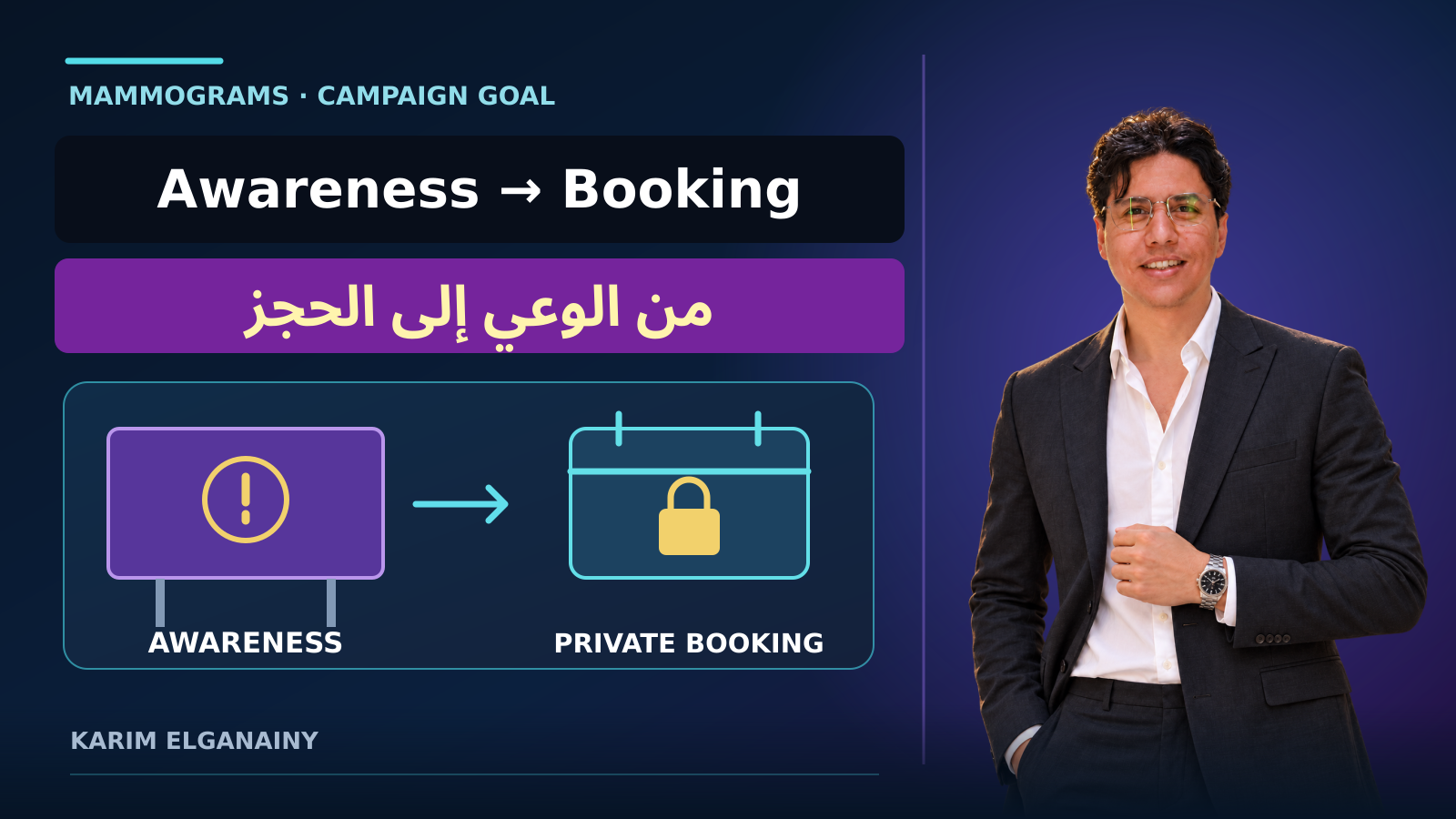
The news is a campaign, not an outcome report
Clear Channel Outdoor and OUTFRONT announced on October 23, 2026 a US digital billboard campaign for the Million Mammograms initiative, running throughout October. The stated ambition is one million mammograms by 2028, not an achieved result. The announcement does not establish measured screening impact. Primary announcement.
The useful marketing question is what happens between public attention and a private next step. The framework below is independent editorial analysis, not a description of this campaign’s undisclosed operations or results. It concerns communication design, service readiness and responsible measurement. It does not recommend an individual screening schedule; personal medical decisions belong with appropriately qualified healthcare professionals.
Treat the billboard as a beginning
An outdoor message has limited time to establish relevance. Its job should be clear enough to understand without reading a dense explanation or immediately interacting with a device. A strong public-facing proposition can create recognition and make later information seeking easier. It cannot, by itself, resolve every practical or personal question involved in accessing healthcare.
Design the next step around the circumstances of viewing. A person passing a road display should not need to scan a code or type a link while driving. A memorable destination or recognizable campaign name can support later action, when it is safe and convenient. Different placements may permit different interactions, but the design should never depend on unsafe behavior.
Start the brief with a simple chain: notice, remember, find reliable information, choose whether to continue. Each transition can fail for a different reason. The message might be memorable while the destination is confusing, or the destination might be clear while the service is unavailable. Separating these stages makes the campaign easier to improve without blaming everything on creative performance.
Offer a private route by default
Public solidarity and private action are not the same thing. A person may welcome a campaign’s message without wanting to disclose an appointment, a concern or a health-related decision to friends, colleagues or a public platform. The design should make meaningful participation possible without public disclosure. That principle applies even when voluntary sharing is part of a campaign’s wider communication idea.
A practical landing experience could offer reliable information and a route to an appropriate service without first requiring a social post. If a sharing option is included, keep it separate, clearly optional and understandable before someone uses it. Do not imply that sharing personal details is necessary to support the cause or to access the next step.
Consider the surrounding copy as carefully as the button. Language that praises openness can unintentionally make privacy feel like reluctance or failure. A respectful journey makes room for different circumstances, including uncertainty and a decision not to continue immediately. The marketer’s task is to remove avoidable friction, not to manufacture emotional pressure around a private health choice.
Map the service before buying attention
A campaign can generate interest faster than a service can absorb it. Before planning reach, map what happens after an inquiry: where the person is directed, what information is needed, who answers questions and how availability is communicated. This is an operational readiness exercise, not a promise that every interested person should receive the same service or appointment pathway.
Check whether the destination explains its scope. People should know whether they are contacting a general information service, a healthcare provider or a booking platform. They should also understand which organization is responsible for the next step. A reassuring advertisement loses credibility if its destination changes identity, purpose or expectations without explanation.
Use a small readiness test with staff before public launch. Ask someone unfamiliar with the process to follow the route, describe what they think will happen and identify confusing points. Test accessibility, mobile readability and error messages. Document problems and assign owners. This method can reveal preventable friction without collecting any patient information or claiming clinical effectiveness.
Minimize information at the first interaction
A marketing landing page rarely needs a detailed health history to explain a campaign or direct a person to an appropriate service. Keep the information request proportionate to the immediate task. If a later clinical interaction needs more detail, move that interaction into the responsible provider’s suitable process rather than extending an advertising form into a makeshift medical record.
Separate campaign analytics from clinical systems in both design and access. A marketing team may need aggregate counts of visits or successful handoffs, but that does not mean it needs appointment reasons or personal medical details. Make the intended data flow visible to the relevant privacy and compliance reviewers before collecting information, not after a dashboard has already been built.
Avoid assuming that removing a name makes every dataset safe. Small groups, precise locations and unusual combinations of attributes can still expose people. Use aggregation, access limits and suitable suppression rules where needed. These are proposed design safeguards, not claims about the campaign’s implementation or a substitute for jurisdiction-specific professional review.
Distinguish consent from campaign enthusiasm
Someone choosing to read information has not automatically agreed to receive marketing follow-ups. Someone requesting assistance has not necessarily agreed to be featured in a story. Keep each purpose clear and make any optional choice genuinely optional. Consent language should be understandable at the point of decision, rather than hidden behind a general statement that few readers will interpret correctly.
For a campaign follow-up, specify what the person will receive, from whom and through which channel. Avoid preselected choices that make refusal difficult to notice. Provide a practical way to stop optional communications. The objective is a relationship the person understands, not a larger contact list produced by ambiguity.
Do not use an individual’s health-related action as a shortcut to public persuasion. A compelling personal story needs appropriate permission for its actual use, distribution and duration. An editorial article discussing a campaign can use original explanatory artwork instead of reproducing a patient photograph. Visual relevance does not override the person’s dignity or the rights attached to the image.
Build a measurement ladder without false equivalence
Start with delivery evidence: whether the agreed placements ran and whether the destination functioned. Then examine communication evidence, such as aggregate recall research or information seeking. Next consider operational evidence, such as completed handoffs or booking requests where appropriately available. These are different categories of evidence, not interchangeable versions of the same outcome.
A completed form is not automatically a completed appointment. An appointment is not automatically evidence of a health outcome. An increase during a campaign is not automatically an increase caused by the campaign. Writing those distinctions into the reporting plan protects everyone from pressure to turn the most accessible metric into the most impressive claim.
Use an explicit claim register. For each proposed statement, record the supporting measure, its limitations and the person responsible for approval. A claim about delivery may be well supported even when a claim about incremental behavior is not. That is a legitimate result. Accurate reporting should reward clarity rather than force every campaign to announce a dramatic outcome.
Test incrementality at an appropriate level
If the goal is to understand additional action attributable to advertising, plan the comparison before launch. One possible approach is an aggregate geographic test with comparable areas and clearly documented timing. Another may be a phased rollout. Neither design is automatically valid; the choice depends on available scale, service coverage and the ability to distinguish the campaign from other changes.
Record plausible competing explanations. Seasonal interest, local events, other publicity, service capacity and changes to the booking process can affect observed activity. A credible analysis asks whether those factors differ between the comparison groups or periods. It also acknowledges spillover when people move between areas or encounter the message through other channels.
Avoid promising precision that the test cannot support. If the sample is too small or the conditions too unstable, report the limits and use the work as a feasibility study. Useful learning might identify a broken handoff or a clearer message rather than establish an incremental effect. A modest valid conclusion is more useful than a confident number built on weak assumptions.
Use a hypothetical dashboard to clarify decisions
Imagine a local awareness program with four reporting blocks: delivery reliability, destination usability, aggregate service handoffs and operational capacity. The delivery block informs whether the media agreement was fulfilled. Usability reveals friction on the information route. Handoffs show whether people chose to continue. Capacity indicates whether the service can respond appropriately to the interest generated.
The blocks should not be added together into a synthetic success score. Each answers a different management question. If visits rise but handoffs fall, investigate clarity and relevance before simply purchasing more reach. If handoffs rise while response times deteriorate, address the operational bottleneck before expanding the campaign. These are illustrative decision rules, not observed findings from the announced initiative.
Include a short uncertainty note beside the numbers. State missing coverage, changes in definitions and known delays in reporting. Restrict access to anything beyond aggregate information according to genuine operational need. A dashboard is a decision tool, not a justification for collecting every available signal about an individual.
Adapt the workflow, not the medical message
A team in Saudi Arabia or the UAE can learn from the communication problem without importing a US campaign’s assumptions. Verify local service pathways, language needs, review requirements and the organizations responsible for answering questions. Adaptation should begin with the actual journey people can use, not with copying a slogan and replacing the logo.
Develop Arabic and English explanations around equivalent meaning and clear choices. Check that both versions state the destination’s role and the optional nature of any sharing. Test the mobile experience in both directions of reading. A technically translated page can still fail if the form labels, confirmation messages or assistance routes are unclear.
Keep clinical recommendations under appropriate professional oversight. A marketing team should not improvise an age threshold or examination frequency to make the call to action simpler. When individualized guidance is needed, direct people toward qualified care rather than presenting a universal instruction as a creative convenience. The boundary protects the audience and improves the credibility of the communication.
Define success before the next awareness moment
A responsible campaign brief can be concise: the intended audience, the communication objective, the private next step, service ownership, data boundaries and the evidence needed for each claim. Add a clear escalation route for inaccurate information or an unavailable service. These details make the campaign operationally serious without requiring an elaborate technology stack.
After launch, review what people encountered rather than only what the media plan delivered. Were the choices understandable? Could someone continue privately? Did the responsible service receive usable requests? Which conclusions are supported, and which remain uncertain? Those questions connect a public message to a respectful experience without overstating medical or behavioral impact.
The strongest lesson is not that a large footprint guarantees action. It is that attention creates a responsibility to design the next step carefully. Public awareness can be valuable, but its value should be assessed through proportionate evidence, practical service readiness and respect for personal choice. A campaign earns credibility when it treats those requirements as part of the work, not as qualifications added after the headline.
Source and editorial scope
Primary company announcement, October 23, 2026. Published October 24, 2026. The opening summarizes the announcement; the frameworks, examples and recommendations are independent editorial analysis. They do not claim access to undisclosed operations or results.
Comments
No published comments yet.