
What the research describes
LinkedIn’s B2B Institute Buyability research uses three dimensions: discoverable, credible and winnable. Its preview cites Dreamdata and Webflow’s LinkedIn Ads 2026 Benchmarks for an average of 22 stakeholders with influence: 13 internal and 9 external. Influence is not approval authority, and the figure is not a target for every market.
Give the buyer evidence to carry into the room
This article proposes an original operating method, not a reconstruction of LinkedIn’s research or a guarantee of win rate. Imagine a business evaluating inventory software. The buyer may like the demonstration but still need to explain the work split to operations, the cost range to finance and the account permissions to IT. A broadly appealing sales deck can leave all three questions unanswered. A smaller packet is more valuable if the people assessing it know which claim applies, what supports it, and who can clarify gaps without making them restart the conversation.
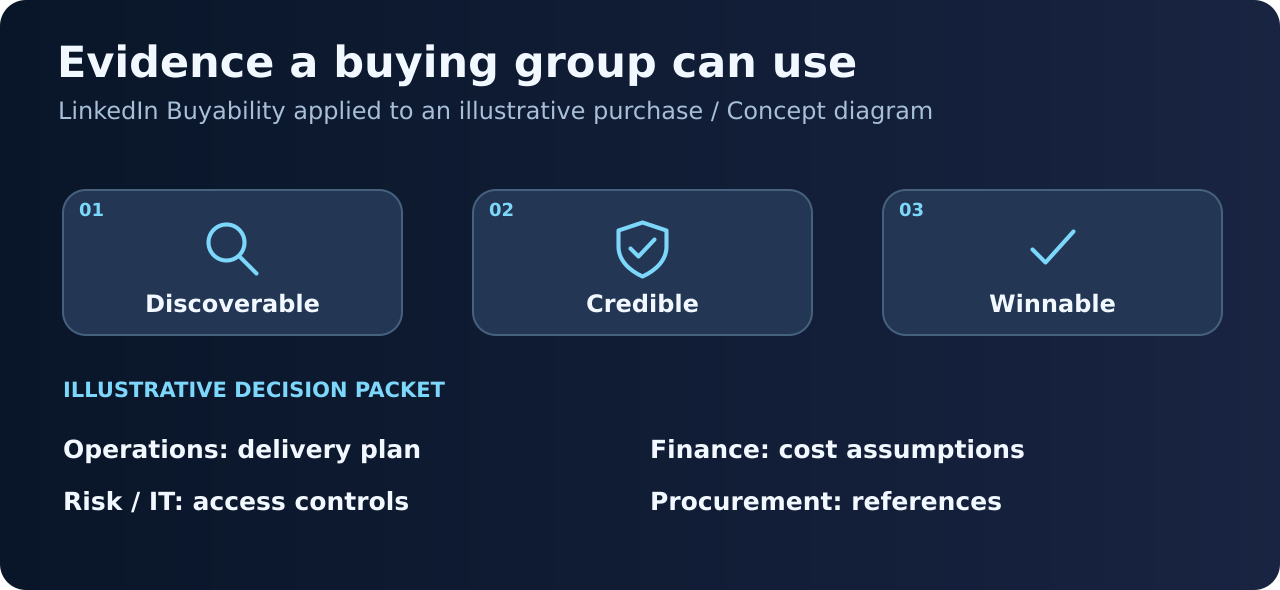
Original illustration for Karim Elganainy’s site: a committee proof matrix for an illustrative software purchase, not a LinkedIn research graphic.
Match the proof to an actual decision
Start by mapping the buying team’s work rather than filling a slide for every job title. Operations needs a credible implementation plan: give the named owners, the sequence to validate and what happens when records fail to match. Finance wants assumptions that can be questioned: show the purchase and implementation costs separately, identify recurring charges and distinguish an estimate from a quote. Risk or IT may need to see that a permission is limited to the necessary account; propose evidence of its scope, not an unsupported statement that everything is secure. Procurement can check whether a reference is comparable and available to contact with permission.
Put a one-page internal case at the front. Begin with the decision sought, the alternatives and the reason to evaluate them now. Under discoverable, make the right document easy to find: use clear names and a visible version date. Under credible, tag claims with a source, owner and limits. Under winnable, give the buyer a usable comparison and a next step with an exit option. The last category is not a promise that better packaging can compensate for poor economics, unavailable support or a genuine mismatch.
Test whether the packet travels
Ask a colleague who did not attend the meeting to use the packet and explain which costs are firm, what the first implementation step requires and which risks remain open. Observe where they must ask for help, rather than coaching them through it. In an actual evaluation, ask whether an authorized contact can share controlled documents with the right colleagues instead of treating successful forwarding as unlimited permission. Remove customer contact details that are unnecessary for the case.
Retire a document when it goes stale, rather than leaving two authoritative versions side by side. Put the current version, owner and review date on the internal case. For example, if implementation changes from a single warehouse to multiple sites, update the staffing estimate and explain which permissions or assumptions need a new review. That makes the comparison useful to a reviewer who enters late and protects the buyer from being asked to defend a figure that no longer applies.
Keep the scorecard simple: time to find the relevant document, unresolved blocking questions, and whether the reviewer can accurately summarize the tradeoff. Record hesitation honestly. If buying it still requires extra work the business cannot afford, a credible packet should make that clear, not imply that an expensive alternative automatically wins. The research motivates asking how suppliers become easier to evaluate; it does not establish a local win-rate benchmark or show that price is irrelevant.
Build a record rather than accumulating slides
Put each claim in a short evidence register. Record the reader it serves, the decision it informs, who supplied it, the environment where it was checked and when it should be reviewed. Then distinguish an illustration, a demonstration, a contractual commitment and a third-party observation. For example, a demonstration of a reconciliation workflow can show what the interface does with a sample file, but it does not show how quickly a buyer's staff can handle its own exceptions. An implementation estimate may help compare plans without becoming a promise to deliver on a particular date. The register should tell reviewers what they can rely on today without suggesting every statement carries the same weight.
Do the same for an important claim you cannot support yet. Say what is missing and how the buying team can get an answer. If a new warehouse depends on a different stock format, list that constraint and the limited trial that would answer the question. An unresolved line in a decision packet is not something to hide beneath attractive design. It is a decision dependency that should have an owner and a deadline. Treat a request to omit it as a sign that the proposed case needs work. The aim is to let a customer make a sound decision, including deciding not to move ahead when the available proof does not support the change.
Walk through the hypothetical warehouse purchase
Ask operations to select a normal reconciliation and a case with a missing field. Agree who marks each case complete, which record has final authority, and which staff time is assumed. A demonstration which succeeds on the normal case but needs manual handling on the exception may still be useful. Record the additional work and establish whether it is occasional or part of the usual shift. The buyer should be able to distinguish a fix already shown from a feature on the supplier's roadmap. When two vendors handle the exception differently, describe the difference in staffing and observable outcomes rather than scoring whichever interface looked more polished.
Give finance a comparable view of both vendor options and the option of keeping the current process. Put licensing, implementation, training and ongoing administration in distinct rows. Clarify what is included in a quote and what the buyer must estimate based on its own workload. An inexpensive option can become less attractive if its recurring manual work is material; a higher-priced option can also remain a poor choice even with an excellent buying packet. Run a simple assumption check: if the site count increases, ask whether charges, effort and risk change together. Do not present a hypothetical scenario as a return already earned or claim the research demonstrated which vendor would win.
Show review boundaries and preserve the decision trail
Give IT or risk a small inventory of the access requested to run the trial and the person who can revoke it. If a capability cannot be assessed without a customer environment, show the limitation and agree on a synthetic or authorized test rather than assuming permission to transfer records. In a useful buying packet each fact has enough context to be checked without including unrelated data. For procurement, describe a reference by its relevant similarities and differences before suggesting a conversation. Give contact details only with permission, and avoid publishing customer names merely because they appeared in prior sales material.
Map the actual people through a limited stakeholder register. A direct user may shape requirements without approving spend. An external consultant may question a plan but not sign an agreement. An approver may be absent from the early discovery meetings. Ask who resolves disagreements, what approvals are required, and who must be informed rather than assigning voting power from their title. Mark unknown roles as unknown until the account clarifies them. Use the cited research figures to remember that influence can be distributed, not to invent participants or create a fixed template of approvals for every country, business size or purchase.
Evaluate the packet without confusing readability with impact
Define one tidy observation window and relevant review sessions, then separate document access from evidence of comprehension. For instance, count completed reviewer tasks on the reviews in scope, such as correctly identifying a cost exclusion or locating the applicable permission list. Next, count unresolved blockers at the end of the review and whether each has a named owner. A document viewed many times may be unclear rather than persuasive. A small number of observed tasks is useful for finding friction, not for claiming a change in win rate. If an early group differs from a later group in budget or urgency, mention it and avoid comparing raw closed-deal proportions as if the packet were the sole explanation.
Before wrapping up, decide how to respond to what you learned. If reviewers repeatedly find the wrong document, repair navigation and version labels rather than adding more content. If they locate the correct file but cannot tell which cost assumptions apply, fix the evidence. If a real business constraint still rules out the offer, tell the buyer directly rather than trying to frame the constraint away. Preserve the original task, decision, responsible person and conditions for reconsidering it. A packet that helps buyers rule out an unsuitable offer can be operating as intended, even when it does not produce a sale. Use the next test to examine the smallest unresolved issue before expanding the approach.
For a useful internal simulation, give the packet to a colleague with a limited set of instructions and no background from the sales call. Ask them to prepare the first approval conversation. Their task is to name the next decision, identify a cost they can defend and point to a risk the packet leaves open. Keep the checklist focused on observable facts. If they misstate the scope or repeat a demonstration as though it were a commitment, note where misleading wording entered the handoff. Save the test packet and the revised one separately. This is a test of whether claims travel accurately between readers, not whether a colleague is impressed by the vendor. A packet that needs the original presenter to interpret every line is not yet ready for internal circulation.
A stronger comparison changes the packet while holding the underlying proposal stable. If pricing, service scope and review roles all change at once, a faster review provides little evidence about the document itself. Start with the single correction that removes the greatest evidenced confusion. Record the unchanged conditions and ask the next reviewer the same question. If the case later progresses, resist assigning the win to this one intervention without a credible comparison. The immediate value is a better-informed approval discussion, even if the final decision is to stay with the current supplier.
Comments
No published comments yet.