
Read the announcement without purchasing its conclusion
BoomerangFX’s 2026-11-17 announcement describes November rollout in USA/Canada/UK. ChatGPT activation depends on market, specialty and approval; Claude/Gemini determine organic inclusion and rank. Paid placements remain separate from answers. This is vendor news, not OpenAI endorsement or evidence of Saudi availability.
My practical response is to separate the buying decision from the excitement of a new discovery channel. A clinic should ask which operational problem it intends to solve before asking how quickly it can activate an account. Is the problem unclear service information, slow responses, unsuitable inquiries, or appointments that cannot be delivered? These are different problems with different owners. A marketing interface may make activity easier to initiate while leaving the underlying service bottleneck untouched. The evaluation therefore starts with a written problem statement and a visible boundary around the proposed work.
The analysis below is an independent operating framework, not a description of verified product functionality. It does not establish treatment suitability, local legal permission, integration compatibility, or commercial results. A clinic evaluating any vendor can use it to request evidence, allocate responsibility and design a bounded experiment. The useful question is not whether an impressive demonstration can produce a booking. It is whether the clinic can trace the right inquiry through an accountable process without misrepresenting what the service can deliver or why the person contacted it.
Build an evidence file before building a campaign
Create a short decision file that distinguishes an observed capability from a planned capability and from an unanswered question. For each requested function, record what was demonstrated, the environment in which it worked, the person who checked it and the limits of that observation. A screen recording of a demonstration is not proof that the clinic's own account has equivalent permissions. Ask for an acceptance test using nonpersonal sample information before treating a proposed connection as operational. Keep the test narrow enough that failure points can be understood and repeated.
The file should also describe the commercial commitment in plain language. Separate setup work, continuing service, media spending, optional components and the work that the clinic must perform itself. Record who owns the website content, reporting exports and campaign history, and what can be retrieved when the relationship ends. These are procurement questions to resolve with the provider, not claims about this announcement. A team should not discover during a cancellation discussion that the evidence required to assess the experiment is unavailable or costly to extract.
Finally, give every uncertainty an owner and a next action. A field marked pending should not quietly become approved because the deadline approaches. If eligibility is unresolved, keep activation out of the launch plan. If measurement is incomplete, treat the activity as a limited observation rather than a reliable performance comparison. This approach does not require a large procurement department. A small clinic can maintain a simple shared record, provided the record identifies decisions, preserves supporting evidence and distinguishes explicit approval from a person merely receiving a message.
Separate discovery, inquiry and clinical judgment
A useful campaign asks a prospective visitor to take an understandable next step, not to accept a clinical conclusion. Review the transition from the public message to the destination page and then to the inquiry form. The same service description should remain recognizable across all three. If an advertisement emphasizes a consultation, the destination should not unexpectedly present a guaranteed outcome or an unrelated purchase. An operational reviewer can check this continuity without pretending to make a medical assessment. Clinical claims require appropriately qualified review rather than marketing enthusiasm.
For the initial test, define a small set of administrative questions that staff can answer consistently: location, opening arrangements, consultation process and how to request contact. Keep questions requiring individual clinical judgment outside the automated marketing workflow. Do not use a submitted concern as evidence that a particular treatment should be promoted to that person. The proposed boundary is intentionally conservative. It gives the clinic a way to evaluate the handoff while preserving a clear distinction between general service information and a professional assessment of an individual situation.
Write a handoff rule that a receptionist can actually use. It should identify who receives an exception, what information is necessary and what response should be sent while the matter is pending. A generic instruction to escalate is insufficient if nobody is available to receive the request. Test the rule during the hours when the campaign is expected to create inquiries. If a human response is unavailable, explain the next step honestly instead of allowing a visitor to mistake an acknowledgment for a completed review or confirmed appointment.
Design the handoff as a visible chain of responsibility
The original diagram separates paid search from organic information, then brings both to eligibility and market rules, inquiry review and a valid booking. This is a proposed management checklist, not a product diagram. A connection in the drawing does not establish that a visitor is eligible, that a channel is available or that a booking has occurred. Staff must verify each transition against actual circumstances. Keeping the discovery paths distinct prevents a paid placement from being presented as an organic recommendation, while the later checkpoints make responsibility for responding and checking the result visible.
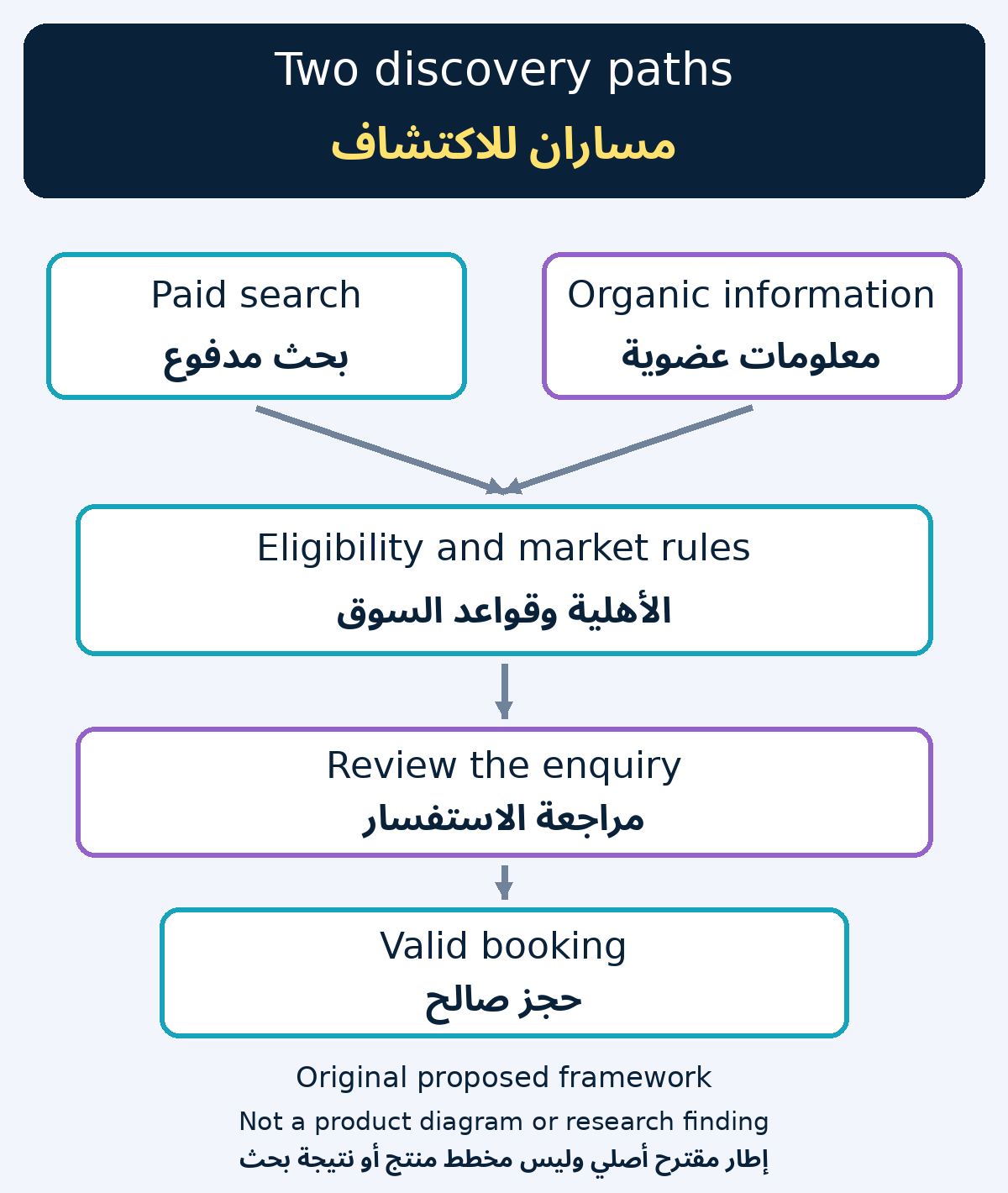
Original explanatory framework by Karim Elganainy, not a product screenshot or performance result. News context: the vendor announcement.
For each transition, nominate a responsible role and a fallback. A marketing operator might check the approved message while a scheduling coordinator verifies actual availability. The roles need not belong to different employees, but their decisions should remain distinguishable. Record the version of the offer that was visible when the inquiry arrived. Otherwise, a later change to a page can make an earlier conversation difficult to interpret. Avoid turning this traceability exercise into a collection of unnecessary personal details; the operating question is what happened, not how much information can be stored.
A rehearsal should include incomplete requests, duplicate inquiries, a changed appointment slot and a visitor who no longer wants contact. These are proposed test cases, not reported failures of any vendor. Ask whether the workflow produces an understandable status for each case and whether someone can correct an error without reconstructing an entire conversation. The aim is not to demonstrate an uninterrupted happy path. It is to discover which exceptions the clinic can handle reliably before a paid experiment increases the number of people encountering those exceptions.
Measure comparable inquiries rather than attractive totals
Define the measurement unit before reviewing a dashboard. An inquiry, a person, an appointment request and an attended consultation are not interchangeable. A person may submit several messages or change an appointment without creating new demand. A practical tracking specification should state how duplicate events are handled, which observation window is used and what qualifies as a completed next step. Keep this specification stable during the initial comparison. If it changes, show the change openly rather than presenting the old and new totals as if they were directly comparable.
Consider a hypothetical exercise with 100 inquiries, 40 appointment requests and 30 attended consultations. The inquiry-to-request rate is 40%, and attendance among requests is 75%. Attendance relative to all inquiries is 30%. These figures describe different denominators; none is a treatment outcome or proof of incremental demand. If 10 requests remain pending, the team must preserve that status rather than classify every unfinished case as a failure. Record when each cohort becomes mature enough for comparison, and do not compare a newly opened cohort with one that has had more time to progress.
Cost reporting needs an equally clear boundary. In this hypothetical exercise, media spending of 3000 and operating work costing 1500 produce a limited measured cost of 4500, expressed in the same selected currency. Dividing 4500 by 30 attended consultations gives 150 per attendance. This is not profit, patient lifetime value or a complete service cost. The exercise excludes other costs unless explicitly added. Its purpose is to make the denominator and cost scope visible, so a team does not celebrate a cheaper inquiry while ignoring additional handling work or a weaker downstream experience.
Run a bounded experiment with a credible comparison
Choose a question that the experiment can realistically answer. For example, can the revised inquiry process reduce unresolved administrative requests without increasing incorrect bookings? That is more testable than asking whether an entire technology category transforms clinic growth. Define what remains unchanged, which cases are eligible and who can stop the test. Keep the initial scope small enough that staff can inspect individual exceptions. A bounded experiment is not merely a smaller spending limit; it is an arrangement in which responsibilities, definitions and recovery actions are understood before activity begins.
A comparison should account for changes in the offer, operating hours, staffing and available appointments. If these change alongside the campaign, report them as alternative explanations rather than hiding them in a footnote. A simple before-and-after difference does not by itself identify the cause. Where a credible comparison group is feasible and appropriately reviewed, define it in advance. Where it is not feasible, describe the result as an operational observation. Honest language protects the next decision from being built on a stronger claim than the evidence can support.
Agree on pause conditions before reviewing favorable numbers. Stop when the destination misstates the service, when requests cannot be routed responsibly, when the agreed budget is reached or when essential measurement breaks. A pause is not a verdict on the vendor; it is a way to limit uncertainty while repairing a known problem. Preserve the evidence from the interrupted period and record whether subsequent results belong to the same experiment. Restarting after a material change should create a clear analytical boundary, not quietly erase the earlier experience from the report.
Prepare the website without promising algorithmic preference
A clinic can improve the usefulness of its public information without making a claim about guaranteed discovery. Start by checking whether each page answers a real visitor question in clear language. Keep service descriptions, clinician information, location details and contact instructions internally consistent. Distinguish education from an individualized recommendation. Remove unsupported superlatives and ambiguous promises that staff would struggle to explain. These are editorial quality checks proposed here, not a promise that any search or assistant platform will select the page or display it in a particular position.
Review the destination from the visitor's perspective on a small screen. Can someone understand the service, find the next step and tell what will happen after submitting a request? Check that important information is not hidden inside an image or contradicted by an old page. A well-structured destination can also make internal review easier because each claim has a clear place and owner. Do not treat a schema label, an optimization score or a favorable screenshot as a substitute for accurate content and a working service handoff.
For a Saudi clinic or another market outside the stated launch context, keep preparation separate from activation. The immediate useful work is an internal readiness review, not a claim that the announced service is locally available. Before an actual launch, establish the relevant account eligibility, provider scope and local professional requirements through appropriate channels. The recommendations here do not resolve those questions. They explain how to avoid making the clinic's operating plan depend on an assumption that nobody has verified or accepted responsibility for checking.
Decide with evidence that another colleague can inspect
My strategic takeaway is to buy a testable improvement in the patient inquiry experience, not an association with a fashionable interface. A sound decision record should connect the original problem to the observed workflow and then to a bounded next step. Explain what was tested, what remained untested and which results are still uncertain. Include the staff time required to keep the process reliable. A system that looks efficient only because its correction work is invisible may be moving the burden rather than reducing it.
Before expanding, ask a colleague who did not run the experiment to reconstruct the result from the evidence file. Can that person identify the cohort, understand the cost boundary and distinguish a booking from an attended consultation? Can they find the approved message and the reason an exception was handled differently? If not, improve the record before increasing the scale. This is a practical transparency test, not a demand for perfect data. It makes weaknesses visible while the clinic can still correct them without disrupting a larger operation.
The final decision may be to proceed, narrow the scope, delay activation or decline the proposed arrangement. Each can be reasonable when supported by the evidence and the clinic's actual capacity. Record the reason and the condition that would justify reconsideration. Keep the vendor announcement in its proper role as the starting point for inquiry, not the conclusion of procurement. The durable advantage is a disciplined connection between a truthful public promise, an accountable response and a measured service experience that the clinic can explain without exaggeration.
Comments
No published comments yet.