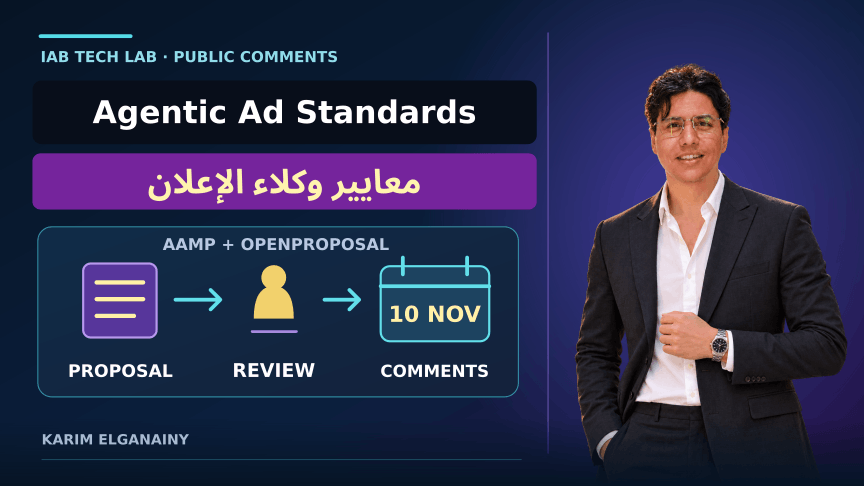
The verified update: more time to comment, not a finalized standard
Checked on 25 October 2026, IAB Tech Lab’s official LinkedIn announcement extends public comment on AAMP 3.0 and OpenProposal to Tuesday, 10 November 2026. PPC Land dates the announcement to 23 October; the public post displayed a relative age when checked. The extension is the fresh development, rather than a new product launch on 25 October.
There is a documentation mismatch worth noting: the official OpenProposal repository still lists 22 October as its closing date. It describes OpenProposal as a draft for representing advertising proposals between an initial brief and commercial terms, warns that it is not ratified, and welcomes comments from nonmembers with GitHub accounts. The newer social announcement supplies the extended deadline; the repository supplies the draft and participation instructions.
Original analysis: use the window to test decisions
The analysis below proposes a practical review method for marketing teams, agencies and publishers. Its examples are hypothetical and are not claims about implemented OpenProposal features, market adoption or performance. A deadline extension creates room for better evidence, but only if participants examine the decisions a future integration must make. A successful demonstration is less useful than a reproducible account of where a proposed workflow becomes ambiguous.
Start with one familiar campaign
Choose a completed campaign whose planning documents the organization is authorized to reuse. Remove client identifiers, confidential prices and personal data unless their use in the exercise has been approved. Preserve the structure of the business problem: the objective, eligible inventory, timing constraints, budget boundaries and reasons the final choice differed from the first proposal. This makes the exercise realistic without turning a public standards review into an unnecessary disclosure.
Ask a planner, an ad-operations specialist and a seller to describe the same transaction independently. Compare what each treats as essential. The planner may prioritize audience relevance, the operator may need creative specifications, and the seller may emphasize inventory conditions. Differences are useful evidence. They reveal information that a polished presentation can leave implicit because experienced people know when to ask another question.
Separate preferences from nonnegotiable conditions
A campaign brief often mixes aspirations with requirements. A preferred placement is different from a placement that is prohibited; a desirable launch date is different from a contracted event window. Before experimenting with automated interpretation, classify each condition. Make clear which items can be traded against price, which require approval to change, and which disqualify a proposal regardless of its apparent value.
For example, a hypothetical product launch could favor evening exposure while requiring delivery before a particular announcement ends. An agent that treats both statements as equally flexible might produce a mathematically attractive plan that misses the campaign’s purpose. Reviewers should test whether the representation preserves those differences and whether a rejected condition remains visible rather than disappearing into a generic compatibility score.
Make every number carry its meaning
A number becomes useful only when its unit and context are clear. A price could apply to impressions, completed views, a fixed placement or an entire package. A projected audience may refer to people, devices or households. A reach estimate may be gross, deduplicated or limited to one property. The review should identify where a reader must infer meaning that ought to travel with the value.
Build deliberately awkward examples. Use different currencies, minimum commitments, estimated volumes and reporting windows. Ask a human to explain why two proposals are or are not comparable, then check whether the proposed representation carries the same reasoning. Do not solve an ambiguity by silently converting it to a convenient default. An explicit unknown can be safer and more informative than a precise-looking number built on an unsupported assumption.
Define authority before enabling action
Planning assistance and purchase authority belong in different parts of the operating model. A system might be allowed to summarize offers, rank eligible options or prepare a recommended allocation without permission to commit money. Write down the boundary before any integration reaches a live account. Identify the person who can approve a commitment and the conditions that make renewed approval necessary.
Test changes as well as initial decisions. A proposal may become more expensive, change its delivery dates or substitute inventory after a planner has reviewed it. The workflow should expose that material change and retain the earlier approved version. In a standards experiment, teams can simulate these events without executing transactions. The important evidence is whether the system distinguishes a recommendation from an authorization and an authorization from its subsequent amendment.
Keep human-readable explanations beside structured output
A technically valid object can still be difficult to evaluate. Ask the workflow to produce a short explanation of the proposed choice: which requirements it satisfies, which tradeoffs it introduces, and which questions remain unresolved. Review that explanation against the structured record. If the prose promises something absent from the record, or the record contains a restriction omitted from the prose, the inconsistency needs investigation.
This is particularly important for approvals involving several departments. Finance may read the commercial summary while operations works from a detailed configuration. Both should be reviewing the same commitment. A useful exercise deliberately changes one condition and checks whether every relevant summary changes with it. The goal is coherent decision support, not an impressive explanation generated independently of the terms it is supposed to describe.
Test the exceptions that consume real time
Routine proposals are a weak test of operational readiness because they often work under several competing interpretations. Include cases where inventory becomes unavailable, an asset misses its deadline, or a delivery requirement cannot be met. Ask where the process stops, what information is retained and who receives the unresolved issue. An exception should not silently turn into a substitute purchase simply because the original plan cannot proceed.
For a hypothetical sponsorship package, consider what happens when one component is unavailable but the remaining elements still appear purchasable. Would the campaign retain its intended value? Who decides whether the bundle can be separated? These questions help reviewers describe necessary business relationships. They do not require inventing a universal answer; the immediate aim is to make different answers representable and discoverable before any commitment is made.
Examine the seller’s workload too
Buyers may see faster evaluation while sellers inherit a larger preparation burden. A publisher could need to translate a diverse catalogue into standardized descriptions, maintain availability and explain exceptions that were previously handled in conversation. Include this work in the review rather than assuming that every minute saved by a planner is an equivalent systemwide saving.
Invite the people who maintain real inventory information to challenge the proposed process. Ask which details change frequently, which cannot be promised until checked, and which descriptions would expose sensitive commercial information. A good trial should reveal where structured publishing is practical and where a conditional response is necessary. Otherwise, the apparent efficiency may simply move uncertainty upstream to a team that lacks the capacity to maintain it accurately.
Compare decisions, not just output speed
Record the existing manual process before estimating improvement. Note the elapsed time, active staff effort, clarification rounds and reasons for rejecting unsuitable options. Then run the same sanitized scenario through the experimental workflow. Faster completion matters only alongside the quality of the resulting decision and the work required to verify it.
Separate avoidable clerical effort from valuable deliberation. Removing repeated data entry can be beneficial; removing a discussion about an unusual audience constraint may create risk. Count rework after the initial output, not merely the time until the first answer appears. A useful evaluation report explains where time moved, which errors appeared and whether the team could detect them before they affected the recommended plan.
Treat missing information as an output
Teams often pressure prototypes to produce a complete answer because an incomplete recommendation looks unsuccessful. That pressure can reward unsupported inference. Design test cases in which the correct outcome is a request for clarification, a narrower comparison or a refusal to rank incompatible offers. Explicitly record why the available information cannot support a confident decision.
An organization could, for instance, receive two packages with different measurement definitions and no reliable conversion between them. A cautious workflow would preserve the distinction rather than collapse both into a common score. This is an original evaluation principle, not a claim that a particular draft currently enforces it. The review should reward truthful uncertainty when certainty would depend on information nobody supplied.
Protect information before preparing public feedback
A useful comment can describe a problem without exposing the actual client, negotiated rate or campaign strategy. Replace those details with clearly labeled fictional values that preserve the relationship being tested. Check screenshots and attached examples for hidden identifiers. Obtain the organization’s normal review before making a public contribution, especially when several parties supplied the underlying material.
Keep privacy, confidentiality and commercial approval distinct. Permission to access a campaign internally does not automatically include permission to publish its terms. Standards participation also should not become a reason to upload production datasets to an unfamiliar service. The safest starting point is a small synthetic example that demonstrates the issue clearly enough for another reviewer to reproduce it without additional private context.
Write feedback that someone can act on
A useful submission identifies the section being discussed, describes a specific scenario and explains the consequence of the ambiguity. Add the expected behavior and an alternative if the preferred solution is too complex. Distinguish a wording problem from a missing concept or an implementation failure. This helps reviewers assess the proposed change without first reconstructing the contributor’s business model.
Avoid presenting internal preference as universal necessity. A requirement essential to one market or buying method may be optional elsewhere. Explain the scope honestly and describe whether the scenario is common within the contributor’s experience or merely a plausible edge case. A modest, reproducible example can be more useful than a sweeping declaration that a specification will transform media buying or cannot possibly work.
Include Arabic-market realities without assuming compatibility
Teams operating across Arabic-speaking markets can test naming conventions, mixed-language briefs, currencies and calendar expectations using fictional examples. The question is whether the information remains unambiguous when different participants read or translate it. A local team should also identify which commercial assumptions must be supplied explicitly instead of being inferred from an English-language template.
This review does not establish regional availability, Arabic-language support or compatibility with any named platform. Those require separate evidence. It does help prevent a globally framed exercise from overlooking ordinary local operating conditions. Invite reviewers who actually manage the relevant accounts, and distinguish language presentation issues from differences in commercial practice. They may require different remedies even when they appear together in one proposal.
Decide what evidence would justify the next step
Before the trial ends, agree on the evidence required for a broader test. It might include consistent interpretation of key conditions, reliable visibility of unresolved questions, manageable maintenance work and a clear approval boundary. Define a reason to pause as well, such as unexplained changes to commercial meaning or dependence on manual repairs that the team cannot sustain.
The immediate outcome can be a well-supported comment, a list of unresolved questions or a decision to keep monitoring. None requires declaring the standard finished or migrating live spending. The most useful response to an extended comment window is disciplined participation: turn real operating experience into precise feedback, preserve uncertainty where evidence is missing, and make any later investment depend on what the workflow demonstrates rather than what its category promises.
Comments
No published comments yet.