The news: an October 23 launch, examined on October 25
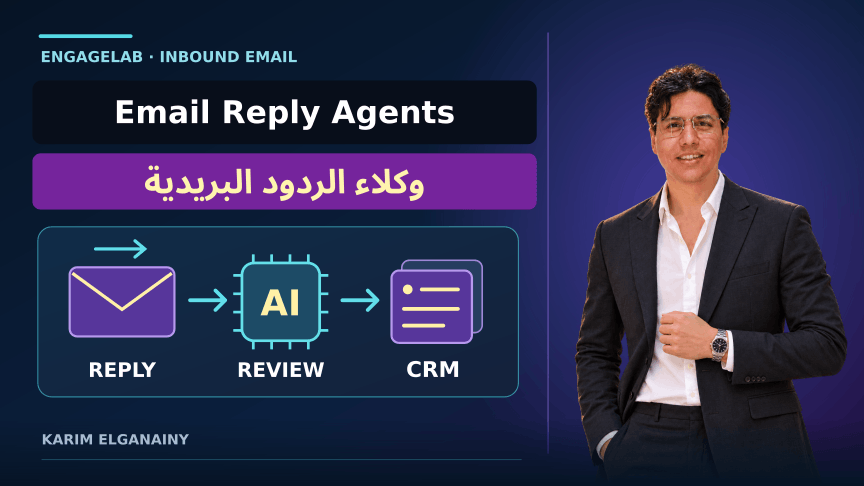
Aurora Mobile announced EngageLab Agent Email on October 23, 2026, with enterprise availability. The company describes AI handling of incoming replies, conversation threading in Gmail and Outlook, answers grounded in private company knowledge, and intent information written into CRM. These are vendor-described capabilities, not independently measured outcomes. Aurora Mobile announcement.
The commercial question is what happens when a campaign starts a conversation that the organization cannot finish well. A carefully targeted message can still produce a disappointing experience if the reply disappears into an unowned mailbox. Adding an answer generator will not resolve unclear ownership, contradictory policies or an overloaded sales queue. The following analysis proposes an operating model for evaluating this category of infrastructure. Its examples, controls and measurements are editorial recommendations, not claims about tested EngageLab performance or features confirmed beyond the announcement.
Treat the reply as a new customer task
A customer who responds has changed the job. Before the response, marketing was trying to earn attention. Afterward, the business needs to understand a specific request and decide who can resolve it. A request for a delivery estimate, a complaint about an earlier interaction and a question about enterprise purchasing should not share one generic conversion path.
Start by defining a short list of intentions that employees can apply consistently. Useful categories might include product information, existing order assistance, commercial negotiation, appointment administration, opt-out and an unresolved category. Keep the last category visible. A system forced to choose a confident label for every message can create misleading certainty that later contaminates reporting.
Each category needs an owner, an allowed next step and a service expectation. For example, a commercial question could be assigned to a sales queue, while an objection to further contact should suppress the relevant marketing journey. The important deliverable is a decision map that a person can inspect, rather than a long list of clever response templates.
Separate knowing an answer from being allowed to act
A strong pilot should distinguish three permissions: reading information, proposing a response and taking an external action. Access to a product document does not imply permission to offer a special price. Access to a calendar does not imply permission to book a meeting. A plausible summary of a customer request does not establish authority to change a contract or issue a refund.
Build an action register before connecting business systems. For each action, record the information required, the employee who owns the rule, the maximum permissible scope and the point at which human approval becomes necessary. Begin with narrow read access and drafts that employees review. Expand only after the team can explain both successful and failed cases.
This separation also improves incident response. When an answer is wrong, managers should be able to determine whether the source was outdated, the interpretation was mistaken or the action exceeded permission. Without those distinctions, every error becomes an unhelpful debate about whether artificial intelligence is generally trustworthy.
Make the knowledge base an operational asset
A useful knowledge collection needs more than a folder of brochures. Public-facing sales material may omit exceptions, while internal documents may contain expired offers or information that should never appear in a customer reply. The pilot owner should decide which material can support external answers and which material is for employee context only.
Give each approved entry a responsible owner, effective date, review date, target market and escalation contact. Where two documents disagree, settle the disagreement before the pilot begins. If the business cannot confidently answer a question today, an automated response should not invent a resolution tomorrow. An explicit inability to answer can be a good outcome when it routes the customer correctly.
Test whether the proposed response preserves qualifications. A statement about typical delivery timing must not become a guarantee. A condition attached to an offer must remain attached when the answer is shortened. The review should examine what a customer could reasonably understand, not just whether individual words appear somewhere in the source material.
Design conversation continuity around identity and context
A coherent conversation requires the business to associate the right history with the right person. That sounds simple until a customer forwards an email, switches addresses or asks on behalf of a colleague. In a proposed implementation, uncertain identity should limit the information disclosed and trigger verification through the organization's approved process.
The operating design should also distinguish the customer's latest request from older quoted messages, signatures and automated acknowledgments. A chain may contain a previous refusal, an outdated price or a different person's contact details. Reviewers should evaluate whether the response addresses the newest question without treating every sentence in the thread as a current instruction.
Repeated delivery and conflicting updates deserve explicit tests. If a message is processed twice, the organization should not send contradictory answers or create duplicate sales tasks. These are acceptance criteria to investigate during procurement and implementation, not assumptions that any specific vendor has already solved them for a particular configuration.
A hypothetical pilot for a regional retailer
Imagine a retailer serving customers in Saudi Arabia and the UAE that wants to improve responses to product-information emails. This is an illustrative workflow, not a case study. The team could choose a single product category, a defined language set and a small group of employees who already handle the relevant enquiries.
Before using live customer correspondence, the team should assemble synthetic messages covering ordinary questions, mixed Arabic and English, incomplete addresses, negative reactions and requests outside the approved scope. Reviewers independently assign the expected intention, the permitted information and the correct destination. Disagreement between reviewers is a signal to improve the policy before assessing the model.
The next stage could run in a restricted shadow mode, if the selected configuration supports it. Employees continue sending replies while comparing their decisions with proposed classifications and drafts. Only after review should a narrowly defined low-risk category become eligible for assisted handling. Negotiation, identity uncertainty and complaints remain with people throughout the initial experiment.
Measure the complete resolution, not the fastest first sentence
A fast initial message can hide a slow or unsuccessful conversation. The primary measure should therefore describe a completed customer task, using a definition the service and marketing teams both accept. Supporting measures can include time to a substantive answer, repeat contact about the same issue, avoidable transfers, corrected responses and the share of requests that remain unresolved.
Use a comparison design that limits obvious confounding. For an illustrative test, eligible conversations might be assigned between the existing process and an assisted process while keeping product category, staffing coverage and campaign offer comparable. Review results by language and request type. A blended average can conceal a serious weakness in a smaller but commercially important segment.
Do not select a favorable time window after seeing the results. Decide the observation period, review sample and stop conditions in advance. If volume is low, report that uncertainty rather than announcing a percentage improvement that depends on a handful of conversations. The goal is a defensible operational decision, not a dramatic pilot slide.
Protect CRM from confident but unverified interpretations
A reply can provide valuable context without proving buying intent. Asking whether an item is available is different from authorizing a purchase. Asking to speak with someone does not automatically mean that the person meets a sales qualification framework. Treat inferred intention as a proposed classification, with the original evidence accessible to the employee reviewing it.
A recommended CRM record should distinguish customer-stated information from system-inferred labels. It should also record when the inference was created and whether a person confirmed it. If the customer later clarifies their request, downstream tasks should be corrected rather than allowing the first interpretation to persist indefinitely.
Marketing and sales should jointly define what creates a new opportunity, what updates an existing one and what merely adds context. Otherwise, automation can increase apparent pipeline by producing more records without increasing genuine demand. The success measure should reward useful handoffs that employees accept, not the number of database fields populated.
Evaluate Arabic service quality as a separate workstream
For a Gulf-market pilot, language review should extend beyond grammar. An answer can be fluent yet miss whether the customer is asking a question, expressing frustration or politely declining. Recruit reviewers who understand the intended audience and ask them to assess meaning, tone, clarity and the accuracy of the next step.
Use examples that vary formality, spelling and the mixture of Arabic with English product names. Keep the test set specific to the business instead of relying on a generic translation benchmark. If an answer needs clarification, the wording should make it easy for the customer to supply the missing information without repeating the entire enquiry.
Do not infer local-language readiness from a global launch. Verify the required language behavior and operational support directly before treating it as a deployment condition satisfied. Likewise, document market-specific service details such as working hours and approved delivery statements. The purpose is to prevent a polished answer from carrying the wrong commercial assumptions.
Understand the economics of assisted handling
A credible cost model should include preparation, supervision and correction. Count the time needed to maintain approved knowledge, investigate errors, inspect samples, manage integrations and train employees. Subscription or usage charges are only one component. An apparent reduction in frontline minutes can be offset by a growing review burden elsewhere.
For a clearly hypothetical calculation, suppose an eligible conversation saves three employee minutes but needs one minute of review on average. The relevant starting point is two net minutes, before accounting for setup and rework. If complex cases become slower because employees must reconstruct what happened, those extra minutes also belong in the calculation.
Value can come from improved continuity or more consistent handling even when direct labor savings are modest. Keep those benefits separate and attach observable measures to them. Avoid translating every faster response into incremental revenue without a credible comparison. A conservative business case is more useful than a confident return estimate built from assumed conversion gains.
Establish a stop switch and a customer recovery path
Before expanding the pilot, rehearse how the team will pause assisted replies, preserve the pending queue and return responsibility to employees. A stop switch is only useful if someone knows when to use it and can see which conversations still need attention. Record the owner for weekends and periods outside normal operating hours.
Create a correction process for inaccurate information. The customer should receive a clear, proportionate explanation and a useful next step, rather than being passed among teams while the organization investigates internally. Keep internal incident analysis separate from customer communication so that recovery does not depend on a long technical review.
For healthcare organizations considering similar administrative workflows, the boundary should be particularly explicit: public service information and appointment administration are different from individualized clinical guidance. Any proposed use involving sensitive records or patient-specific advice requires a separate specialist-led assessment. The commercial experiment described here is not a clinical deployment plan.
Strategic takeaway: build a reply operation before scaling it
The most useful opportunity is to turn response handling into a managed part of the customer journey. That requires shared ownership across marketing, service, sales and technical operations. A campaign team should know where replies go, how uncertain requests are handled and what evidence demonstrates that the customer actually received help.
For a marketing leader deciding what to do next, the practical sequence is straightforward: map one reply journey, clean its knowledge, define permitted actions, create a representative evaluation set and run a bounded comparison. Expand by intention and risk, not simply by message volume. Keep the ability to return to a human-led process throughout.
Agentic email is worth evaluating where it addresses a visible operational gap. Its value will be established by fewer dropped conversations, better accepted handoffs and reliable resolution under real conditions. Buying infrastructure is the beginning of that work; disciplined service design determines whether it becomes a durable marketing advantage.
Sources and evidence boundary
Aurora Mobile’s October 23, 2026 announcement establishes the launch and stated product scope. The operating recommendations, hypothetical pilot and illustrative economics in this article are original analysis, not reported customer results or independent product testing.
Comments
No published comments yet.