
What GE HealthCare announced
On November 20, 2026, GE HealthCare announced two Imaging 360 capabilities. One assistant helps staff explore radiology protocol analytics. A separate application can suggest a protocol for preparing a CT or MR examination. Both concern preparation, but they do different jobs. The release describes their design and a planned demonstration at the RSNA meeting; it does not establish that either capability is available to every hospital or geography. GE HealthCare announcement
Two workflows, not one approval button
The first assistant is aimed at imaging leaders, administrators and protocol managers. It accepts questions in natural English and is designed to spare users from navigating multiple dashboards to find operational data. GE says the assistant is read-only, cannot edit protocols or source data, and does not provide clinical interpretation or patient-specific recommendations. An authorized operations lead could start by asking about variation in the use of a protocol family, then check definitions and dates in the approved system.
The separate protocoling application provides recommendations for radiologists or technologists to review before they select the final protocol in the radiology information system, or RIS. GE describes it as vendor-agnostic. That is a design claim, not confirmation that it works on every scanner or local system. Easier reporting and decision support for an individual imaging order are different; neither announcement establishes that the tool automatically starts a scan.
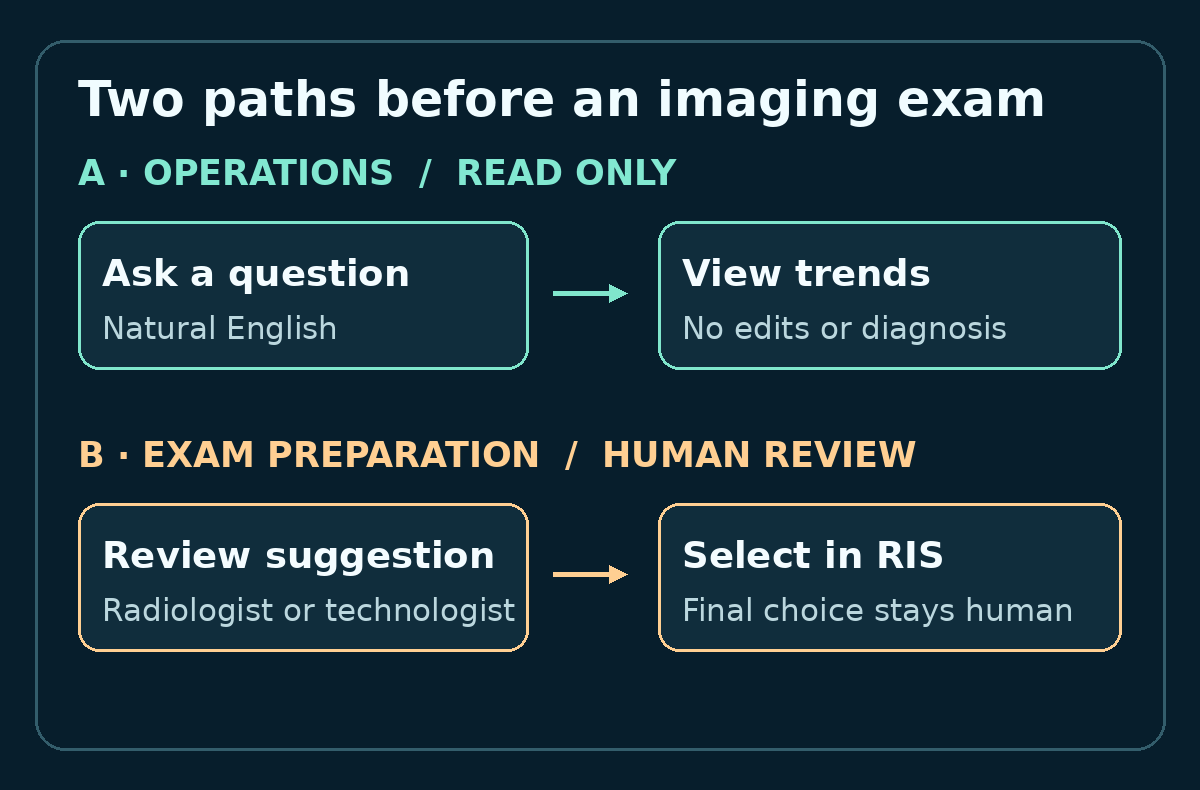
Original diagram of the two announced capabilities, not a GE screenshot or clinical recommendation.
The announcement does not measure time saved
The press release mentions an average of 1.3 hours per day spent on protocoling as background, not as a product result. The release’s body refers to an estimate from two observational studies, while its footnote cites a GE-sponsored January 2019 survey. I would not use it as the benchmark for a local department or as the number of hours the tool can recover. The release does not report an independent evaluation of safety or capacity gains or specify local availability. Check the product version, integrations, validation and permissions before any real assessment.
A fictional operational exercise
Imagine an isolated evaluation that replays 120 de-identified requests in two comparable groups of 60 without directing live care. Manual review takes a median of nine minutes. Assisted review takes a median of six minutes, but sends nine of 60 requests back to a specialist, compared with four of 60 for the manual process. The three-minute difference between medians does not mean three minutes saved on every request. Nor does it answer why more cases were escalated. Record time up to the final human selection and include rework in the comparison. These are original fictional figures, not GE results.
Decide whether to continue before you start
Agree on when a request starts and ends, then report the median and delays among slow cases, segmented by site and exam class. Measure how often reviewers reject suggestions and how often the review trail is complete. Acceptance is not a sufficient quality measure. Define stop conditions jointly with workflow and governance owners and document when the team returns to manual review, especially if errors appear or the human audit trail is lost. The useful first step may be agreeing how preparation time is defined, not buying software or extrapolating from a small pilot. Patient data should remain in the approved environment.
Comments
No published comments yet.