The announcement has an earlier history
Cuttable’s 23 October U.S. release describes a platform update and says the United States supplies 40% of revenue, a company claim. Its 22 October Australian announcement had already described the relaunch and A$20 million Series A led by Airtree Ventures. This 25 October analysis does not present either as a new funding event today. U.S. company release.
The important operating question is what a team should learn between one batch of advertisements and the next. Faster production is straightforward to observe; better creative judgment requires more careful evidence. The analysis below proposes a bounded, hypothetical pilot. It is not a report of Karim’s client results, a product endorsement or an independent verification of the vendor’s performance claims.
Understand the proposed loop before buying the promise
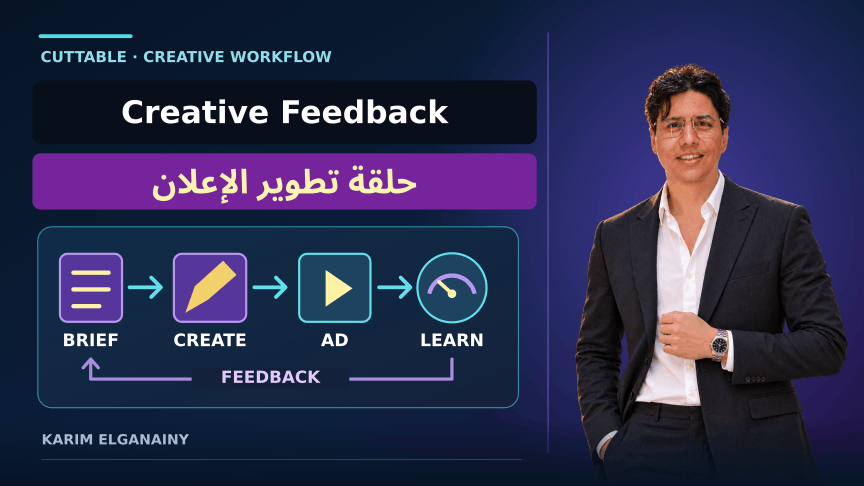
Cuttable describes a workflow connecting a creative brief and brand inputs to editable advertisements, publication and subsequent performance feedback. Its product materials identify Meta Ads Manager as a publishing destination and source of results. Those are vendor descriptions of functionality, not proof of incremental sales or reliable causal explanations. Product overview.
A team evaluating this approach should draw its own process map. Identify the information entering the brief, the decisions the software proposes, the edits people make and the evidence returned after delivery. Then ask where the current process loses useful knowledge. Perhaps campaign reports never reach writers, or perhaps writers receive numbers without knowing which message was actually tested. An integrated interface matters only if it helps repair a specific break in that chain.
Define the decision the pilot must improve
Begin with a decision such as which benefit to emphasize, which product objection to answer or which existing footage deserves a new treatment. Avoid an objective as broad as making more content. A team can generate many variations while learning little if every version changes several things at once or reaches a different audience under different conditions.
Write the proposed learning in one sentence. For example, a fictional accessories brand could ask whether showing a practical packing problem communicates a bag’s usefulness more clearly than a product-only presentation. This is a hypothetical creative question, not a prediction about which approach will win. The sentence should identify what will change, what will remain comparable and what evidence would justify the next brief. If the team cannot agree on that sentence, production is premature.
Build a brief that carries constraints as well as ideas
A usable brief includes the customer situation, intended action, product facts, approved claims, available assets and the boundaries of the experiment. Add the elements that should remain stable, such as the offer and destination, so a promising result is not later credited to the wrong change. Keep unsupported claims out of the source material rather than relying entirely on final review to catch them.
Include explicit creative exclusions. A product demonstration should not imply a capability the item lacks, and a generated setting should not suggest an endorsement or real event that never happened. Give reviewers the reason behind important restrictions. When a team understands why a claim is unavailable, it can find another persuasive approach. A brief containing only prohibitions tends to produce repeated corrections without building better judgment for future work.
Organize assets so that edits remain traceable
Create a small, well-described asset set before expanding production. Record which product each image shows, whether it is current, the intended usage and any limits on modification. Preserve original files separately from edited outputs. This makes it easier to diagnose an incorrect color, obsolete package or misleading demonstration without searching through an unstructured collection of exported images.
Assign each creative a stable identifier and connect it to the brief, source assets, approved version and publishing record. The identifier should survive ordinary naming changes. Otherwise the team may analyze a performance row without being certain which visual or copy variant actually ran. Traceability is an operational benefit in its own right: it supports corrections, prevents accidental reuse of retired material and makes useful lessons available to people who were not present during the original production meeting.
Keep the approval boundary visible
Separate generating a draft, approving an asset and authorizing a paid publication. These stages involve different decisions and should remain distinguishable even when a tool makes the handoff convenient. Cuttable’s publishing guidance describes selecting destination campaigns and reviewing ad details before submission. Meta publishing documentation. A team should verify its actual account configuration rather than assume that every screen or permission matches a demonstration.
Give each review an owner. Creative review checks clarity, accuracy and brand fit; media review checks destination, budget context and intended delivery; the business owner checks whether the offer remains valid. One person may cover several roles in a small team, but the questions still differ. Record the approved version and do not let a later automated variation inherit approval merely because it shares a file name or campaign label.
Design a test that can answer its own question
Choose a limited set of meaningfully different concepts rather than a large collection of cosmetic variations. Hold the offer and destination stable where feasible, and decide in advance how the platform’s delivery behavior will affect interpretation. Unequal exposure can make a weak comparison look decisive. A creative receiving little delivery may simply remain untested rather than demonstrably ineffective.
Set a sensible observation period and minimum evidence requirement based on the account’s usual activity. Do not borrow an arbitrary conversion threshold from an unrelated business. If evidence remains insufficient, preserve the result as inconclusive. A disciplined pilot can still teach the team about production effort, approval quality and reporting completeness while leaving the commercial question unresolved. That is preferable to declaring a winner merely because a weekly meeting requires a headline.
Read performance without inventing a causal story
An attributed purchase is a platform-reported association under a particular measurement setup. It does not, by itself, explain which visual element caused a person to buy. Audience composition, offer strength, seasonality, landing-page experience and delivery optimization may all influence the observed result. A feedback system should preserve that uncertainty instead of converting every favorable metric into a confident creative rule.
Ask for the evidence behind a recommendation. Which assets were compared? How much opportunity did each receive? Were the products and prices comparable? Did anything else change? If the answer is unavailable, use the suggestion as a hypothesis for another test, not a settled explanation. Distinguish an operational recommendation that is convenient to try from a causal claim that requires stronger research. This keeps the team’s learning record honest and prevents fragile assumptions from becoming permanent brand doctrine.
Separate business value from production throughput
Measure time from an approved brief to a usable asset, reviewer effort, correction frequency and the number of genuinely different concepts tested. Count the complete workflow, including preparation and quality checks, rather than only the rendering step. Saving minutes during generation may have little value if the review queue grows or if the resulting assets require extensive repair before they can run.
For the commercial side, agree on a business-relevant outcome and inspect the assumptions behind it. Revenue attributed to advertising is different from contribution after product and fulfillment costs. A lower cost per action may be unhelpful if the action is poorly qualified. Do not turn a vendor’s return-on-ad-spend example into a forecast for the account. Compare the pilot’s total cost with the work and decisions it actually improves, including the time spent maintaining integrations and correcting source information.
A hypothetical two-cycle operating plan
Imagine a small ecommerce team testing one product family. In the first cycle, the creative lead prepares a clean brief and a limited asset library. The media lead records the comparison setup, and the reviewer approves each final version. The team publishes only the agreed concepts, preserves the identifiers and checks that the correct destination and measurement events are functioning. This is an illustrative process, not an instruction to activate a campaign without authorization.
At the review, the team writes down observations separately from explanations. It may observe that one concept attracted more qualified visits, while acknowledging that delivery differed. The second brief then tests the suspected message more deliberately, rather than simply producing more copies of the apparent winner. If results are inconclusive, the next step may be a clearer comparison or a revised landing page, not another batch of assets.
End the pilot when the agreed decision can be made, the authorized budget or observation window is reached, or a material quality problem requires a pause. Expansion should depend on understandable learning, manageable review effort and acceptable business results. Stopping after a useful negative finding is a legitimate outcome. A tool does not need to become a permanent system merely because setup required effort.
Protect creative diversity from a narrow feedback loop
A system trained only on the account’s recent successes may encourage repetition. Reserve some of the experiment plan for genuinely different questions, with separate expectations for exploratory work. Otherwise the team can become highly efficient at reproducing yesterday’s approach while missing a new customer concern or an emerging product use. Exploration should be deliberate and bounded, not disguised as random variation.
Review the collection of concepts as a portfolio. Ask which benefits, situations and objections have been tested and which remain absent. Keep strong brand ideas available even when immediate response data is limited, while avoiding unsupported claims about their long-term effect. The point is to make the tradeoff explicit. A production system should help the team use judgment across several time horizons rather than silently reducing every creative decision to the easiest short-term metric.
Test Arabic execution and local relevance directly
For an Arabic-speaking team, product access is only the beginning of suitability. Test right-to-left layout, line breaks, punctuation, mixed Arabic and English product names, voice delivery and the relationship between copy and visual direction. A technically correct translation can still sound unnatural or place the emphasis on the wrong benefit. Use a reviewer familiar with the intended audience rather than assuming that a polished preview proves linguistic quality.
Keep market-specific offers, currencies, destinations and product availability explicit in the brief and approval checklist. Compare localized concepts on their intended merits instead of treating Arabic as a mechanical version of an English winner. The sources cited here do not establish validated Arabic performance for the platform. Teams should verify language support and regional account compatibility directly before depending on either for an essential workflow or committing a broader production budget.
Preserve an exit path and an accountable owner
Before expanding the workflow, confirm how the team can retain approved assets, creative identifiers and a readable learning history. Avoid making the only explanation of a successful campaign inaccessible outside one interface. Assign an owner for source updates and integration review, with a backup who understands the process. These steps make continuity possible when staffing, platforms or commercial requirements change.
The strategic takeaway is to judge the quality of the next decision, not the volume of the next export. A useful creative feedback loop should make the team clearer about what it knows, what it merely suspects and what it will test next. If that clarity does not improve, faster asset generation may simply accelerate confusion. If it does improve, the team has an operating asset that can remain valuable even as individual tools and formats evolve.
Sources and evidence boundaries
U.S. release, 23 October; earlier Australian release, 22 October; official product overview; official Meta publishing guide. Company descriptions are attributed, and the pilot framework is original analysis. No vendor outcome is treated as independently proven or causal.
Comments
No published comments yet.