A name can imply more than it says
A founder may spend weeks choosing an evocative word and then add “The” almost as an afterthought. Vafaeesefat, Mahmood and Chen put that choice under a microscope in a Psychology & Marketing study first published on 16 November 2026. Their question concerned the definite article at the start of English brand names. The distinction matters: the authors studied what a reader infers from a grammatical cue, not whether a name certifies that the brand was first.
The proposed mechanism is perceived originality. In ordinary English, “the” can point to an instance that speakers expect the listener to identify. With an unfamiliar brand, the reader may infer that it is the defining or originating example in a category rather than one more version. That is different from thinking that the name looks unusual. A visually distinctive name can still signify a follower; a plain name can sound established. A naming brief that mixes all of these ideas will have trouble identifying what respondents actually perceived.
Consider two quite different questions that get asked in the same naming meeting: does the label help a first-time visitor recognize a category, and does it make the visitor think that this particular provider helped originate it? The first answer can be yes and the second no. Likewise, an audience can infer that a business pioneered a concept without finding the name clear enough to remember. In a pre-launch interview, ask participants to explain the difference between names using their own words before showing rating scales. A spontaneous explanation is more useful for diagnosing an unintended inference than an extra point on a general preference scale.
What the two kinds of evidence establish
The authors report five controlled experiments with fictional names and one marketplace analysis. The experiments included North American university students and online Prolific participants. For example, one restaurant-name comparison analyzed 308 respondents after exclusions, while a preregistered experiment about perceived originality analyzed 591 native English speakers after exclusions. Several questionnaires assessed brand attitude, willingness to purchase or willingness to recommend. The experimental comparison isolates a wording change under the study conditions. These measured responses should not be described as completed orders, lifetime value or a verified improvement in a live campaign.
The marketplace study used the business-level records of 150,346 businesses in the Yelp Open Dataset across 22 categories. Some 6,574 names began with “the.” In the authors’ adjusted model, those businesses had ratings 0.138 stars higher on average, holding the model’s listed factors constant. The controls included primary category, location, review count and whether the business was a chain. This is an adjusted association. The researchers did not randomly rename real businesses. Other differences, including service quality, location within a market, pricing, years in business and the kinds of customers who leave reviews, may influence both the observed name mix and ratings. None of this warrants promising that an existing brand would gain 0.138 stars after a rebrand.
The experiments and marketplace evidence address different weaknesses. A fictional brand reduces interference from someone’s experience with an established brand, at the cost of stripping out things a customer normally sees, such as what friends say, how the place looks and whether appointments are available. Reviews bring back the reality of actual providers but introduce differences the naming experiment avoids. A rating aggregates the experiences of people who chose to leave reviews, not all eligible shoppers. A regression control is also not a substitute for random assignment: even a stable association across model specifications need not recur in a new locale or across brands of the same size and age. Read the two designs as complementary, not interchangeable.
When the cue loses plausibility
One controlled test varied both the article and whether the fictional brand was described as pioneering or imitative. The article helped brand attitudes in the pioneering condition; the point estimate went the other way in the imitator condition, but that individual comparison did not reach a conventional 5% threshold. Separately, the Yelp association was weaker for categories independently judged more competitive. This is a boundary condition, not a market forecast. A category may feel crowded in one city and still have a genuinely distinct use case in another.
The same caution applies to an established brand whose familiar name already has strong recognition. A word that helps an unfamiliar name signal a position may feel contrived when inserted into a name people already know. An exploratory comparison reported in the paper supports caution, not a universal rule about rebrands. Established businesses must also consider search migration, channel handles, packaging, legal clearance and the possibility that customers think a different company took over. A small survey movement would have to clear a much higher decision threshold in that case.
How to test it without inventing provenance
For a fictional specialist in repairing commuter bicycles, test the working names “Spoke Ledger” and “The Spoke Ledger.” These are illustrative labels, not name recommendations or claims about a real repair shop. Cross the two names with two message contexts: neutral service details versus verifiable differentiation, such as publishing an itemized parts quote before signed approval. Hold the logo, layout, price, service area, offer, placement and booking path fixed. Randomly assign each eligible participant to one cell, avoiding repeat exposure across cells. Ask what kind of business they saw before revealing the purpose; otherwise the question might teach them to pay attention to the article.
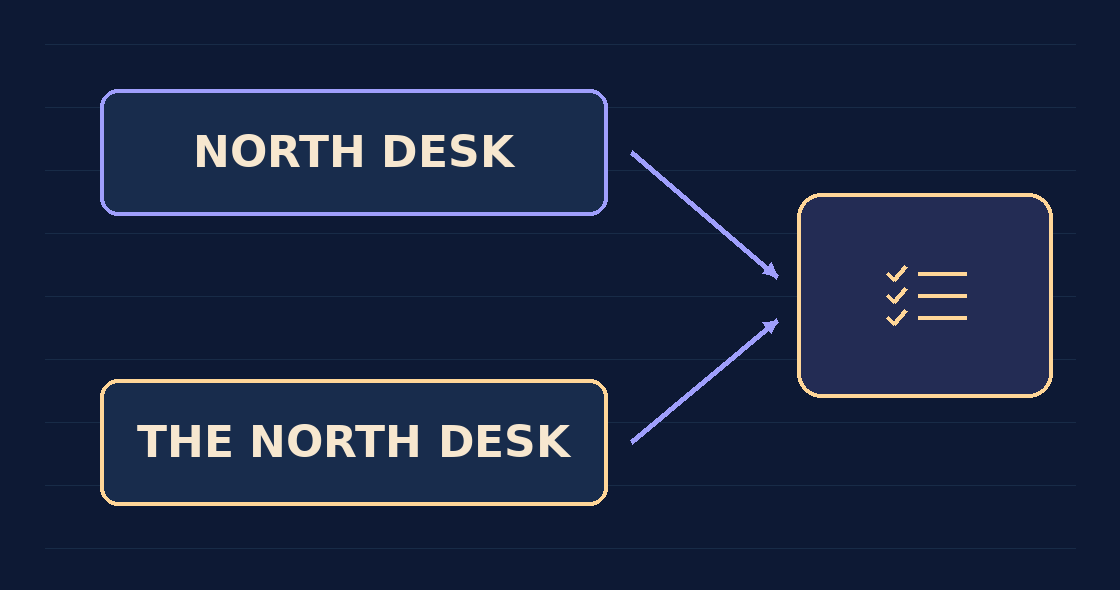
Original naming illustration: identical concept cards can lead to different impressions. The cards and checklist are not stimuli or results from the paper.
Primary source behind this illustration
Run a short comprehension pretest to check that the four variants describe the same service and that the second context communicates a demonstrable practice, not unsupported market leadership. Then specify one primary outcome: in a customer research panel, perhaps a concrete choice between comparable listings; in a permitted live test, perhaps a verified quote request per assigned visitor. An action proxy is not confirmed revenue. Capture unaided name recall, perceived originality and exact service comprehension as supporting outcomes. If booking is measured, keep completed actions, cancellations and duplicate requests separate. Choose the minimum improvement worth acting on and a sample-size target before opening the dashboard. Compare the name effect within each message context and report uncertainty around the differences, rather than comparing whichever two cells happen to be farthest apart.
Keep the two decisions separate in the scorecard. If both names perform similarly once credible differentiation is shown, improve how that evidence is surfaced rather than choosing a name on a narrow statistical margin. If the article only helps when no evidence is visible, test whether respondents are filling a gap in the message by assuming a history that the business does not have. In that case, a high score on perceived originality could be a warning rather than a win.
Record the number assigned to each cell, the number actually shown the stimulus and the number completing the action. A platform that automatically favors the more clickable variant may direct it toward a different mix of people; if possible, use a genuine random split rather than counting impressions after automated optimization. Run through the conversion path with synthetic data before opening the experiment. Keep treatment assignment separate from the outcome so a respondent who gives an unfavorable answer is not silently removed. Interpret the results as an interaction only if the differences between the two name contrasts are large relative to uncertainty, not because one happens to reach a threshold and the other does not. If the evidence is inconclusive, keep the simpler name or gather more information within the originally approved design rather than repeatedly peeking and stopping at the first favorable result.
What to carry into other languages
The testable claim is about English “The.” Arabic “الـ”, Italian “il” and Chinese naming structures are not interchangeable treatments. In markets that use Arabic and English, verify that an audience reads each proposed name as intended rather than assuming it speaks both languages the same way. Check whether the relevant words sound like an ordinary reference, a generic descriptor or a brand in each language. A transliteration can preserve sound while losing a grammatical implication. Local comprehension and claim substantiation matter more than copying the same typography.
For healthcare or another trust-sensitive category, make the article optional and credibility mandatory. Claims of being first, exclusive or uniquely qualified require their own evidence, whatever the grammar. Useful proof is a current credential or a clearly explained service process, not a linguistic hint standing in for it. A result that raises perceived originality but lowers understanding, increases mistaken affiliation or confuses people about who provides the service should count against the option. Test the cue as a reversible naming choice; build an identity around something customers can verify.
A bilingual naming review also needs a policy on inconsistent results. If the English version performs well but people reading the Arabic version mistake the label for a category or a public institution, do not average the two results. Check the proposed wordmark in each use case, including a search result, a map listing, a phone greeting and a plain-text message. A brand name operates outside its logo as often as inside it. Look for false recognition, spelling errors and relevant routes by which a reader would find the real business.
One decision rule is to retain neither English version as an automatic default. If people do not understand the service from either name, keep working on the category descriptor and booking message. If they understand it but cannot spell it without the logo, recheck spoken and typed discovery before spending on media. If they do understand and can find the right provider, a modest gain in an important action can justify keeping the article on that specific identity. Document the basis for the decision so changes in audience, translation or distribution do not silently turn a local result into an all-market policy.
At the end, review the result with someone who did not write the variants. Give that reviewer the exact version shown, its quoted promise, the treatment counts, the denominator and the evidence for each differentiating claim. Ask them to describe what a customer could legitimately take away and what the business can actually deliver. This independent reading catches cases where a team that already knows the brand hears nuance outsiders miss. A name that survives that check is easier to brief to designers, customer-facing staff and translators.
Comments
No published comments yet.