A video opening can give a viewer a reason to stick around, or make them wonder whether the image generator got something wrong. Both are surprises. They do not necessarily do the same job. A field study on two Chinese short-video platforms makes the distinction concrete, and gives marketers a better question to ask than “Should we use AI?”
What the researchers tested
Shichen Zhang, Liang Peng and Yinliang (Ricky) Tan published their study online on November 9, 2026 in Information & Management (volume 64, dated 2027). They compared five openings in short product ads: no opening clip, a conventional opening, a conventional AI-generated opening, an AI opening with an unusual appearance, and an AI opening with an unexpected action. The main product footage stayed the same across conditions; the opening clips matched in length, placement and broad subject matter. The experiment ran on Douyin and Kuaishou across six product categories. The August 16–30, 2025 analysis contains 10,440 video-day observations, not 10,440 people or purchases. The study does not establish that viewers themselves were randomly assigned to versions.
The difference is easier to see than to name: a dog made of vegetables changes what the viewer sees; a dog riding a motorcycle changes what the viewer expects that character to do. The authors propose that unusual appearances may look like AI errors, whereas surprising actions can prompt viewers to wonder what happens next. A separate survey of 151 participants offers evidence consistent with that interpretation; it does not prove what viewers were thinking in the field.
Completion and purchase are different outcomes
In the main analysis, the unexpected-action opening increased the share of views reaching 99% of the video by about 1.2 percentage points compared with no opening (p < .01). The unusual-appearance opening showed no statistically significant difference on that measure. It did show fewer clicks and shorter average viewing in supplementary analyses of the full sample; the click result was not significant in the subset that had views.
Purchase conversion meant purchases divided by views. It was rare in this setting. The main-model estimate was positive for the unexpected-action version (p < .05); the evidence for the unusual-appearance version was weaker (p < .10, not significant at 5% in that model). Some robustness specifications showed stronger evidence for both. AI disclosure had different interactions with the two openings on completion, but the conversion interactions were not statistically significant. None of that is a basis for removing required disclosures or promising a return on ad spend.
A higher rate can come with fewer results
The researchers also found fewer views for the AI openings than for the no-opening reference. Imagine two variants, purely for illustration. A gets 20,000 views × 1% = 200 purchases. B gets 10,000 views × 1.5% = 150 purchases. B records more purchases per view, but A delivers more purchases. These are fictional numbers, not results from the study or from any account.
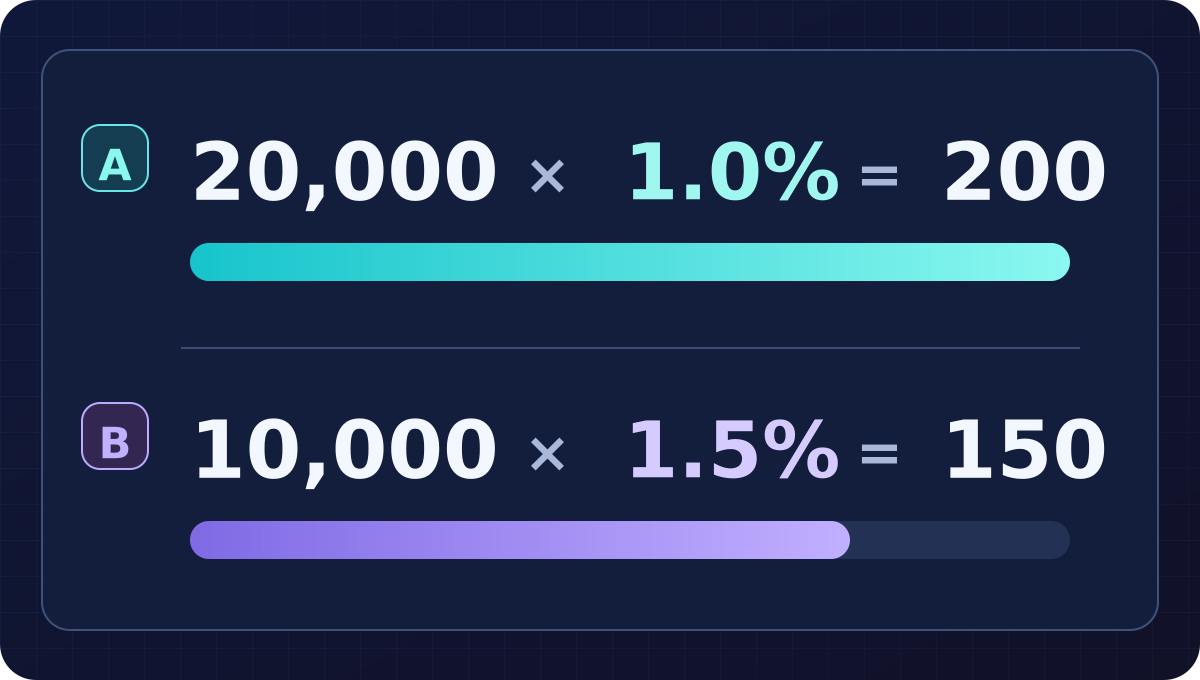
Original graphic created for this site using fictional purchase figures, not data from the paper. Here the percentages are purchase rates. The study’s separate near-completion measure is the share of views reaching 99% of the video.
When comparing pooled results, divide total purchases by total views; don't average daily or creative-level percentages as if every row had equal exposure. Zero-view rows don't have a defined purchase-per-view rate. Log them for delivery analysis and handle them explicitly when comparing rates. The study's main model coded such rows as zero and separately checked 5,191 positive-view rows. Its reported video-day statistics and model coefficients are not necessarily the same as a view-weighted rate for the entire campaign.
How I would test it
Take a fictional desk-lamp ad. In one version, go straight to the product. In another, start with a normal shot of the lamp. In a third, have a small animated paper figure reach up and turn it on. Keep the product footage, offer, CTA, audience, placement, allocation rules and any required disclosure consistent. Make the openings equally long where present; the no-opening version will naturally be shorter, so add a same-duration neutral opening as a comparison. Decide what a qualified action is before you launch. Read delivery, 99% completion, qualified actions and cost per qualified action together. If completion rises but qualified actions decline, the creative may be better at holding attention without moving people toward the offer.
This is a hypothesis for a local test, not a result for Saudi Arabia, another platform or a regulated category. Six product categories, two platforms and a short collection window are useful boundaries, even with thousands of observations.
Comments
No published comments yet.