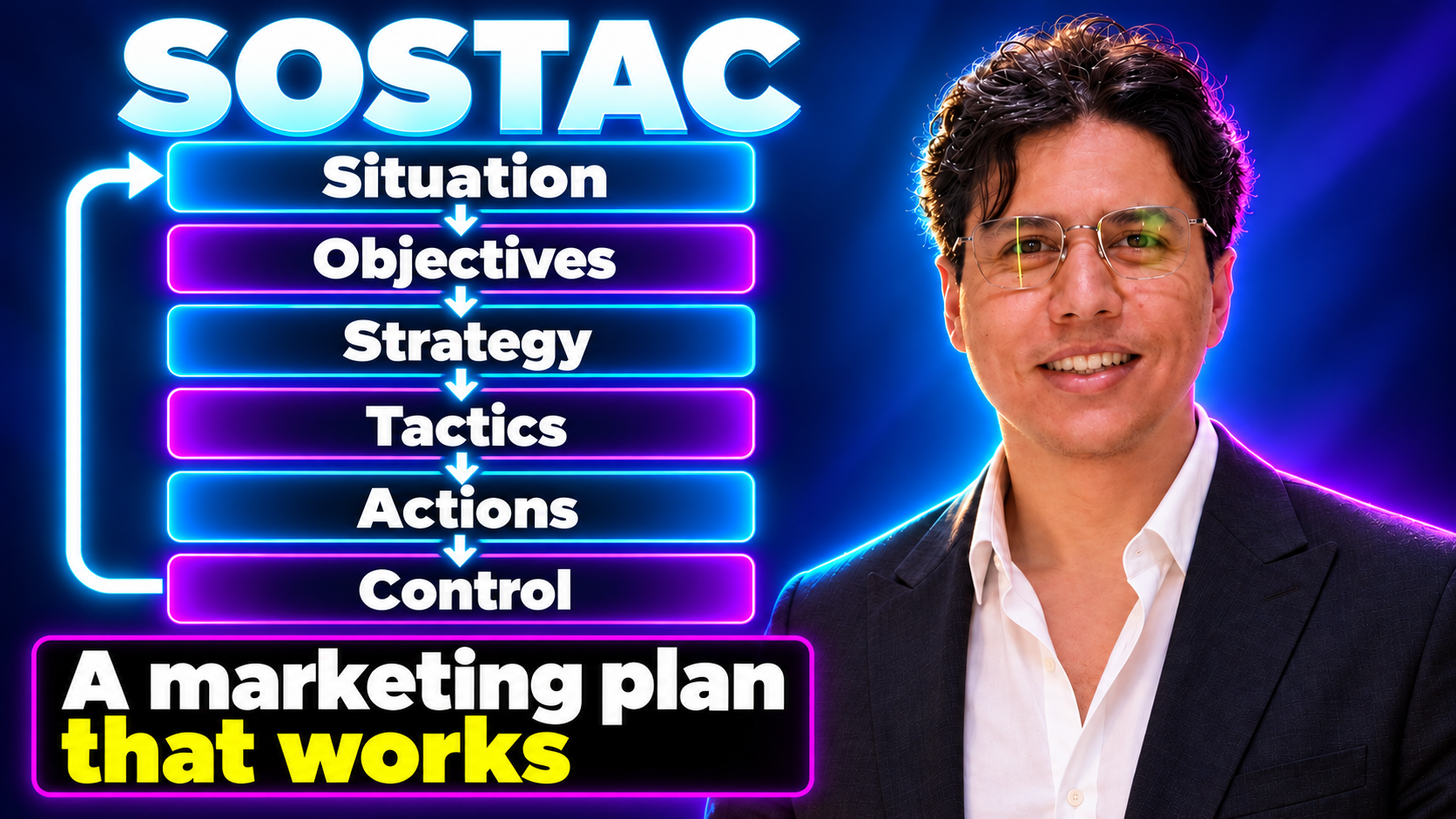
A marketing plan becomes useful when another person can follow the reasoning behind it, carry out the work, and tell whether the result justifies continuing. SOSTAC gives learners a way to connect those responsibilities. It encourages a team to examine its starting position, define the change it wants, choose an approach, specify the work, assign delivery, and learn from performance. The value comes from the connections between these decisions. A beautifully written objective cannot rescue a campaign that the organisation lacks the capacity to deliver.
This practical course article develops that connection through an original fictional hospital example and a shorter comparison from another sector. By the end, learners should be able to build a coherent marketing plan, distinguish strategy from tactics and actions, design useful measures, and run a review that leads to decisions. The healthcare example concerns communication and service access. It provides no medical advice, clinical protocol, or promise of treatment outcomes. Every organisation, operational figure, budget, scenario, and numerical target in the examples is fictional and exists only for teaching.
Understanding the planning framework
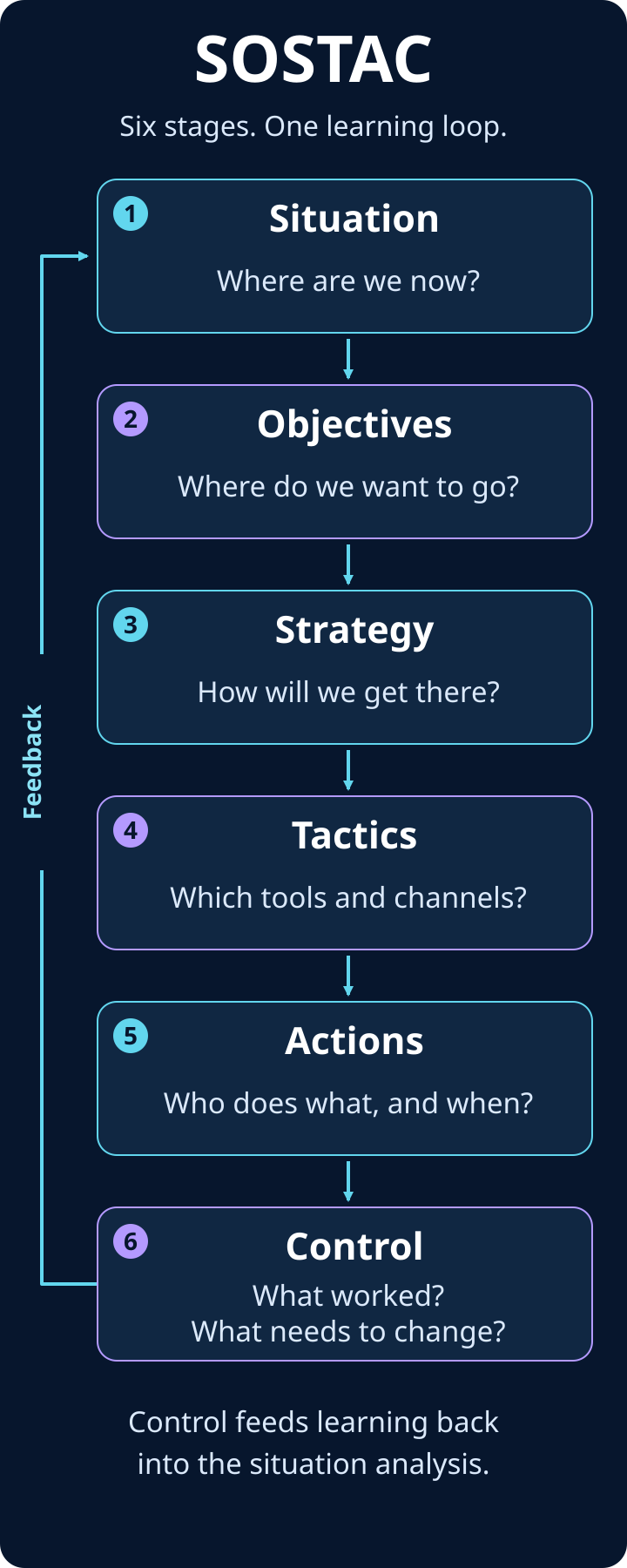
SOSTAC was developed by PR Smith. Its six components are Situation Analysis, Objectives, Strategy, Tactics, Actions, and Control. The supplied course introduction presents these components on physical PDF pages 38–39, connecting organisational analysis and goals with marketing choices, execution, and monitoring. PR Smith’s official explanation also distinguishes strategic choices from tactical detail, identifies responsibility and timing within Actions, and connects ongoing measurement with the next planning cycle. PR Smith’s explanation of SOSTAC.
For this course, treat each component as a decision that must survive scrutiny. Ask whether the evidence supports the diagnosis, whether the objective addresses that diagnosis, and whether the proposed activities can reasonably produce the desired change. Then check whether people, money, systems, and service capacity support those activities. Finally, decide what evidence would make you continue, revise, or stop. These questions turn a familiar sequence of headings into a practical management discipline.
A fictional hospital and day surgery worked example
Consider Cedar Bridge Hospital, a fictional independent hospital with a day-surgery department. Its marketing team receives complaints that prospective patients struggle to understand the administrative journey from an initial enquiry to an assessment appointment. Some expect an immediate procedure booking. Others cannot find clear information about referral requirements, appointment preparation, or whom to contact about administrative questions. Clinical suitability and treatment decisions remain entirely with the appropriate clinical professionals.
The fictional hospital’s commercial director initially asks for more advertising. The planning group instead investigates whether additional demand would help. Reception staff describe repeated questions, confusing website navigation, and incomplete appointment information. Operations colleagues report that service availability varies with staffing. The team therefore frames the problem as improving understanding and access within approved capacity. More enquiries may eventually be useful, but the first plan should address the observable obstacles in the existing journey.
This framing establishes an important boundary. Marketing can help people find accurate information and contact the right service. It should not use conversion targets to pressure people toward surgery or override clinical judgement. The plan must also protect operational resilience: a campaign that fills every available appointment without room for variation could create delays and undermine the experience it promises.
Situation Analysis and the evidence behind the problem
Start with a compact evidence file. Record the source, period, owner, definition, and known weaknesses of each finding. Examine current performance alongside customer understanding, brand perception, internal capabilities, competitors, and the wider sector. A website analytics report can show where people leave a page, but it cannot explain every reason for leaving. Staff observations provide useful hypotheses, while structured research helps establish whether those observations represent a broader pattern.
In the fictional Cedar Bridge dataset, a completed monthly enquiry cohort contains 120 unique enquiries about the service. Of those enquiries, 80 lead to booked assessment appointments and 60 eventually lead to attended assessments. The attendance result is observed only after the cohort has had enough time to complete its journey. The enquiry-to-attendance rate is therefore 60 divided by 120, or 50%. The booking-to-attendance rate is 60 divided by 80, or 75%. These rates answer different questions and must keep their denominators visible.
Avoid calculating a journey rate by dividing this month’s attendances by this month’s enquiries when they concern different people and different booking cycles. Equally, repeated phone calls from one enquiry should not inflate the apparent number of opportunities. The teaching dataset uses synthetic aggregate counts only. A real organisation would need an authorised measurement design that protects information and limits access appropriately; a marketing spreadsheet should never become a substitute for approved clinical systems.
The fictional operational review identifies 90 staffed assessment slots in a typical service month. Management reserves 10 of these slots for variation and operational needs, leaving a fictional planning ceiling of 80 routine bookings. This ceiling is a scenario assumption, not a recommended clinical staffing ratio. The approved number would depend on the actual service and responsible operational judgement. The marketing plan should be revised whenever the capacity assumption changes.
Use SWOT to condense evidence into implications. Cedar Bridge’s strength is an experienced enquiry team; its weakness is inconsistent administrative information. An opportunity is to make the referral journey easier to understand. A threat is a mismatch between promoted availability and actual scheduling capacity. Each statement should point to evidence and a planning response. Generic descriptions such as strong brand or intense competition add little unless the team explains what they mean for this specific decision.
The situation summary now becomes focused: existing interest is substantial, information gaps may contribute to avoidable friction, and capacity limits make indiscriminate acquisition unsuitable. The remaining uncertainty is causal. The team has not proved that revised information will increase attendance. That uncertainty belongs in the plan as something to test, rather than disappearing behind confident language.
Objectives that connect ambition with constraints
Objectives express the changes the plan is intended to produce. Begin with organisational purpose, then choose outcomes that fit the diagnosed problem. The course introduction connects objectives with mission, vision, positioning, market share, and new products. Those considerations remain relevant, but a local service improvement plan needs measures that its team can influence and explain. Every objective should name its population, baseline, intended result, measurement window, owner, and important conditions.
Cedar Bridge sets a fictional target of increasing attended assessments from 60 to 72 per comparable, fully observed monthly enquiry cohort by the end of its fictional 90-day planning period. This is a proposed improvement of 12 attendances, or 20% relative to the fictional baseline. It is an ambition to test, not a forecast or guarantee. Bookings must remain within the fictional operational planning ceiling of 80 routine appointments in any service month unless operations explicitly approves a different capacity plan.
A second fictional target concerns administrative responsiveness: increase the proportion of eligible enquiries receiving a substantive administrative response within two working days from a fictional baseline of 62% to a fictional target of 90%. The denominator is all eligible enquiries received during the reporting period. Define substantive response carefully so that an automatic acknowledgement cannot be counted as a resolved enquiry. Specify how weekends, missing contact details, and enquiries requiring clinical routing are handled before collecting the result.
Add balancing measures without pretending every one requires an arbitrary numerical target. Review complaints about misleading information, unresolved questions, accessibility difficulties, staff workload, and rescheduling caused by service constraints. Any concerning clinical or safeguarding matter belongs with the responsible clinical process. Marketing success cannot be inferred from appointment volume alone, and a stronger attendance number does not cancel a deterioration elsewhere.
Finally, test whether the objectives fit together. Improving attendance among already interested people may make better use of existing bookings. Increasing acquisition aggressively could overwhelm the same team tasked with faster responses. When objectives compete, leaders must state the priority and decide what can wait. Documenting that trade-off gives staff permission to protect service quality rather than chasing whichever metric appears most visible in a meeting.
Strategy as a set of deliberate choices
Strategy explains the chosen route from the diagnosis to the objectives. It should identify whose needs matter most in this plan, what value the organisation will offer, and which constraints shape the approach. A useful strategy also makes exclusions visible. If every audience, channel, and service receives equal emphasis, the team has probably listed possibilities without choosing among them.
Cedar Bridge’s fictional strategy prioritises people already seeking information about assessment and the professional referrers who help them navigate the service. Its positioning centres on clear administrative guidance and an understandable next step. The sequence is to improve the existing journey before increasing acquisition. The plan does not make claims about superior clinical outcomes or promise that an enquiry will lead to a procedure. Its success depends on appropriate access and clearer expectations.
This is where segmentation, targeting, and positioning become operational. A self-directed enquirer may need a plain-language explanation of the process. A referring professional may need a concise administrative checklist and an accurate contact route. These audiences can receive different information while the underlying service promise remains consistent. Segmenting by information need is more useful here than inventing detailed personal profiles that the team cannot validate or responsibly use.
Write the strategic logic in one connected paragraph: because existing enquiries encounter administrative friction and appointment capacity is constrained, the hospital will first improve clarity and responsiveness for current demand, using coordinated website and enquiry-team information, then reassess acquisition once service performance supports it. Someone reading that paragraph should be able to reject a proposed activity that contradicts it.
A broad awareness campaign would require a strong explanation under this strategy. A revised assessment information page would fit more readily. That difference illustrates how strategy guides resource allocation. It also makes disagreement productive: colleagues can challenge the diagnosis or the selected audience, rather than arguing only about whether a particular advertisement looks attractive.
Tactics that make the strategic choice concrete
Tactics specify the offer, message, channels, and service details through which the strategy will operate. In the fictional hospital plan, the marketing mix includes the accessibility of information, the clarity of administrative pricing explanations where relevant, the contact process, the service environment, and communication materials. Paid media is only one possible component. The team should choose tools because they address an identified barrier.
The first tactic is a revised service information page that explains the administrative assessment journey, separates enquiries from confirmed appointments, and directs clinical questions to the appropriate team. The second is a consistent enquiry response guide, written with the staff who answer questions. The third is a concise information resource for referrers. A further tactic is an approved appointment communication process that helps people understand timing and practical preparation without adding promotional pressure.
For each tactic, state its hypothesis. For example, clearer explanations may reduce repeated administrative questions, giving staff more time to respond meaningfully. Better appointment information may reduce avoidable confusion before attendance. These are testable expectations. They should not be described as established facts about Cedar Bridge until the evidence supports them.
Check the entire experience from the perspective of someone unfamiliar with the organisation. Does a mobile visitor see the correct contact route? Can a person who prefers telephone communication obtain the same information? Do the website and staff guide describe the next step consistently? Are fees and limitations presented clearly when applicable? These checks help the team avoid improving one attractive page while leaving the surrounding journey confusing.
Actions that turn the plan into owned work
Actions convert tactical intentions into assignments, dependencies, and delivery standards. The distinction is easiest to see in a single chain. Prioritising clarity for existing demand is the strategy. Revising the service information page is a tactic. Assigning its draft, review, publication, and verification to named roles is the action plan. Each layer answers a different management question and should remain identifiable in the document.
For Cedar Bridge, the marketing manager owns the overall plan. An operations lead confirms appointment availability and administrative accuracy. Appropriate clinical reviewers check any content within their remit. The enquiry supervisor tests whether the response guide works in realistic conversations. A web specialist implements the approved page, while the reporting owner verifies that the measurements use the agreed definitions. Approval and delivery responsibilities should be explicit rather than hidden inside a shared team name.
The fictional implementation sequence begins with evidence validation and staff consultation, proceeds to drafting and review, and then introduces a limited pilot before wider use. Publication depends on approved content, current capacity information, working contact routes, and a completed measurement check. If an approval is delayed, the team should adjust the schedule rather than quietly publish an unreviewed version to preserve a launch date.
A fictional teaching budget of £12,000 covers content and design work, web implementation, staff training time, research, and measurement. This is an invented allocation envelope, not a market price benchmark. The owner should identify which costs are fixed, which rise with activity, and which internal hours are unavailable for other work. A contingency is useful only when someone has authority to decide what it may fund.
Before launch, rehearse common situations with synthetic examples. Test an incomplete enquiry, a request outside the service scope, an unavailable appointment, and a question requiring clinical routing. Confirm who corrects errors and who can pause promotion. These small operational rehearsals often reveal dependencies that a campaign calendar alone would miss.
Control that produces decisions rather than decoration
Design control before launching the work. A dashboard should distinguish outcomes, early indicators, and balancing measures. Attended assessments are an outcome, but they arrive with a delay. Response performance and repeated administrative questions may offer earlier signals. Workload, complaints, accessibility problems, and capacity utilisation help show whether apparent improvement comes with unacceptable costs. Keep the set small enough for the responsible team to review properly.
For every measure, document the calculation and source. Attendance reporting should identify the cohort, the observation window, and any cases still awaiting an appointment. Response reporting should show the count meeting the standard and the eligible total. Satisfaction reporting should include the question asked, the number invited, the number responding, and the result. A favourable score from a small self-selected group cannot safely represent everyone who used the service.
Cedar Bridge’s fictional team reviews operational signals weekly and holds a broader monthly decision meeting. These are teaching choices, not universal reporting requirements. The cadence should reflect how quickly the team can detect problems and act. At each review, participants record the finding, its plausible explanation, the decision, the owner, and when the decision will be checked. That record prevents the same unresolved issue from returning as a fresh discovery.
Suppose the fictional pilot improves response speed while attendance remains unchanged. The team should first check whether the attendance cohort has matured and whether the metric definitions remained stable. It might then investigate whether the information addressed the wrong barrier or whether scheduling constraints dominate the journey. Increasing advertising would not logically follow from a faster response metric alone.
Alternatively, suppose attendance improves while staff report rising workload and unresolved questions. The plan may need simpler information, more realistic response commitments, or operational changes before further promotion. If a service cannot support the promise being communicated, pause the relevant promotion and correct the mismatch. Control should give the team a practical way to protect people and resources when results depart from assumptions.
Be cautious about attribution. A before-and-after change can coincide with staffing differences, seasonal demand, referral patterns, or an unrelated service improvement. Record these influences. Where practical and appropriate, compare similar periods or stagger changes so that interpretation becomes clearer. Avoid claiming that marketing caused the full observed improvement when the design only shows an association.
Running the course as a working session
Begin the workshop by giving learners the fictional scenario without presenting the proposed solution. Ask them to identify facts, assumptions, and missing information. This reveals how easily a request for advertising can become a campaign before anyone checks the problem. Each group should choose the evidence it would obtain first and explain how that evidence might change its plan.
Next, have learners build the planning chain in order. They should produce a short situation conclusion, a small set of defined objectives, a strategic paragraph, a justified selection of tactics, and an action schedule with owners. Require each tactic to reference the objective it supports. If the connection is weak, the group must either explain it, redesign the activity, or remove it.
Then exchange plans between groups. Reviewers should check the denominators, capacity assumptions, and distinction between desired outcomes and completed activities. Ask whether an unfamiliar colleague could understand who must do what before launch. Challenge unsupported confidence: which prediction remains uncertain, and what result would lead the team to reconsider? This makes critique specific enough to improve the plan.
Finish with a simulated control meeting. Provide a fictional update containing mixed results, such as faster responses alongside rising workload. Learners must decide what to continue, change, investigate, or pause. Assess their reasoning and the traceability of their decisions, rather than rewarding the group with the most elaborate slide deck. The practical output is a plan that can be operated and revised.
A nonhealthcare worked example for a bicycle repair business
The same planning discipline can support a fictional bicycle repair workshop. Its situation analysis might reveal that enquiries are healthy but customers do not understand service categories or expected turnaround. Its objective could focus on completed appropriate bookings and clearer expectations, bounded by mechanic availability and parts supply. The relevant constraints differ from healthcare, so the plan needs its own evidence and operating assumptions.
A suitable strategy might prioritise local commuter cyclists seeking dependable routine maintenance. Tactics could include a clearer service menu, practical booking information, and a collection reminder. Actions would assign the menu rewrite, pricing verification, website update, and front-desk training. Control would examine completed jobs, turnaround, rework, customer feedback, and workload alongside enquiry conversion.
This comparison shows why copying another organisation’s tactics is unreliable. Both businesses may benefit from clearer information, but their audiences, risks, service capacity, and decision processes differ. A discount that helps fill a bicycle workshop’s quiet period does not automatically belong in a hospital marketing plan. SOSTAC supplies the planning structure; the organisation must supply the judgement and evidence.
Recognising the limitations and completing the plan
SOSTAC does not determine whether research is sound, whether an objective is ethical, or whether a proposed strategy will work. A team can fill every heading while relying on inaccurate data or avoiding difficult choices. The framework also cannot remove budget conflicts or substitute for specialist clinical, legal, financial, or operational judgement. Those responsibilities need to be recognised explicitly when they affect the plan.
The best final check is to trace the plan in both directions. Starting with the evidence, can the reader follow a credible route to the intended result? Starting with an activity, can the reader identify the objective and situation finding that justify it? Then test whether delivery capacity, review authority, and measurement are present. Missing links indicate work to finish before launch.
A useful SOSTAC plan remains readable during execution. Keep its central decisions concise, place supporting evidence where reviewers can inspect it, and update assumptions when new information arrives. The course succeeds when learners can explain their choices, operate within real constraints, and change direction for a documented reason. That capability makes the plan valuable long after the workshop ends.
Sources
- Supplied course introduction, physical PDF pages 38–39: introduction to SOSTAC and its six components. Page references use the physical PDF page sequence.
- PR Smith Marketing, official SOSTAC explanation: model attribution and clarification of Strategy, Tactics, Actions, and Control. Accessed 14 October 2026.
- The Cedar Bridge Hospital and bicycle repair examples, fictional figures, teaching exercises, and practical planning recommendations were created for this article. They are not case studies of real organisations or reported research results.
Related course reading: [VRIO analysis for assessing organisational capabilities](/articles/vrio-analysis-marketing-strategy).
Comments
No published comments yet.