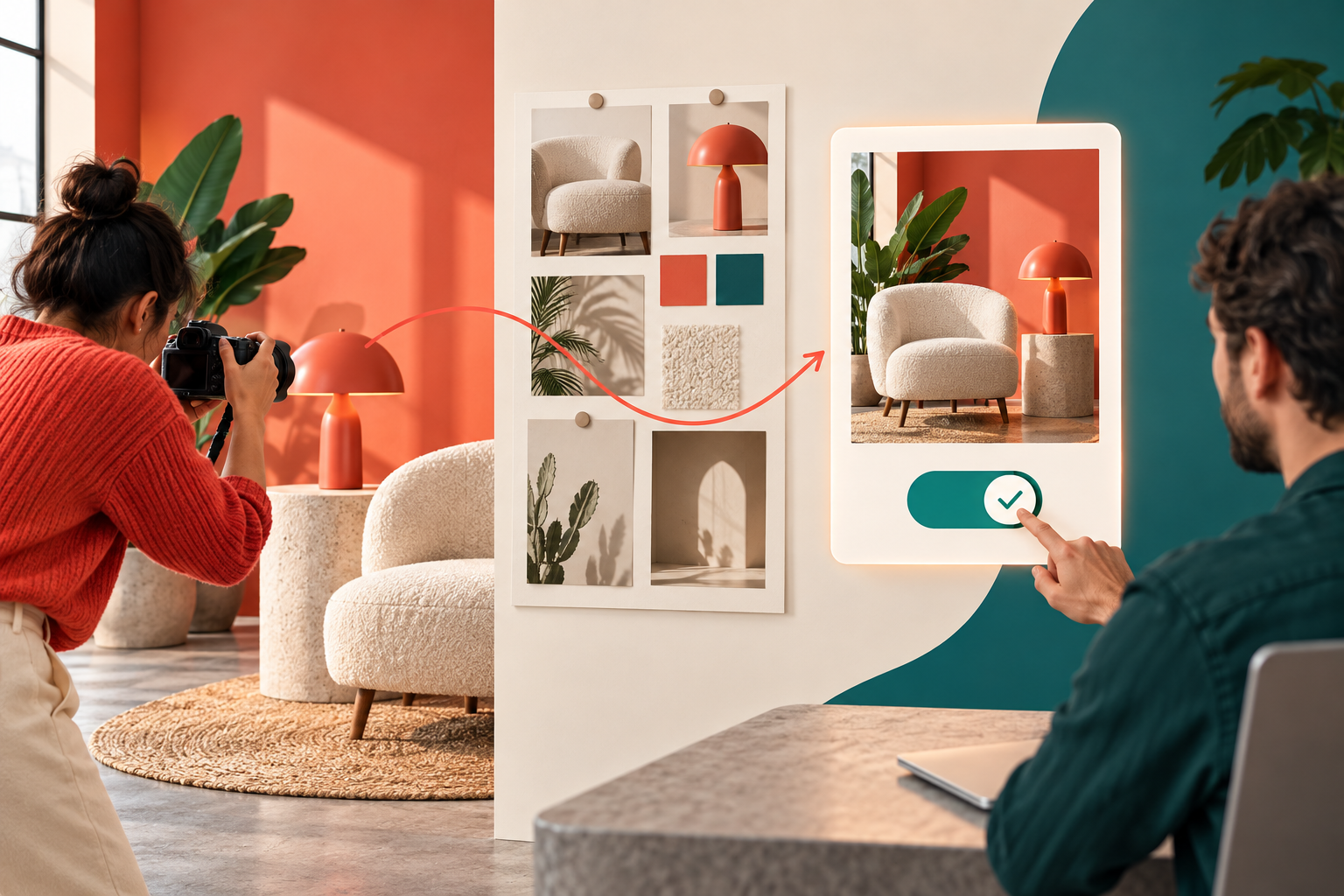
Original editorial illustration; this is not a real product screenshot, laboratory photograph or clinical result.
Pinterest is making existing creator content easier for brands to distribute through advertising. Its Creator Commerce Hub documentation says brands can promote eligible Pins, creators receive an email when a brand selects their content, and creators can disable future promotion through content permissions. Social Media Today covered the expansion on 7 October 2026. The primary documentation does not establish a universal creator payment or licensing fee. That absence matters when evaluating the commercial relationship. Pinterest's Creator Commerce Hub and dated secondary coverage.
The opportunity is to connect useful inspiration with paid reach without treating every piece of content as a newly commissioned campaign. The strategic question is whether the content helps a particular buyer evaluate a product and whether both parties understand permissions, representation, and measurement. An eligible Pin is a starting point for review, not proof that the creator endorses every advertising claim a brand might attach to it.
Separate promotion from a negotiated partnership
An existing Pin can have value because it shows a product in a credible context. A paid partnership has a different commercial structure: the parties agree on work and terms, and the platform's partnership tools identify the relationship. Pinterest separately documents brand approval and partnership tagging. Treating these arrangements as interchangeable can create confusion about compensation, content rights, and responsibilities. Pinterest's paid partnership guidance.
A brand should write down which arrangement it is using. Is it sponsoring an eligible existing Pin, commissioning a new asset, contracting a creator for ongoing work, or seeking permission to reuse material outside Pinterest? Each question needs an answer. Access to a promotion mechanism does not automatically settle off-platform rights, exclusivity, editing authority, or the creator's agreement to a broader campaign.
Understand the buyer's context
Pinterest content often works as a reference during planning. A person may save an interior idea, compare a beauty routine, or collect examples before buying. The commercial value of a creator Pin is therefore connected to the decision it supports. A product shown in an actual use context can answer questions that a clean catalogue image leaves unresolved.
Choose content by the audience question rather than by visual appeal alone. A furniture retailer could examine whether a Pin demonstrates scale, material, or room compatibility. A beauty business could favor content that explains an appropriate use context without exaggerated results. A tourism provider could prioritize practical planning information. The same attractive image may be useful to one audience and irrelevant to another. Paid reach will amplify that difference rather than automatically resolve it.
Audit the content before sponsoring it
Review the original image, caption, destination, product references, and implied claims. Check whether the featured product is still sold, whether the price or availability has changed, and whether the destination works on mobile. Confirm that people, music, artwork, or third-party brands in the asset do not create additional rights problems. Keep the creator's context visible during review.
An asset may be technically eligible while commercially unsuitable. For example, a discontinued color can generate frustrated inquiries, and an old comparison can misrepresent the current product. Establish a short approval record showing who assessed accuracy, permissions, and brand suitability. A logged review gives the team a defensible reason for selecting the content and makes it easier to remove or revise a weak candidate before spending money.
Creator control needs an operational process
Pinterest provides a setting to stop advertisers from promoting content. Its help page also says switching it off does not affect campaigns already running. Creators should therefore review the permission setting and advertising emails rather than assuming that a later opt-out reverses every earlier use. Content permission instructions.
For a creator business, assign responsibility for checking notifications and recording which Pins were promoted. If a brand use raises concerns, document the exact Pin and contact the relevant support or commercial party. Avoid treating silence as a negotiated endorsement. For a brand, respect the distinction between platform eligibility and relationship quality. Even where promotion is technically possible, contacting an important creator may prevent misunderstandings and create a better foundation for a future partnership.
Build a content selection scorecard
Create a practical scorecard covering decision relevance, factual accuracy, product visibility, mobile readability, destination quality, and rights clarity. Use consistent definitions so two reviewers do not select content based only on personal taste. A Pin that clearly explains a use case may deserve priority over a more glamorous image with an unclear commercial connection.
Do not turn the scorecard into a fabricated prediction of revenue. Its purpose is to organize review and reduce avoidable mistakes. Record the reason for selection and the hypothesis being tested: better product understanding, a more relevant audience, or a stronger path to purchase. After the campaign, revisit those judgments using evidence. The resulting asset library becomes more useful because each item has a documented purpose rather than a vague label such as high-performing creative.
Run a controlled first campaign
Compare creator content with a brand-created asset serving the same buying question. Keep the product, offer, geography, landing experience, and campaign objective as comparable as the platform permits. Set a spending cap and a written review date. Do not change the product offer midway and then attribute the result entirely to the creator.
An illustrative plan is a two-week operational pilot followed by a longer measurement window if the buying cycle requires it. This is a suggested workflow, not an evidence-based universal campaign duration. Review delivery, destination behavior, product inquiries, and purchases or qualified leads. Record substantial differences in audience or placement. A clean comparison should explain those differences rather than hide them behind a single performance percentage.
Track contribution without claiming perfect attribution
Connect campaign identifiers to the website and business records where supported. Report media cost and any creator or licensing cost separately, then combine them when evaluating profitability. Returns, cancellations, and fulfillment problems matter because revenue booked at checkout may not become retained revenue. For services, replace a raw form submission with a meaningful qualification or appointment outcome.
Suppose one campaign spends an illustrative 2,000 riyals and produces ten qualified inquiries; its media cost per qualified inquiry is 200 riyals before production or commercial fees. These are hypothetical numbers explaining a calculation, not Pinterest results or a Saudi market benchmark. The useful next question is whether those inquiries progress profitably. Private sharing and delayed purchases can obscure the path, so distinguish attributed conversions from evidence that the campaign caused additional demand.
Establish fair creator economics
The documentation reviewed does not state that every promotion automatically pays the creator. A creator should not budget around an assumed fee. A brand should not infer that promotion permissions amount to unlimited ownership. If the relationship becomes strategically important, negotiate a written arrangement covering scope, compensation, usage duration, editing, additional channels, and any exclusivity.
Creator value includes expertise, audience understanding, and the cost of producing useful material. A sustainable partnership recognizes those contributions rather than simply buying reach around an asset. Evaluate the creator's ability to explain the product accurately and respond to audience questions. If performance is strong, use the evidence to design a clearer ongoing agreement. If performance is weak, diagnose relevance and destination problems before concluding that the creator lacks commercial value.
GCC applications require product and language checks
A Gulf retailer needs a working local destination, accurate availability, suitable currency, delivery information, and content that fits the intended market. A global Pin can inspire interest in an item that cannot be shipped to the buyer. That gap creates wasted spend and customer dissatisfaction. Geography should therefore be part of asset selection, not an afterthought in reporting.
Arabic adaptation may require a new explanatory caption or a separately approved asset rather than simply translating a slogan. Check that local customers can understand the product and the next step. Do not assume that a platform's global inspiration activity proves sufficient demand in Saudi Arabia or the UAE. Start with actual eligibility, audience availability, and observed business outcomes for the account and product being tested.
Healthcare needs a narrower creative brief
Health-related inspiration can easily drift into unsupported treatment claims or unrealistic visual expectations. Before sponsoring content, check whether its wording or imagery implies an outcome that the business cannot responsibly substantiate. A cosmetic service illustrated by a creator's appearance can be interpreted as a promised result even without an explicit numerical claim.
Use professional review and appropriate permissions. Avoid requesting sensitive medical information through an advertising interaction simply because the platform makes inquiry capture easy. Educational content about preparation, service processes, or questions to ask a qualified practitioner can be more suitable than an unqualified transformation claim. The campaign should help people understand options while preserving the distinction between general information and individual medical assessment.
What this update does not establish
The help documentation is operational guidance, not an independent performance study. It does not establish a conversion uplift, a guaranteed payment, universal market eligibility, or superiority over negotiated creator partnerships. Some campaign settings may depend on the account and available product. Check the actual workflow before committing to a proposal or a launch date.
Changes to permissions, notifications, or eligibility can also affect operations over time. Keep the reviewed help links and the date of your internal check. If a feature behaves differently, update the process rather than repeating an outdated assumption. The durable lesson is that creator distribution requires commercial governance alongside creative selection; easier activation increases the need for clear responsibility rather than removing it.
Karim's strategic opportunity
Karim can package a creator-content audit and a measured Pinterest pilot for a business whose products benefit from visual planning. The engagement would identify suitable existing material, document rights and claims, improve the buying destination, and compare qualified outcomes with brand-created content. This is more useful than promising cheap acquisition from an unfamiliar placement.
The decision to expand should rest on product fit, profitable downstream behavior, creator relationship quality, and a workable review process. Keep creative production, promotion permission, and negotiated licensing visible as separate decisions. If the pilot produces useful buyer insight but little immediate revenue, that can still improve future content; it should not be reported as proven return on advertising. Responsible experimentation turns the update into a source of learning and commercial opportunity without exaggerating what Pinterest has actually demonstrated.
Comments
No published comments yet.