
Published November 4, 2026, covering the November 3, 2026 announcement for periods ending September 30, 2026. All financial comparisons below are against the corresponding 2025 periods, in SAR million.
The financial facts, briefly
Dallah’s November 3 results show Q3 revenue of SAR1,085.82m versus 1,061.26m (+2.3%) and shareholder profit of 436.09m versus 141.90m (+207.3%). Nine-month revenue was 3,206.98m versus 2,956.45m (+8.5%); profit was 620.62m versus 421.72m (+47.2%). Disposal gains after zakat were 356.6m. Company-defined, non-IFRS adjusted profit fell: Q3, 79.5m versus 111.4m (−28.6%); nine months, 276.4m versus 316.9m (−12.8%). These adjusted figures are reported measures, not our subtraction of the disposal gain. Source: Argaam financial results.
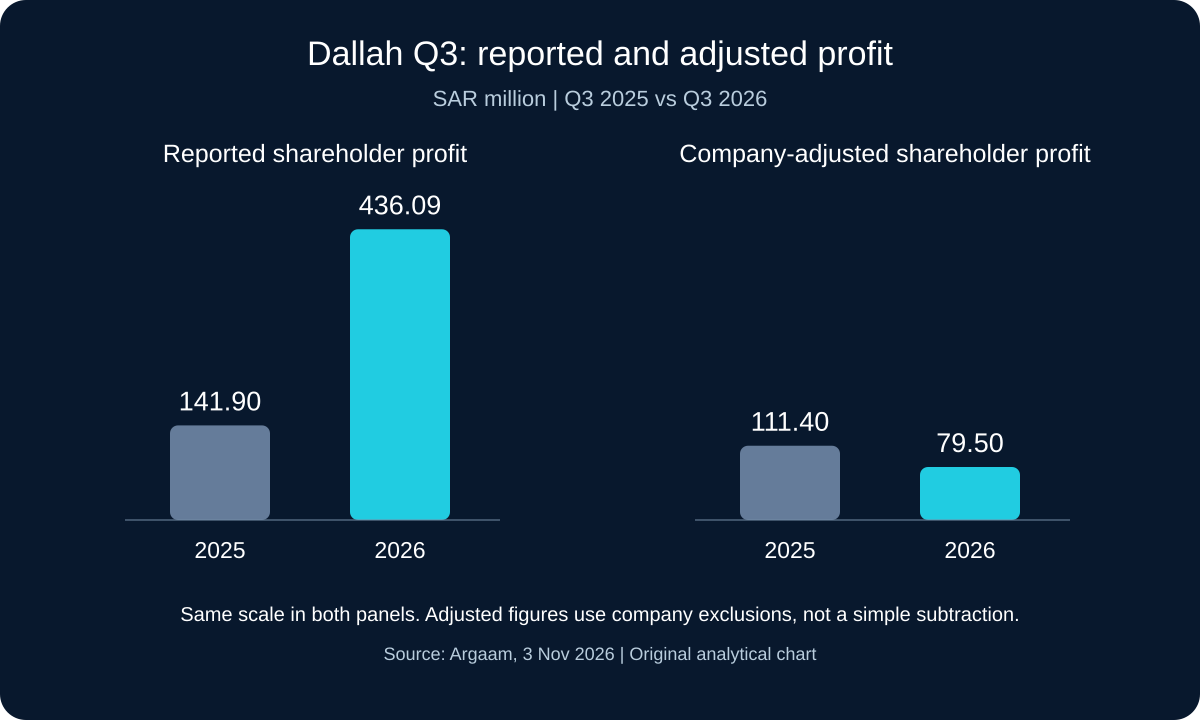
Two earnings measures viewed separately; adjusted measures do not replace accounting results. Data source: Argaam.
Analysis: turn financial context into better questions
The rest of this article offers an independent management framework for hospital growth teams. It does not diagnose Dallah’s internal operations, assign causes to its performance or claim access to its marketing data.
When reported and adjusted earnings move in different directions, the useful marketing response is to examine the economics behind a proposed campaign. A board-level profit figure cannot establish whether an outpatient service has spare appointments, whether a new facility is ready for additional demand or whether acquired patients generate an appropriate contribution after delivery costs.
A prudent starting question is: which patient needs can the organization serve well, promptly and sustainably? That keeps financial discipline connected to access and service quality. It also avoids treating patients as interchangeable revenue units. Clinical need and suitability remain decisions for qualified care teams, not advertising algorithms.
Separate the group story from the facility decision
Consolidated financial reporting and local marketing planning operate at different levels. A group can contain established hospitals, expanding departments and facilities still building awareness and referral relationships. Each requires a different decision horizon.
For a mature hospital, marketing may focus on helping people find suitable services, simplifying booking and reaching appropriate audiences for available sessions. Before buying more traffic, teams should examine unanswered calls, booking abandonment, unclear service information and the difference between advertised and actual appointment availability.
For a ramping facility, early spending may support basic discovery: accurate location pages, clear directions, verified clinician information and explanation of available services. An immediate profitability threshold designed for an established hospital could prematurely stop useful learning. Equally, “brand building” should not become a permanent excuse for activity without observable progress.
Where acquisitions or disposals change a group’s perimeter, comparisons also need care. Ask finance which facilities were included in each period and whether a comparable operating view exists. This is a general comparability safeguard, not an assertion about a specific transaction’s operational effects. Do not invent same-facility growth from consolidated numbers.
Build a service-level decision sheet
A practical planning meeting should bring marketing, finance, operations and clinical leadership together around a small set of service lines. For each one, record available capacity, the intended audience, booking constraints and a finance-approved definition of contribution.
Start with capacity that can actually be booked. A theoretical room count is less useful than confirmed clinician sessions, staffing coverage and realistic scheduling windows. Include downstream dependencies. A campaign for consultations may create demand for diagnostics or follow-up appointments that the organization must be able to support.
Next, distinguish a submitted inquiry from an attended, appropriate appointment. Track the journey in stages: inquiry, successful contact, booking, attendance and financial reconciliation. Keep clinical outcomes outside unsupported marketing promises, and avoid presenting every later service as revenue “generated” by an advertisement.
Finally, agree the cost boundary. Contribution should use a consistent finance-owned methodology rather than whatever makes a campaign appear strongest. Discounts, direct delivery costs, cancellations and the timing of collections may matter. Marketing should understand those definitions without substituting its own spreadsheet for accounting policy.
Test access improvements before scaling spend
Imagine a hypothetical hospital with unused appointment slots but a high volume of unanswered calls. Increasing advertising could increase wasted inquiries without improving access. The first test might instead extend contact-center coverage, improve callback handling or make booking instructions clearer.
Now imagine a different service with strong demand and a long wait. Broad acquisition spending could worsen the patient experience. More useful communication might explain realistic appointment options or direct people to clinically appropriate alternatives, subject to operational and clinical review.
These examples illustrate why a low cost per lead is insufficient. It tells a team what an inquiry costs, not whether the organization could help the person, whether the appointment took place or whether the campaign improved the overall system.
Use limited pilots with a defined service, geography, time window and comparison approach. Establish the expansion and pause criteria before launch. Where feasible, compare similar periods or use a suitable holdout, while accounting for seasonality and operational changes. Treat uncertain attribution as uncertain.
Keep the dashboard small and interpretable
A useful weekly dashboard can include spend, qualified inquiries, contact success, booked appointments, attendance, available slots and finance-validated contribution. Pair these with service indicators such as booking complaints and access delays. No single number should decide the budget alone.
Separate operational failures from audience problems. If inquiries are relevant but calls go unanswered, changing creative may miss the real issue. If booking is straightforward but the campaign attracts unsuitable requests, revise the audience and message. If capacity is constrained, pause expansion until operations confirms readiness.
Protect privacy throughout measurement. Use aggregated reporting wherever practical, restrict access to necessary information and obtain appropriate governance review before combining advertising and patient records. A sophisticated attribution model is not useful if it creates avoidable exposure of sensitive information.
A sensible first month
In the first week, align financial definitions and identify two or three services with confirmed capacity and a clear patient-access need. Document the assumptions that would change the spending decision.
In the second week, review the public journey from search result to booking confirmation. Correct inaccurate service descriptions, unclear location information and operational handoffs before adding demand.
In the third week, run a bounded test with agreed ownership. Track attendance and capacity alongside acquisition costs. In the fourth, review the results jointly and decide whether to expand, redesign or stop. Carry unresolved attribution and collection timing forward explicitly rather than hiding them in an average.
This process creates a stronger budget discussion: the organization can explain what it tested, whom it could serve, what changed and what remains unknown.
Source and editorial scope
Financial reference: Argaam’s Dallah financial-results report, also accessible through the November 3 news link. Published here on November 4, 2026. The operational framework and hypothetical examples are independent analysis, not company guidance or personalized investment advice.
Verification note: the original Saudi Exchange disclosure could not be opened during preparation; the financial sourcing here is Argaam.
Comments
No published comments yet.