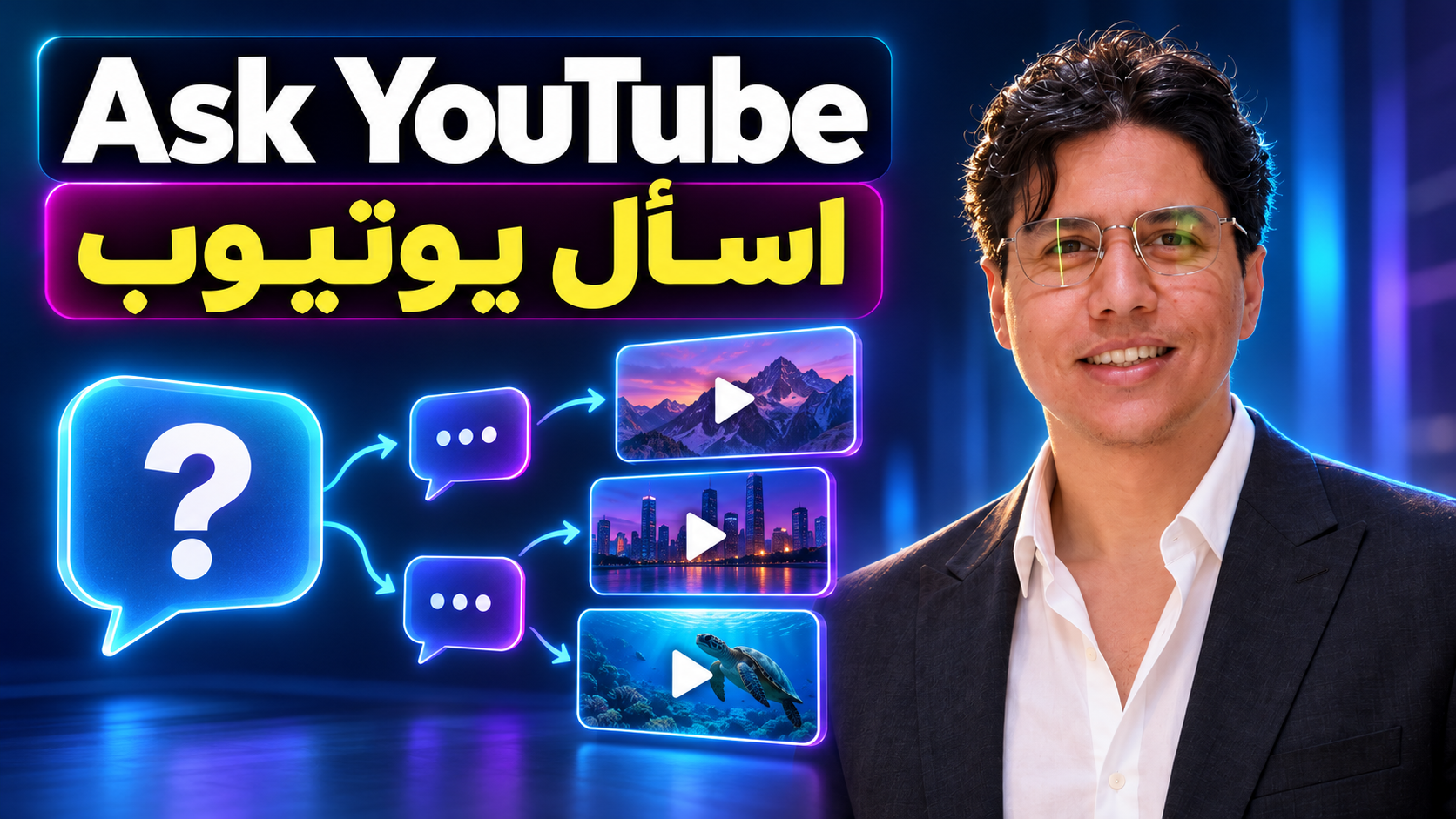
A customer rarely makes a complex buying decision with one perfectly chosen keyword. Someone choosing a clinic, software supplier or training course may begin with a broad question, add a budget, clarify a concern and then compare two approaches. A useful video library should help that person continue the decision without starting again at every step.
The expansion of Ask YouTube makes that editorial problem timely. For marketing teams, the immediate opportunity is to examine whether their videos answer real questions clearly enough for a human to use. The workflow proposed below is original business analysis. It is a testable approach to content planning, not a claim that particular wording, chapters or production techniques will secure placement in an AI search response.
What has actually changed
YouTube's October 12 announcement expands conversational search across web, mobile and TVs for US viewers. People can ask complex questions and refine the results through follow-ups. The same announcement describes contextual questions while watching Shorts and live streams as coming soon, rather than already universally available.
The search help page specifies US searches in English, with access expanding gradually. Responses can combine text, videos, Shorts and relevant clips. It describes relevance, engagement and quality as ranking priorities. These sources do not establish an Arabic-search launch or a Gulf rollout date.
That boundary matters when assigning a budget. A Saudi business can improve its content now, while a product-access experiment must use an eligible account and record the actual experience. Preparing useful answers does not require pretending that every local viewer already has this interface.
Start with the next decision your customer faces
The strategic hypothesis is straightforward: a video that resolves a recognizable decision may remain useful across several discovery interfaces. A viewer could arrive through conventional search, a recommendation, a colleague's message or conversational search. The team should therefore organize around customer uncertainty before selecting a platform-specific optimization tactic.
Collect recent questions from approved, anonymized sales notes, customer-service themes and public comments. Separate questions about understanding a problem from those about choosing an approach or selecting a provider. A video explaining what a service involves has a different job from a video comparing service options. Treating both as generic awareness content makes the promise harder to understand and the result harder to measure.
For an illustrative business-software provider, the opening question might concern when a spreadsheet becomes difficult to manage. Follow-up questions could address migration effort, permissions, staff training and the cost of maintaining two systems. The resulting content brief has a coherent decision path. It also gives the sales team something more useful to share than a product montage.
Build a question map before writing the script
Choose one primary question and three or four genuinely related follow-ups. For each, write the answer the business can support, the evidence available and the limits of the explanation. If two answers require substantially different audiences or assumptions, separate the videos. Completeness does not require packing an entire buyer journey into one recording.
A simple editorial worksheet can contain five fields: viewer situation, question, supported answer, proof and next action. The proof might be an approved demonstration, a published methodology or a clearly labeled fictional example. A company testimonial is useful for describing one customer's experience, but it cannot establish that everyone will obtain the same result.
Have a colleague unfamiliar with the topic read the worksheet. Ask what they still need to know before taking the proposed next step. Their confusion is valuable research. Resolve it before filming, when changes are inexpensive, rather than relying on editing to rescue an unclear argument.
Make each answer understandable in context
Open with the question and the conditions that affect the answer. Explain unfamiliar terms before using them as shortcuts. When a recommendation depends on company size, location or existing tools, state those assumptions near the recommendation. A clear boundary can prevent a short excerpt from sounding more universal than the full explanation intended.
Use specific chapter names that describe the question being answered. Check that captions accurately reflect product names, prices and qualifications. Place supporting links in a relevant description and explain what each link supports. These are usability and editorial-quality recommendations; the announcement does not establish them as special ranking switches for Ask YouTube.
Before approving a video, review several short sections independently. Can a reviewer understand what is being compared, which audience the answer concerns and whether the example is hypothetical? Where the meaning depends on an earlier disclaimer, repeat the essential qualification naturally. Do not repeat a keyword mechanically or turn every sentence into a promotional claim.
A helpful production rule is to keep evidence close to the claim. If a screen demonstration shows one configuration, say so. If a result depends on an assumption, show that assumption while discussing the result. This supports comprehension even when the viewer skips directly to the middle of the video.
Localize the decision, not just the vocabulary
For a Gulf-facing brand, an Arabic version should reflect the questions customers actually ask in Arabic. Literal translation can preserve every sentence while losing the practical meaning of the buying situation. Ask a native editor to review the sequence of questions, professional terminology, currency references and the level of explanation.
An English video aimed at regional procurement managers may appropriately use a technical term that an Arabic consumer video should explain. Likewise, a reference to a free consultation, delivery area or booking requirement must match the real service. Do not translate an offer into a market where the business cannot honor it.
Keep language-specific performance separate. If the English version attracts more views, investigate audience size, existing distribution and publication history before judging the Arabic script. The pilot should answer whether each audience understood the content and took an appropriate next step. A larger aggregate number can hide a weak localized experience.
Health-related content needs a narrower promise
A healthcare-marketing team can begin with operational questions: how to prepare administrative documents, where to find published appointment information or what a consultation process generally involves. These examples should use the provider's approved information. Avoid turning the content experiment into personalized clinical advice or collecting patient details through public comments.
Any clinical explanation needs qualified review and the institution's normal approval process. Keep eligibility conditions and uncertainty visible, and avoid implying that a search interface validates a treatment claim. If the audience asks a personal medical question, route them to an appropriate professional channel rather than producing a confident public diagnosis.
For the pilot, select topics that can be explained with public information and fictional scenarios. That keeps the experiment focused on communication quality. It also makes it easier to share drafts among editors without creating an unnecessary privacy problem.
Measure useful discovery without inventing attribution
Define success before changing the library. Use a small set of business-relevant measures: qualified visits to the corresponding resource, completed appropriate inquiries, sales-team reuse and time spent correcting misunderstandings. Pair these with available video metrics such as viewing patterns and audience retention. No individual measure tells the whole story.
When the platform does not expose a reliable Ask YouTube source category, record that limitation. A lift in total search traffic cannot automatically be attributed to conversational discovery. Search phrases can also be incomplete or unavailable at low volume, so avoid promising a detailed long-tail keyword report that the account cannot actually provide.
For exploratory product testing, use a fixed set of questions and record date, device, language, account eligibility and follow-up wording. Save the observations in a consistent review sheet. An appearance in one response is evidence of that observation only. Personalized experiences and changing results make it unsuitable as a guaranteed ranking claim.
Evaluate the whole journey after the click. Does the destination continue the question the video answered? Can the visitor find the promised checklist or service details? A strong video can generate attention that a vague landing page wastes. Assign someone to inspect the page and form on mobile before interpreting weak conversions as a content failure.
Run a bounded four-week editorial pilot
In the first week, choose one customer decision and document the baseline. Review two existing videos, their destinations and the questions the sales team still receives. Identify a small comparison group with similar subject matter and maturity, while acknowledging that a nonrandom comparison cannot prove causation.
In the second week, prepare one revised video and one new supporting answer. Keep an editorial change log covering title, opening, structure, captions and destination. Avoid changing the offer, media budget and entire website simultaneously. Too many simultaneous changes make even a positive result difficult to interpret.
In the third week, publish through the business's normal approval process and collect structured feedback. Ask a few representative viewers what they understood and what remains unanswered. If an eligible test account is available, inspect the fixed search questions separately. Do not make access to an unreleased regional feature a dependency for basic content-quality work.
In the fourth week, review completed actions, audience feedback, production effort and correction time. Treat this as an early editorial readout; low traffic or long buying cycles may require a longer observation window. Document the uncertainty instead of declaring a winner because one video received a temporary burst of attention.
Assign an owner and review date to answers that contain changing service details. Keep a record of where the same claim appears in captions, descriptions and linked pages. If an offer changes, update the connected material together or clearly retire the obsolete asset. A useful answer library needs maintenance as well as production; include that recurring effort when deciding whether a new series is affordable.
Decide what deserves another investment
Expand the approach when it produces clearer answers, fewer recurring misunderstandings and credible evidence of commercially useful engagement at an acceptable production cost. If viewers understand the topic but hesitate at the next step, investigate the offer or destination. If the content attracts the wrong audience, revisit the original question and distribution choices.
The practical response to conversational discovery is disciplined explanation. A question-led library with honest evidence, accurate localization and a measurable next step gives a marketing team assets it can use across customer conversations. Ask YouTube supplies a timely reason to test that discipline. The business case should come from the team's own results, with regional availability and attribution limits kept visible throughout.
Comments
No published comments yet.