
Ant Group announced a major update to its Afu health app on November 23, 2026. The company says people can now talk to the AI over live video, show items such as medicine packaging or documents, answer follow-up questions and request an online physician’s review. The vendor says the physician-review service covers 16 specialties. It also announced new wellness management features and broader support for connected devices. Afu is powered by the LingSante model family, including LingSante-3.1, which Ant said it released as open source. Ant Group’s announcement through Business Wire
What the announcement does and does not tell us
The company reported that Afu had reached 150 million users as of September 2026 and handled nearly 20 million health inquiries per day. Those are adoption figures from the company. Inquiries are not unique patients, completed clinician consultations or improvements in health outcomes. The release describes intended capabilities; it does not provide a controlled comparison of clinical performance or reliable evidence that an individual video reading can be used to make a care decision. An announced forthcoming international version is also not evidence of current local availability or approval.
A live camera changes what a person must put into words. That is a product-interface change, not a reason to treat the service as a substitute for diagnosis. Video may be useful to some people and inaccessible to others because of connection quality, device limitations, disability, privacy, language, or the desire not to be recorded. A healthcare service should make its non-video route visible and comparable. Separately label automated, administrative and professional steps; never make the label depend on whether the assistant sounds confident.
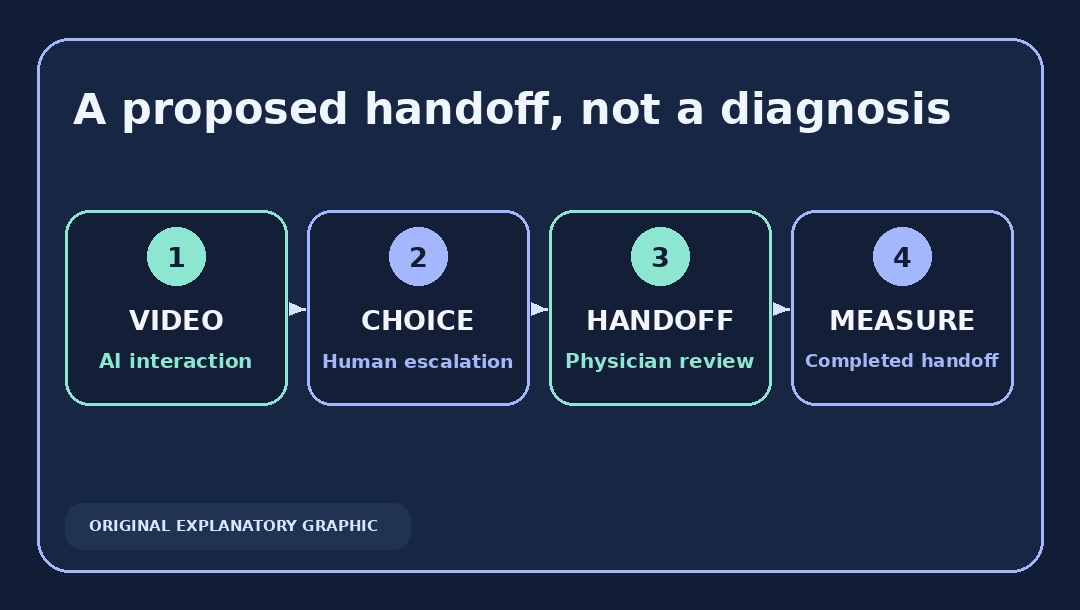
Illustrative service map, not the Afu interface: automated intake and professional review are distinct steps.
Is a request actually handed over?
In an administrative pilot, first show what the digital assistant does, who can access any information and how to proceed without it. A patient who wants a clinician should be able to request one without being forced through an AI session. After a handoff request, distinguish a submitted request from a confirmed booking, and distinguish that booking from a completed encounter. Indicate who owns the request, what state it is in and where to ask for help if the connection fails. Do not imply a review has been performed just because a queue entry exists.
A useful hypothetical workflow would let a participating user request a callback, choose an available channel and optionally provide the minimum authorized intake information. The service displays the next step and makes the human operator’s scope clear. An operations team should monitor unassigned requests, repeated submissions and unresolved handoffs before evaluating marketing conversion. For the public, describe only the confirmed service and do not promise an outcome or response time that the operation cannot meet.
Test administrative outcomes before interpreting uptake
Compare the proposed administrative flow with a plain reference route that already lets people reach a human. For example, a fictional network could compare eligible sessions on an optional guided intake page with a direct-booking page, with the same clinic availability and outreach. Define the denominator as eligible sessions, and report successful handoff among those requesting one as a different metric. Track median and high-percentile time to a confirmed human contact, abandonment, duplication, failure recovery, and how often people take the non-video path. Where consent and governance permit, check whether accessibility or language groups experience different completion rates; do not publish data for tiny groups.
Keep clinical responsibility, privacy review and incident handling with authorized professionals. The key decision is whether the interface reduces administrative friction without weakening choice or accountability. A larger number of AI sessions is not itself a reason to expand a service.
Decide where the video step belongs
An intake page can solve one well-defined service problem without attempting to perform clinical work. Choose the point in the journey you actually want to improve. People may be dropping out because they cannot find a language option, because a callback time is unclear, or because the clinic is already full. None of those problems is automatically solved by adding a camera. Interview the people who handle calls, review requests and accessibility queries. Look for a point where an optional conversation might reduce rework without standing between a patient and a human response.
Write a simple service blueprint covering the view on the phone, what is captured on the server, who can see each element, and who actually acts on a request. For example, a hypothetical clinic could pilot an optional way to clarify whether someone wants scheduling assistance or information about an existing appointment, without using the AI to recommend care. Give the direct phone and booking routes the same prominence. If the alternative takes many more clicks, the product has turned apparent choice into a default everyone must accept. Use plain language for roles and do not make users infer from a human-like avatar whether a licensed clinician is present.
Privacy is a flow, not a sentence at the foot of the page
A camera can reveal much more than the person intended to share. The frame can include a family member, a badge, a household location clue, or a document intended only for another recipient. An administrative experiment does not need to collect every available signal. Start with a data map that says what is requested, why, when it is discarded, and who can retrieve it. Decide separately whether a stream needs to be recorded, whether a transcript is needed, and whether any excerpt belongs in a patient-facing administrative record. Do not present one permission switch as if it answered every one of those questions.
In a prototype, use fictional details and non-sensitive examples. For a real service, evaluate the provider's access, retention, and oversight before inviting patients. Separate service records from marketing measurement, and keep video, audio, and uploaded material out of advertising dashboards. Avoid assuming that a general sign-up consent would authorize a new secondary use. Make declining the optional feature uncomplicated and show a usable fallback immediately. The alternative route should be documented in operational testing as rigorously as the new camera feature.
Make the state visible on both sides of a handoff
A patient-facing progress label should be backed by actual service events. Use “request received” when a case exists but has no owner, “assigned” when someone is responsible, and a confirmed booking only after the authoritative schedule reflects it. Staff benefit from seeing the same state and a timestamp of the latest transition. A second attempt after a connection drops should not become an independent request automatically. Design recovery around a stable reference so the user can resume rather than repeatedly start over.
Test handoffs at quiet and busy times. If nobody can pick up a request, show a short truthful explanation and the alternative route instead of letting an animation imply active monitoring. If a user's device disconnects, be explicit about whether they need to call again. For a queue that crosses teams, identify a primary owner; “sent to another team” without responsibility invites silent loss of requests. Use test data to rehearse delayed assignment, repeated taps, errors at the last step and an unavailable alternative. Validate that staff see the same state before describing the route in a campaign.
Measure what happens without the optional interface
If you compare two versions of a page, decide in advance what both versions must share. Opening hours, available appointment inventory, language, marketing copy and the path to a human should not vary just because someone sees a camera button. Keep users in their originally assigned group when reviewing outcomes, including people who skip video; analyzing only users who completed the video will favor those with better devices, spare time or more confidence in the interface. Log technical failures separately from voluntary choices so that an accessibility problem is not reported as a lack of interest.
Consider both a short operational measurement window and a later review of unresolved requests. A rate calculated when all tasks are open rewards whichever group had its earliest cases processed. Analyze comparable cohorts only after a consistent waiting period, and show the count of cases still in flight. A local team might choose to monitor completed contacts per eligible session, the proportion of failed handoffs recovered, and differences in time to a human by language. Document how each number is calculated and distinguish actual delays from missing timestamps. Do not use a reduction in observed time as evidence of clinical improvement.
Match marketing promises to what operations can deliver
A campaign should describe the customer experience the organization has actually tested. If the service only starts an administrative request, do not call it a confirmed consultation. If video is optional, make that clear near the action button and in the first explanatory text. A message that says “request a callback” sets a different expectation from “speak to a clinician now.” Match the copy to verified coverage and availability. Verify the translation with a person who understands the service: words for “review,” “consultation,” and “appointment” can imply different things in another language.
Where useful, compare an acquisition metric with an operational outcome side by side. For example, an increase in starts after a new campaign may be paired with an increase in unanswered requests. The correct first response is not necessarily more impressions. It may be to limit the campaign to hours with sufficient staff, clarify the landing page, or revert to a direct route until the handoff is reliable. Keep the ability to switch off the optional step without removing ordinary routes to staff. That operational escape route ought to be tested before launch.
Establish accountable review and stopping rules
Agree who reviews failed transfers, unexpected data collection and accessibility complaints. Give that person a way to stop the pilot and revert the workflow. Define a small set of signals in advance, such as a growing unassigned queue, repeat submissions or an unexplained fall in contact completion for a language group. Those thresholds come from the provider's current operations and governance, not from adoption figures in a press release. No AI pilot should create a new staff duty without making ownership, response capacity, and escalation explicit.
A useful launch decision can be as simple as three questions: did more eligible people reach the intended human service; did the optional route make existing access at least as clear; and did the operation resolve failures without adding unsafe dependence on the automated step? Negative or uncertain results are a reason to refine the administrative workflow, not to increase marketing spend. The point of the Afu announcement is that the front door can change. It does not remove the need to make the handoff transparent, measurable and accountable.
Comments
No published comments yet.