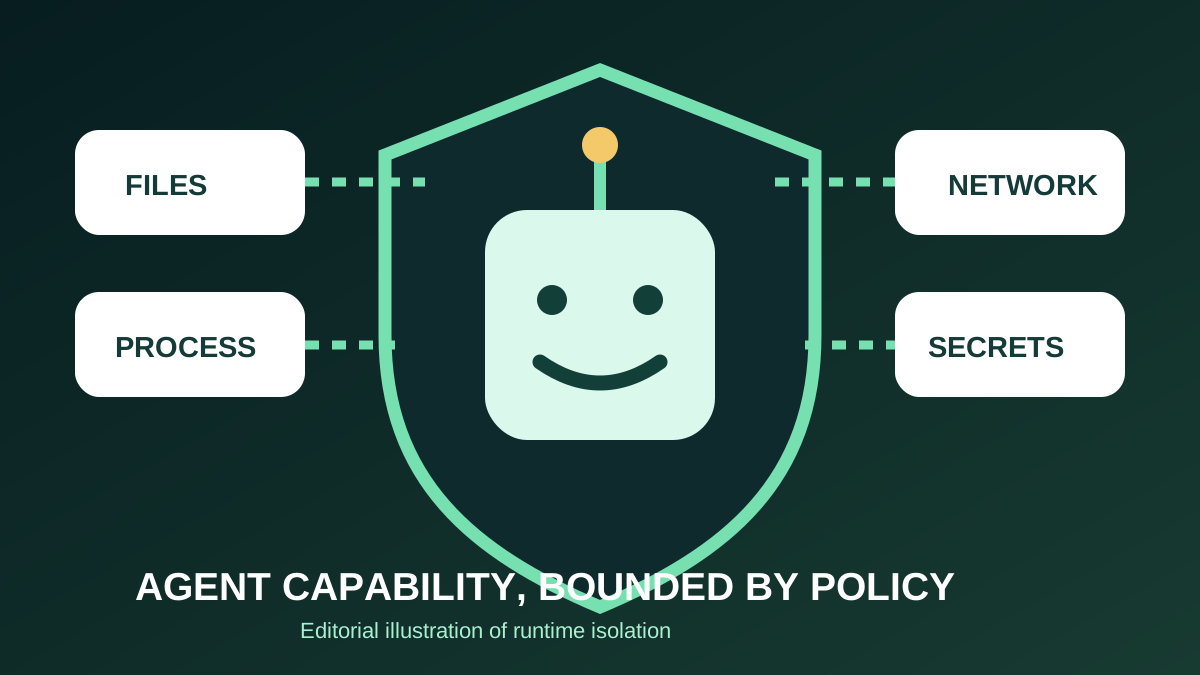
NVIDIA's OpenShell has become one of the fastest-growing agent-infrastructure projects on GitHub after the release of its 0.1 generation. The open-source Apache 2.0 project provides isolated environments for autonomous agents and supports clients including Codex, Claude Code, OpenCode and Copilot CLI. The official repository and developer guide document the current capabilities and installation requirements.
Why prompt instructions are not enough
An agent that can edit files, install packages, call APIs and use credentials is valuable precisely because it has power. A prompt saying “do not read secrets” is not a security boundary: malicious web content, a compromised dependency or an incorrect plan can steer the agent elsewhere. OpenShell tries to enforce limits below the model at runtime.
Each agent runs in a sandbox. Kernel controls restrict accessible files and system calls, while network connections pass through policy checks. Real credentials are not exposed directly to the agent; OpenShell injects them only into requests bound for approved endpoints. Before a policy expansion is applied, formal checks flag access to a new host, credential or API method for review.
What this changes for business automation
The model supports a least-privilege architecture: a publishing agent can read one source directory, write one output directory, call approved research domains and deploy through a specific endpoint without gaining the rest of the workstation. Logs and policy files make the intended boundary inspectable, which is stronger than relying on a conversation transcript alone.
It does not solve every risk. A permitted endpoint can be compromised, an overly broad file rule can expose sensitive information, and a human can approve a dangerous policy change. Application-level authorization, data classification, backups and review remain necessary.
A practical pilot for a content workflow
Start with a non-production copy of the daily publishing workflow. Allow read access to article sources and write access only to a dated output and cover folder. Restrict outbound traffic to authoritative research sources, package registries and the deployment API. Provide separate credentials with no access to patient, finance or advertising systems.
Create test cases for expected work and abuse: attempt to read a forbidden secret, write outside the project, contact an unapproved domain, change a schema and delete content. Review the event log and confirm the action is blocked before adding any production token. Require approval for every new host or write path during the pilot.
Measure task completion, false blocks, review time, policy-change count and security incidents. The pilot succeeds when routine work remains usable and prohibited actions fail consistently; speed alone is not the criterion.
GCC and healthcare relevance
Hospitals and regulated businesses should not interpret a sandbox as permission to expose protected data to a general agent. Use de-identified test data, separate environments, regional hosting review, audit retention and the organization's existing identity and access controls. OpenShell can be one enforcement layer, not the entire compliance program.
Karim's strategic takeaway
For publishing, reporting and QA agents, define capability as a small permission map rather than a trusted personality. OpenShell is valuable because it can make those boundaries executable and reviewable. Adopt it first where automation already saves time but a mistaken file or network action would create real damage.
Comments
No published comments yet.