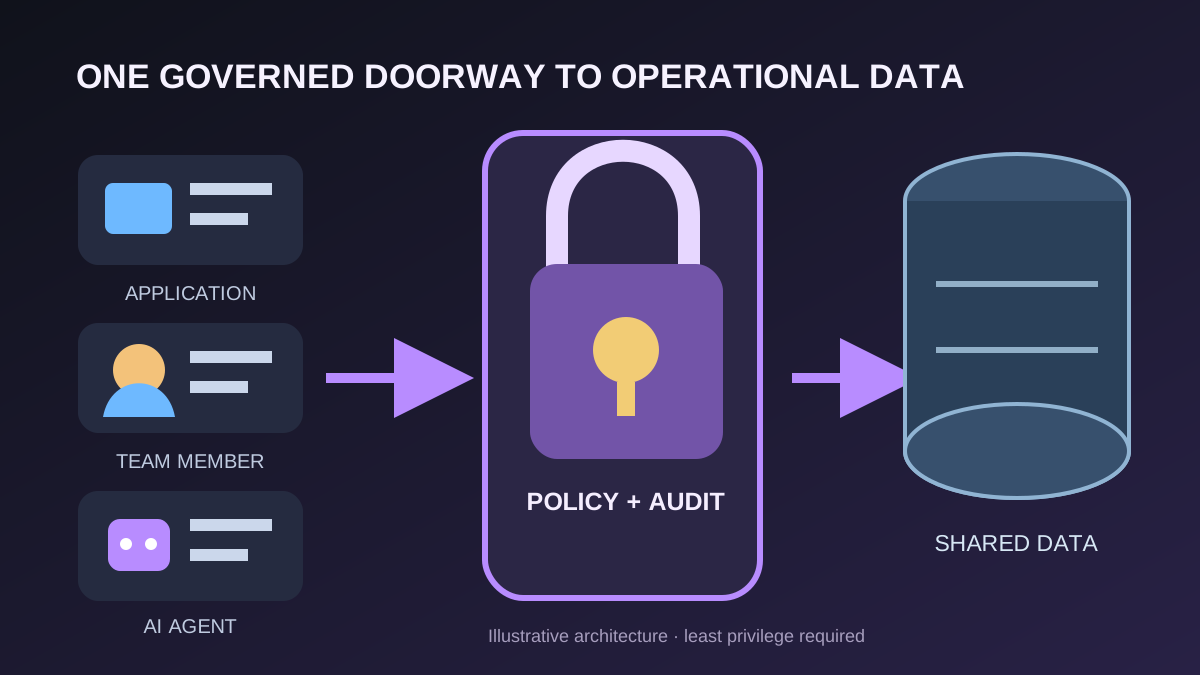
Monospace from Directus ranked first on Product Hunt’s 1 October 2026 daily list. The product is presented as a governed API layer for applications, people and AI agents. Directus’ official repository describes instant REST and GraphQL APIs, a visual Studio, native MCP access and policy-based permissions down to field level.
What the architecture changes
Many organizations give each application or automation a separate integration into customer, content and operational systems. Permissions drift, logic is duplicated and no single team can easily explain what an agent is allowed to change. A governed layer places a consistent schema, access policy and audit boundary in front of those systems.
MCP makes that layer usable by compatible AI tools. The important control is not that an agent can connect; it is that every request should inherit a scoped identity and permissions. A read-only content researcher and a production publisher should never share the same key or role. Field-level access matters when one record combines public content with internal notes or personal data.
Useful commercial applications
A marketing team could let an assistant search approved campaign results and content, draft a brief and create a review item without exposing billing or patient data. A healthcare group could allow an analytics agent to read de-identified operational measures while blocking record-level personal information. A website team could expose article status and analytics to an editorial agent but require a human-controlled action for publication.
The product is not a shortcut around data governance. It concentrates authority, which means a configuration error may affect several applications at once. Teams must examine deployment model, license, backups, logs, rate limits and how schema changes are approved. Product Hunt ranking demonstrates launch attention, not independent proof of enterprise reliability.
A safe pilot for Karim’s publishing workflow
Create a non-production workspace containing article drafts, source URLs and aggregate performance data only. Define three roles: researcher can read; editor can create and update drafts; publisher remains unavailable to the agent. Give every agent its own short-lived credential and log the actor, tool, record and change. Run 20 real editorial tasks and score completion accuracy, unauthorized attempts, human correction time and time saved.
Before any production connection, test prompt-injection scenarios in imported content, revoke credentials, restore a backup and confirm that sensitive fields never appear in tool responses. Keep approval outside the model for publication, deletion, schema changes and access policy updates.
Karim’s strategic takeaway
Monospace is interesting because it treats agent access as an operational architecture problem, not a chatbot feature. The opportunity is a controlled marketing operating layer where research and drafting accelerate while publication, customer data and destructive actions remain explicitly governed.
Comments
No published comments yet.